Excerpt
Discover IFAK pouch plate carrier setups with mounting tips, TCCC essentials, and rapid tourniquet deployment for tactical readiness.
Key Considerations for Choosing an IFAK Pouch Plate Carrier Setup
Selecting the right individual first aid kit setup requires balancing capacity, durability, and accessibility. In combat, law enforcement, and high-threat environments, an individual medical kit exists solely for immediate life threats. Data shows that in combat casualties, roughly 90% of deaths resulting from severe hemorrhage are preventable with immediate intervention. Securing medical gear directly to armor ensures life-saving tools remain present during an emergency. Mounting an individual medical kit directly on armor reduces the time needed to access trauma supplies by up to 50% compared to retrieving gear from a backpack or drop-leg pouch.
When selecting tactical trauma equipment, material selection dictates field longevity. High-grade textiles such as 500D or 1000D Cordura nylon offer abrasion resistance while resisting moisture and tears. Investing in durable mil-spec pouches ensures critical seams and retention points do not fail under tension or extreme environmental exposure. Reinforced bartack stitching along stress points prevents blowouts when users yank tear-away modules under duress.
A central design consideration involves choosing between traditional modular attachments and integrated systems. According to military surveys, 78% of service members prefer medical gear integrated closely with their protective vest rather than dangling extensions.
| Feature |
MOLLE-Mounted IFAK |
Integrated / Dangler IFAK |
| Attachment Method |
PALS webbing straps on cummerbund or back |
Hook-and-loop beneath front flap or plate bag |
| Ambidextrous Access |
Moderate (depends on placement) |
Excellent (centered beneath front plate) |
| Profile & Bulk |
Varies by size and placement |
Streamlined and centered |
| Modularity |
High (movable across any PALS grid) |
Dedicated to hook-and-loop plate carrier fields |
| Re-indexing Speed |
Standard |
High (often utilizes pull-out inserts) |
Mounting Options for an IFAK Pouch Plate Carrier System
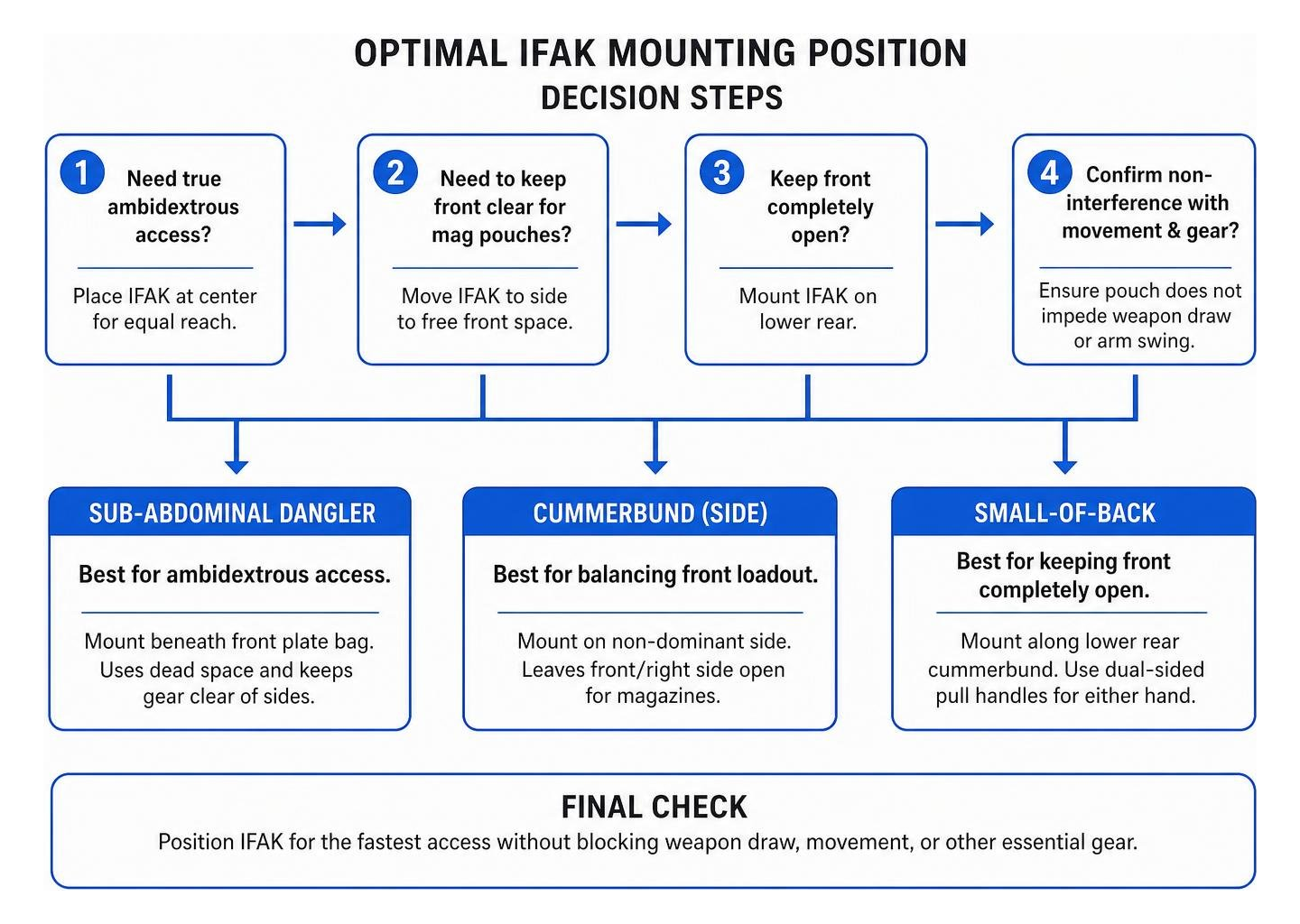
Mounting an individual kit requires evaluating the entire torso profile. Modern plate carriers offer multiple mounting surfaces, each with distinct advantages:
-
Sub-Abdominal Dangler Position: Attached via hook-and-loop beneath the front ballistic plate bag, this position offers true ambidextrous reach. It utilizes otherwise dead space beneath standard armor plates and keeps medical gear clear of side-mounted equipment. This location allows an injured operator to reach life-saving supplies with either hand while seated in a vehicle or lying prone.
-
Cummerbund Placement: Mounted on the non-dominant side, a side-mounted kit leaves space for a mag pouch plate carrier configuration on the dominant or front side. The user must ensure the pouch does not impede weapon draw or arm swing. Keeping the pouch tucked slightly rearward on the cummerbund preserves an unhindered rifle presentation.
-
Small-of-Back Mount: Positioned horizontally along the lower rear cummerbund, this setup frees up the entire front profile. It requires dual-sided pull handles so either hand can withdraw the inner sleeve without visual confirmation. This placement is particularly popular among tactical teams that require maximum frontal real estate for offensive equipment.
Medical Essentials for an IFAK Pouch Plate Carrier Loadout
An effective medical kit avoids excess clutter, prioritizing supplies built around Tactical Combat Casualty Care (TCCC) guidelines. A standard tactical loadout should weigh approximately 1.5 pounds (0.68 kg), providing critical medical capability without dragging down the operator. Standard components such as the Rescue Essentials I.C.E. IFAK provide a framework for essential field items.
Essential components include:
-
Hemostatic Gauze: QuikClot or combat gauze impregnated with clotting agents to control arterial bleeding rapidly.
-
Chest Seals: Vented occlusive dressings designed to treat penetrating chest injuries and mitigate tension pneumothorax.
-
Pressure Bandage: An elastic trauma dressing (such as an Israeli bandage) to maintain continuous direct pressure over wound packings.
-
Nasopharyngeal Airway (NPA): A flexible tube paired with surgical lubricant to maintain an open upper airway in an unconscious casualty.
-
Trauma Shears: Compact, heavy-duty shears capable of rapidly cutting through uniform fabrics and web gear.
-
Nitrile Gloves: Nitrile protective barriers to maintain hygiene during treatment and protect against bloodborne pathogens.
Closure Mechanisms and Rapid Tourniquet Deployment
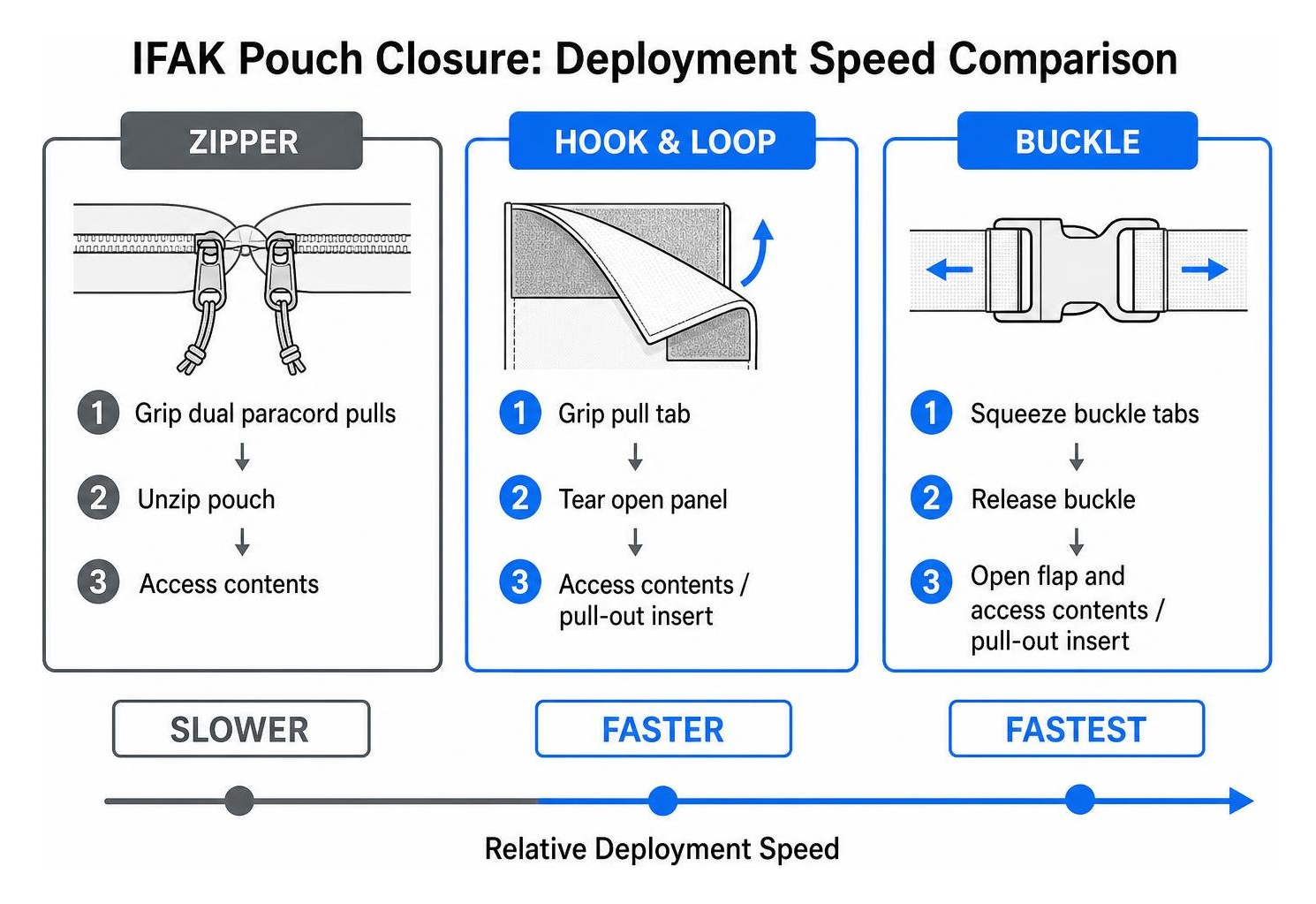
When seconds count, closure hardware directly impacts response efficiency. Dual zippers equipped with paracord pulls provide reliable retention, while hook-and-loop tear-away panels allow an operator to yank an internal supply tray out with a single motion.
Tourniquets require independent mounting for instantaneous access. Instead of burying a windlass inside the zippered main pouch, users should rely on external elastic sleeves, rigid holders, or dedicated accessories crafted from rugged tactical nylon. This structure guarantees the tourniquet remains accessible in under three seconds without unzipping main medical compartments. Securing tourniquets externally prevents debris intrusion into the medical pouch while ensuring immediate, one-handed deployment during active bleeding emergencies.
Optimal Placement to Avoid Gear Interference and Maximize Mobility
A balanced armor setup prevents physical exhaustion and mobility restrictions during prolonged operations. Placing overly bulky medical kits on the side cummerbund can prevent clean elbow tucks or interfere with primary weapon transitions.
Ensure that side-mounted medical pouches allow adequate clearance for rifle magazine pouches tactical setups on the chest. Furthermore, verify that the placement allows comfortable movement when dropping into a prone shooting stance or sitting inside tactical vehicles for extended durations. Streamlining pouch depth ensures that armor fits closely against the torso, reducing fatigue and preventing snag hazards during tactical operations.
Best Practices for Tactical Readiness and Loadout Integration
Maintaining medical readiness requires consistent training and gear upkeep. An ifak pouch plate carrier setup is only as effective as the operator's familiarity with its contents under stress. Regular dry-fire drills and casualty response scenarios help build muscle memory, allowing team members to deploy tourniquets, chest seals, and pressure bandages in pitch darkness or high-stress environments.
Medical gear should be checked regularly for expired sterile seals, degraded elastic bands, and dirt accumulation. Packaging seals on hemostatic agents and occlusive chest dressings can degrade over time due to heat, moisture, and operational abrasion. Quarterly inspections ensure that all life-saving medical supplies remain sterile, functional, and ready for deployment.
Safe Pro USA designs rugged tactical platforms that streamline equipment configurations for defense and law enforcement personnel. Operators should establish uniform standard operating procedures across team units so that every team member knows the exact placement of life-saving medical gear on their partner's vest. Placing an individual first aid kit in a standardized location eliminates hesitation during team-based medical interventions. To discover more operational strategies and field hardware guides, explore tactical gear insights and platform updates.


