Why Choosing the Right Armor Plates Could Save Your Life
Armor plates are the difference between a survivable hit and a fatal one — and with so many options on the market, picking the wrong plate is a risk no tactical professional should take.
Here is a quick breakdown of the most important things to know before buying:
| Protection Level |
Threats Stopped |
Best For |
| Level III |
7.62x51 NATO (.308), 5.56 NATO |
General rifle threats |
| Level III+ |
M855 green tip, M193, 7.62x39 |
Enhanced rifle threats |
| Level IV / RF3 |
.30-06 M2 AP (armor-piercing) |
Maximum rifle protection |
| Level IIIA |
Handgun rounds up to .44 Mag |
Soft armor / concealable use |
Key facts to know:
- Level IV is the highest NIJ rating and stops armor-piercing rifle rounds
- Ceramic and polyethylene plates are significantly lighter than steel
- "Level III+" is an industry designation, not an official NIJ rating
- Civilians can legally buy armor plates in most U.S. states (except felons; CT and NY have purchase restrictions)
- Plates should be inspected annually and stored in a cool, dry location
No armor is truly "bulletproof." Every plate is designed to resist specific threats under specific conditions. Choosing the right plate means matching your threat environment to the right protection level, material, and fit — and verifying that the plate is actually NIJ certified, not just "NIJ tested."
This guide covers every major decision point: protection levels, materials, plate cuts, sizing, maintenance, legality, and the top brands worth trusting with your life.
I'm Michael Wratten, Vice President of Marketing and Sales at Safe Pro USA, with over 20 years in the defense and protective equipment industry — including roles at leading tactical gear manufacturers, and 20 years in law enforcement with the LAPD and West Covina PD. My hands-on experience evaluating and fielding armor plates for real-world use gives me a practical perspective that goes well beyond spec sheets.
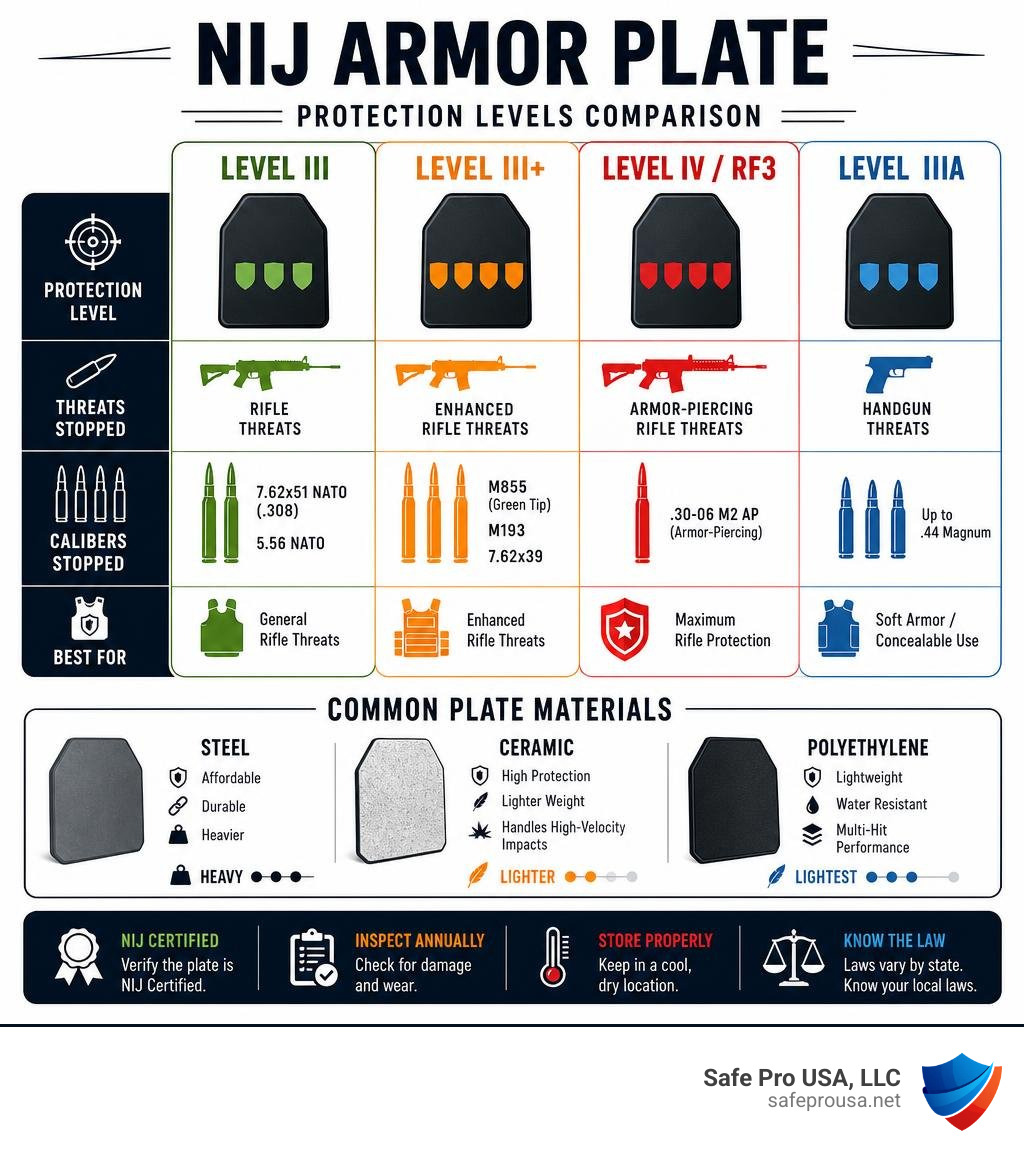
Understanding NIJ Protection Levels for Armor Plates
The National Institute of Justice (NIJ) sets the gold standard for ballistic protection in the United States. When evaluating armor plates, understanding these standardized protection levels is the absolute foundation of making a safe purchase.
Historically, the NIJ 0101.06 standard has guided the industry, establishing clear baselines for both soft and hard armor. However, as ballistic technology and threat landscapes have evolved, the transition to the updated NIJ 0101.07 standard is redefining how we categorize rifle-rated protection.
The standard you rely on dictates exactly what kind of kinetic energy and penetrator types your armor can withstand. To help clear up the confusion, we have compiled a quick reference table comparing the primary NIJ protection levels and the calibers they are designed to stop:
| NIJ Level (0101.06) |
New NIJ Level (0101.07) |
Core Ballistic Threats Stopped |
Velocity Metric |
| Level IIIA |
HG2 |
.357 SIG, .44 Magnum SJHP |
~1,430 ft/s |
| Level III |
RF1 |
7.62x51mm NATO M80 Ball |
2,780 ft/s |
|
Level III+ (Industry standard) |
RF2 |
7.62x51mm M80, 5.56mm M855 (Green Tip), M193 |
Up to 3,115 ft/s |
| Level IV |
RF3 |
.30-06 Springfield M2 Armor Piercing (AP) |
2,880 ft/s |
Level III vs. Level IV Armor Plates
The debate between Level III and Level IV plates usually comes down to a trade-off between weight and maximum threat protection.
Level III plates are engineered to stop standard, non-armor-piercing rifle rounds. Under the NIJ 0101.06 standard, a Level III plate must survive six impacts from a 7.62x51mm NATO (.308 Winchester) M80 ball round. These plates are incredibly popular because they can be made entirely of lightweight materials like Ultra-High-Molecular-Weight Polyethylene (UHMWPE), offering exceptional mobility for patrol officers or civilians concerned with common rifle threats.
Level IV plates, on the other hand, represent the pinnacle of hard armor protection. A Level IV plate is specifically tested to defeat armor-piercing rifle rounds, most notably the destructive .30-06 Springfield M2 Armor Piercing (AP) round. Because defeating a hardened steel or tungsten penetrator requires shattering the core on impact, Level IV plates almost always utilize a ceramic strike face paired with a composite backing. While they provide unmatched security against battlefield threats, they are historically heavier and thicker than their Level III counterparts. You can learn more about these rigorous testing processes by reviewing our industry ballistic standards.
The New RF2 and RF3 Standards
The introduction of the NIJ 0101.07 standard brings much-needed clarity to the rifle plate market. One of the biggest issues with the older '06 standard was the massive performance gap between Level III and Level IV. This gap led manufacturers to create the unofficial, non-certified designation of "Level III+" to signify plates that could stop the widely available 5.56mm M855 "Green Tip" round—a round that can actually penetrate many pure polyethylene Level III plates due to its mild steel penetrator tip.
The new '07 standard fixes this by replacing Roman numerals with clear "RF" (Rifle) designations:
-
RF1: Equivalent to the old Level III, tested against 7.62x51mm NATO M80 Ball.
-
RF2: Officially bridges the gap. It tests against all RF1 threats plus the high-velocity 5.56mm M855 Green Tip and M193 rounds.
-
RF3: Replaces Level IV, requiring the plate to stop the formidable .30-06 M2 AP round.
This updated classification system ensures operators know exactly what level of special-threat protection they are purchasing without relying on marketing buzzwords.
Ballistic Threat Capabilities: From 5.56 to .30-06 M2AP
When selecting armor plates, it is vital to match the plate to the exact ballistic profiles you are most likely to encounter:
-
5.56 M193: This is the standard 55-grain lead-core civilian round. While light, its extreme velocity (often exceeding 3,100 ft/s out of a 16-inch barrel) can easily penetrate thin steel plates through pure kinetic shear.
-
5.56 M855 (Green Tip): Featuring a 62-grain bullet with a mild steel penetrator tip, this round is notorious for passing directly through standard Level III polyethylene plates, which lack the hardness to deform the steel tip.
-
7.62x39: The classic AK-47 round. It is a slower, heavier round that is easily defeated by almost all Level III / RF1 plates.
-
.308 M80 (7.62x51 NATO): The baseline testing round for Level III. It carries massive kinetic energy but lacks a hardened penetrator core, making it highly survivable for modern composite plates.
-
.30-06 M2AP: Featuring a hardened steel penetrator core, this round is designed to punch through hardened steel targets. Only Level IV (RF3) plates with a robust ceramic strike face can successfully shatter and capture this threat.
Materials Science: Ceramic, Composite, and Polyethylene
The materials used to manufacture armor plates dictate their weight, thickness, durability, and cost. Modern defense manufacturing has largely moved away from heavy metals toward advanced ceramics and high-strength polymers.

Ceramic and Composite Armor Plates
Ceramic plates are the choice of military and tactical professionals worldwide. They are constructed using a hard ceramic strike face—typically made from Alumina (Aluminum Oxide), Silicon Carbide, or Boron Carbide—bonded to a high-strength composite backing material like aramid fibers or polyethylene.
When a high-velocity rifle bullet strikes a ceramic plate, the extreme hardness of the ceramic shatters the bullet's core instantly. The ceramic tile itself cracks, dispersing the bullet's kinetic energy across a wider surface area. The residual fragments and energy are then caught by the composite backing.
-
Pros: Outstanding ballistic performance; capable of stopping high-velocity armor-piercing rounds; significantly lighter than steel.
-
Cons: More fragile than steel; can crack if dropped repeatedly; typically thicker (often 0.9 to 1.1 inches).
For those facing serious rifle threats, choosing high-performance hard armor options ensures you are protected by the latest in ceramic material science.
Ultra-High-Molecular-Weight Polyethylene (UHMWPE)
Polyethylene plates represent the cutting edge of ultra-lightweight personal defense. These plates are constructed by layering sheets of UHMWPE fibers at 90-degree angles, which are then compressed under extreme heat and pressure into a solid, rigid tile.
When a bullet strikes a PE plate, the friction of the spinning round melts the polymer fibers. The bullet becomes wrapped in the plastic, which quickly cools and binds, trapping the round.
-
Pros: Exceptionally lightweight (often under 3.5 lbs per plate); naturally buoyant; highly resistant to moisture, sweat, and chemicals; superb multi-hit capability against lead-core rounds.
-
Cons: Thicker profile; cannot stop steel-core penetrators like M855 or armor-piercing rounds unless paired with a ceramic strike face.
Why Modern Operators Avoid Steel Plates
While steel plates (typically made from AR500 or AR550 hardened steel alloy) were once popular in the civilian market due to their low cost and long shelf life, we strongly advise against them for serious tactical use.
The primary danger of steel armor is spalling and fragmentation. When a high-velocity copper-and-lead rifle bullet strikes a steel plate, the plate does not deform. Instead, the bullet explodes outward along the surface of the flat plate. This sends razor-sharp shrapnel (spall) upward into the wearer’s neck, chin, and face, or downward into their femoral arteries. Even with "anti-spall" build-up coatings, these protective layers can fail after just one or two impacts.
Additionally, steel plates are incredibly heavy—often weighing between 8 and 10 pounds per plate. Carrying 20 pounds of dead weight on your torso rapidly induces fatigue, destroys your mobility, and degrades your tactical readiness. For these reasons, modern military and law enforcement agencies exclusively field ceramic or composite plates.
Sizing, Cuts, and Ergonomics for Tactical Carriers
No matter how strong an armor plate is, it will not protect you if it does not fit your body or if it restricts your movement so severely that you cannot return fire or seek cover.
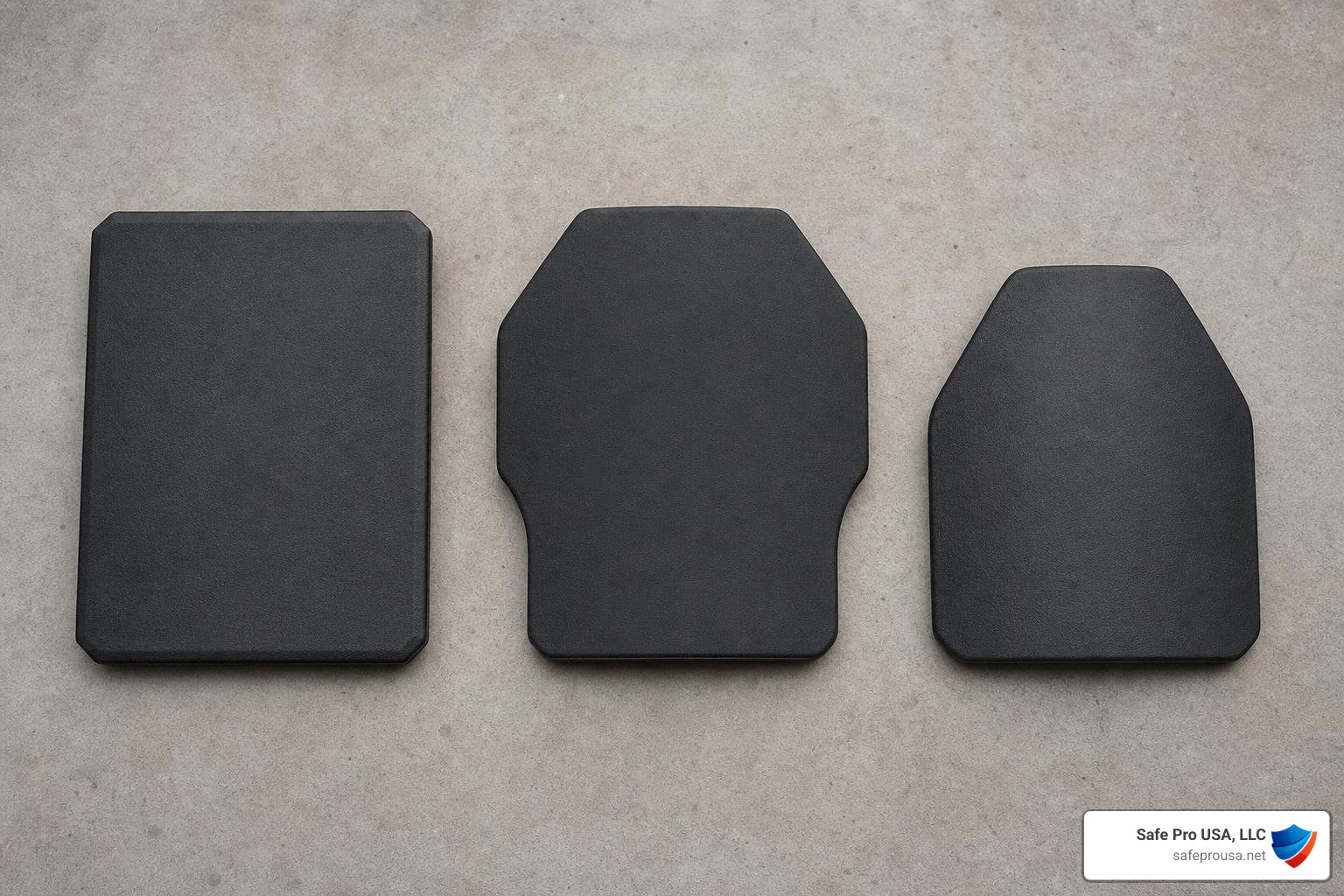
Single-Curve vs. Multi-Curve Designs
When shopping for plates, you will encounter single-curve and multi-curve options:
-
Single-Curve Plates: These plates are curved along a single vertical axis, resembling a simple cylinder. While cheaper to manufacture, they do not conform to the natural, complex shape of the human chest and back. They tend to create uncomfortable pressure points, bounce during movement, and make shouldering a rifle difficult.
-
Multi-Curve Plates: These plates are ergonomically sculpted to mimic the natural curvature of the human torso, wrapping around the chest and sloping slightly at the shoulders. Multi-curve plates distribute weight much more evenly across your shoulders and upper body, drastically reducing fatigue during extended wear.
SAPI, Shooters, Swimmers, and Full Cuts
The "cut" of a plate refers to its physical shape and how the corners are angled:
-
SAPI Cut (Small Arms Protective Insert): The standard military profile. It features moderately angled top corners to provide a solid compromise between vital organ coverage and arm mobility.
-
Shooters Cut: Features slightly more aggressive corner cuts than a SAPI plate, allowing for a cleaner, more natural pocket to shoulder your rifle stock.
-
Swimmers Cut: Designed with highly aggressive upper corner cuts. This profile maximizes your range of motion, making it ideal for operators who must climb, swim, or engage in high-intensity physical activity.
-
Full Cut: A traditional square or rectangular plate. It offers the maximum surface area of protection but severely limits arm movement, making it best suited for back plates or stationary security roles.
Standalone (SA) vs. In-Conjunction-With (ICW) Plates
Understanding the difference between Standalone and ICW plates is critical for safety:
-
Standalone (SA) Plates: These plates are designed to defeat their rated ballistic threats entirely on their own. You simply insert them into a plate carrier and you are ready to go.
-
In-Conjunction-With (ICW) Plates: These plates are designed to be worn in front of a soft armor vest (typically Level IIIA). The hard plate slows and deforms the rifle round, while the soft armor backing catches the remaining energy and fragments. ICW plates are thinner and lighter than standalone plates, but they require you to wear a dual-armor setup to achieve their rated protection.
Lifespan, Maintenance, and Legal Considerations
Owning personal protective equipment comes with a responsibility to maintain it properly and understand the laws governing its use.
Do Ballistic Plates Expire?
Yes, armor plates have an expiration date, or more accurately, a recommended service life. Most manufacturers offer a warranty of 5 to 10 years on hard armor plates.
The materials themselves do not simply vanish when the clock strikes midnight on year five, but the adhesives, water-resistant seals, and composite backings can degrade over time when exposed to daily wear, sweat, UV radiation, and temperature fluctuations. Polyethylene and ceramic plates are highly durable, but their long-term integrity depends on proper care.
To get the longest life out of your plates, follow these maintenance best practices:
-
Storage: Always store your plates flat or vertically in a cool, dry, climate-controlled environment (ideally between 50°F and 80°F). Never store your plates in the trunk of a vehicle, where temperatures in the summer can easily exceed 150°F and degrade the binding agents inside composite armor.
-
Inspection: Perform an annual visual and tactile inspection. Feel the edges of ceramic plates to ensure the wrapping hasn't delaminated, and gently press the face to check for internal shifting or crunching sounds that indicate micro-fractures.
-
Backface Deformation (BFD): When a plate stops a high-velocity round, it deforms inward toward your body. The NIJ allows up to 44mm of backface deformation. While the plate stops the bullet, the blunt force trauma can still break ribs or damage internal organs. Adding a non-ballistic trauma pad behind your plate can significantly reduce this impact energy.
Civilian Ownership and State Regulations
In the United States, it is entirely legal for law-abiding civilians to purchase and own body armor. However, there are a few important legal guardrails to keep in mind:
-
Federal Law: Under federal law, it is illegal for anyone convicted of a violent felony to purchase, own, or possess body armor.
-
State Restrictions:
-
Connecticut: State law prohibits civilians from purchasing body armor online. All sales must take place in an in-person, face-to-face transaction.
-
New York: State laws heavily restrict the sale and ownership of body armor to civilians, generally limiting purchases to specific approved professions (such as first responders, security guards, and law enforcement).
-
Export Controls: Body armor is highly regulated under International Traffic in Arms Regulations (ITAR) and Export Administration Regulations (EAR). It is a federal crime to export rifle-rated plates outside the United States without proper government authorization.
Frequently Asked Questions About Ballistic Armor
What is the difference between soft armor and hard armor plates?
Soft armor is constructed from flexible, woven ballistic fibers (like Kevlar or aramid) and is rated up to Level IIIA. It is designed to stop handgun rounds and shrapnel, making it highly concealable and comfortable for daily wear. Hard armor plates are rigid inserts made of ceramic, polyethylene, or steel. They are designed to stop high-velocity rifle rounds (such as 5.56, 7.62, or .30-06) and must be worn in a dedicated plate carrier.
What is the difference between NIJ certified and NIJ tested?
"NIJ Certified" means the plate model has been submitted to an NIJ-approved laboratory, passed the rigorous Compliance Testing Program, and is officially listed on the NIJ Compliant Products List (CPL). Certified plates also undergo random ongoing quality audits at the factory. "NIJ Tested" or "NIJ Rated" simply means the manufacturer sent a few plates to an independent lab for a private test. There is no official government oversight, no listing on the CPL, and no guarantee of manufacturing consistency. Always look for official NIJ certification when your life is on the line.
How do I choose the right size and cut of armor plates for my body?
Your plates should cover your vital organs—specifically your heart, lungs, and the surrounding major blood vessels—not your entire torso. To find your size, measure the distance between your nipples. That measurement dictates your plate width. Next, sit in a chair and measure vertically from the suprasternal notch (the dip at the top of your collarbone) to about one to two inches above your belly button. This ensures the plate won't push up into your throat when you sit down or bend over. Most adults fit perfectly into a standard Medium (9.5" x 12.5") or Large (10" x 12") plate.
Last thoughts
At Safe Pro USA (a proud subsidiary of Safe Pro Group, Nasdaq-Listed: SPAI), we believe that personal protection should never be a guessing game. We manufacture our high-performance ballistic gear right here in the United States, utilizing honest materials, mil-spec quality, and cutting-edge design to ensure maximum durability and comfort.
Whether you are a law enforcement officer patrolling the streets, a military professional preparing for deployment, or a prepared citizen safeguarding your family, investing in premium high-quality armor plates is an investment in your survival.
Stay safe, stay prepared, and choose the gear that is built to bring you home.


