Why Ceramic Rifle Plates Matter When Bullets Are Real
Ceramic rifle plates are hard armor inserts worn in plate carriers to stop rifle-caliber rounds — including armor-piercing threats — that soft body armor simply cannot handle.
Quick answer for buyers comparing ceramic rifle plates:
| Feature |
Ceramic Plates |
| Protection level |
NIJ Level III, III+, and IV |
| Stops AP rounds? |
Yes — Level IV stops .30-06 M2 AP at 2,880 fps |
| Weight per plate |
~4–7.5 lbs depending on protection level |
| Multi-hit capable? |
Yes — tested up to six rounds |
| Service life |
5–10 years |
| Legal for civilians? |
Yes, in most U.S. states |
| vs. Steel plates |
Lighter, no spall risk, higher threat rating |
Rifle threats are not going away. In high-risk environments — active shooter response, patrol, military operations — the difference between a Level III soft panel and a Level IV ceramic plate can be the difference between walking away and not. Yet a lot of buyers still pick gear based on price alone, or grab whatever looks right without understanding what the plate actually stops.
That's a problem worth fixing before you're in the field.
I'm Michael Wratten, VP of Marketing & Sales at Safe Pro USA, and with over 20 years in the defense and protective equipment industry — including roles at leading armor and tactical gear manufacturers, plus two decades in law enforcement — I've tested, sold, and trusted ceramic rifle plates in real-world conditions. Below, I'll break down exactly what to look for so you can buy with confidence.
Why Ceramic Rifle Plates Are the Gold Standard for Ballistic Protection
When it comes to personal defense against rifle-caliber threats, we often see a debate between steel, polyethylene, and ceramic. But if you talk to tactical professionals who actually wear this gear for a living, ceramic rifle plates are almost universally recognized as the gold standard.
Historically, some users shied away from ceramic because of outdated myths about fragility. Let’s set the record straight: modern ceramic body armor is incredibly tough. Today's plates are multi-hit rated and tested up to six rounds of high-velocity rifle fire. They don't shatter like a porcelain dinner plate from a minor bump. Instead, they are engineered to absorb massive kinetic energy and save your life.

One of the biggest advantages of ceramic over steel is weight. Steel plates are notoriously heavy, typically weighing between 5 and 9 pounds depending on their size and protective coating. Carrying that extra weight on your chest and back rapidly accelerates fatigue, slowing down your movement and reducing your agility. On the flip side, high-performance ceramic plates can weigh under 4 pounds per plate while still providing robust protection.
Furthermore, ceramic completely eliminates the deadly threat of spalling. When a high-velocity bullet strikes a steel plate, it doesn’t penetrate; instead, it splinters into a cloud of razor-sharp shrapnel (spall) that travels outward along the face of the plate. This shrapnel often ends up in the wearer's neck, chin, arms, or groin. Ceramic plates solve this by capturing and destroying the bullet within the plate itself.
To explore top-tier options designed for maximum mobility, check out our American-made tactical gear at Safe Pro USA Body Armor.
Understanding the Anatomy of Ceramic Rifle Plates
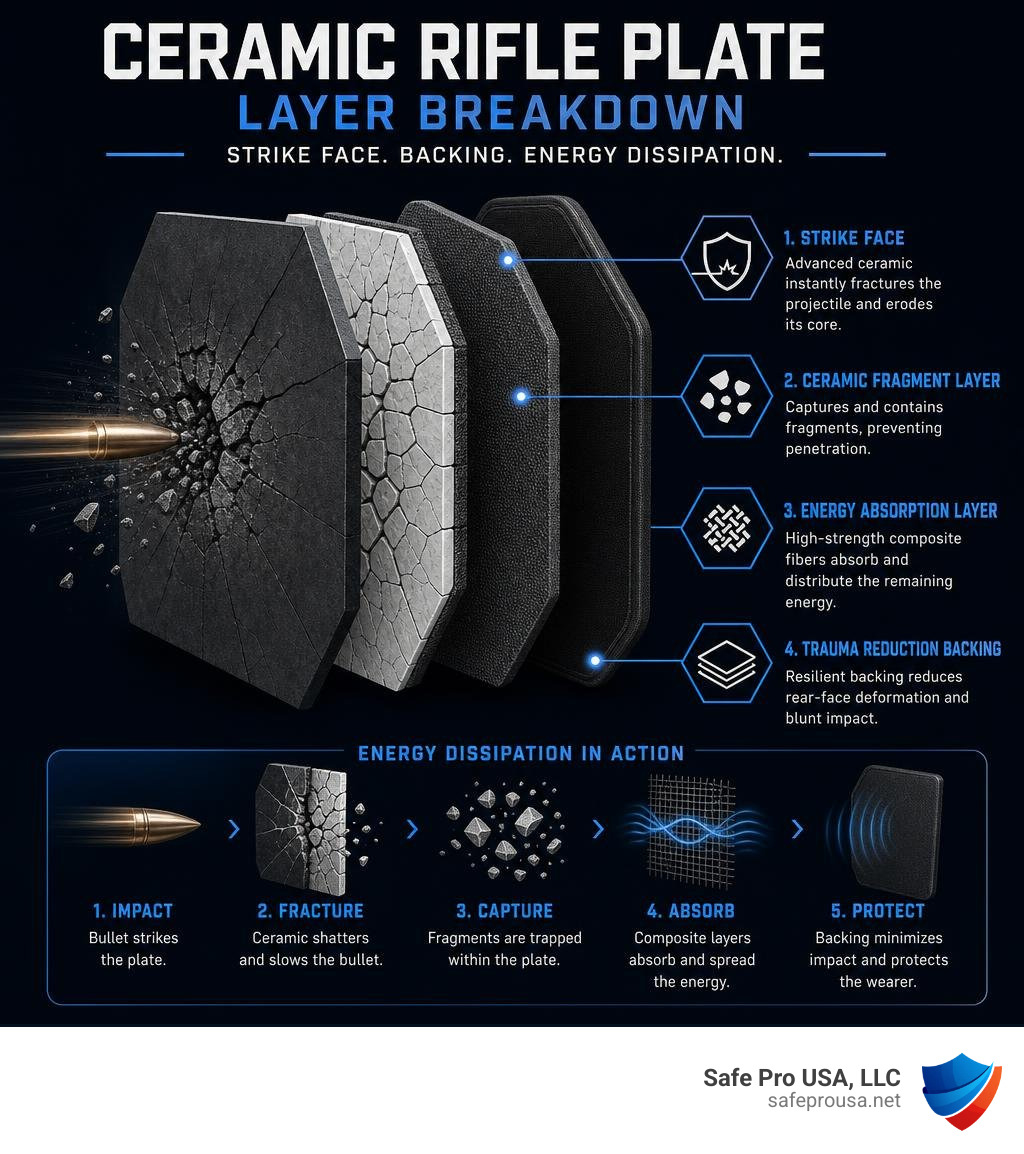
How exactly does a piece of ceramic stop a bullet traveling at nearly 3,000 feet per second? It all comes down to a highly engineered composite design consisting of two primary layers: the ceramic strike face and the ballistic backing material.
-
The Ceramic Strike Face: The front layer of the plate is made of an incredibly hard ceramic material. When a bullet strikes this face, the ceramic does something unique: it is actually harder than the bullet itself. The ceramic forces the soft lead or copper bullet to mushroom, shatter, and lose its aerodynamic shape instantly. As the ceramic cracks, it absorbs and dissipates a massive portion of the bullet's kinetic energy across a wide surface area.
-
The Backing Material: Directly behind the ceramic strike face sits a high-strength backing material, usually made from Ultra-High-Molecular-Weight Polyethylene (UHMWPE) or aramid fibers. Think of this backing as a highly advanced catcher's mitt. Once the ceramic strike face has shattered the projectile and stripped away its speed, the flexible backing catches the remaining fragments and absorbs the leftover energy, preventing the round from passing through.
Manufacturers typically use one of three main types of ceramic materials, each offering a different balance of weight, thickness, and cost:
-
Aluminum Oxide (Alumina): The most common and cost-effective ceramic. It is highly reliable and provides excellent protection, but it is the heaviest of the three materials.
-
Silicon Carbide: A lighter and harder alternative to alumina. It offers fantastic multi-hit durability but comes at a higher price point.
-
Boron Carbide: The absolute premium option. It is incredibly lightweight and exceptionally hard—often used in elite military operations—but it is the most expensive to manufacture.
How to Properly Store and Maintain Your Ceramic Rifle Plates
To ensure your ceramic rifle plates perform flawlessly when called upon, proper care and maintenance are non-negotiable. While they are built to withstand the rigors of combat, they are still precision life-saving instruments.
-
Temperature Control: Always store your plates in a cool, dry location, ideally between 50°F and 80°F with low humidity. Never store your body armor in the trunk of a vehicle where temperatures can easily exceed 150°F. Extreme heat can degrade the proprietary adhesives holding the ceramic and backing materials together, leading to premature delamination.
-
Moisture Protection & Cleaning: If your plates get dirty, clean them using a dry microfiber cloth and water only. Never submerge your plates in water, and absolutely never use harsh soaps, bleach, or chemical solvents, which can compromise the outer protective cover.
-
Annual Inspections: We recommend inspecting your plates at least once a year. Check the outer cover for rips, tears, or broken seals. Feel the plate for any shifting of the internal ceramic core or soft spots that might indicate internal damage.
-
Handling with Care: While modern plates are highly durable, avoid dropping them onto hard surfaces. Dropping a plate can cause micro-fractures in the ceramic strike face that are invisible to the naked eye but could compromise its ballistic integrity.
Protection Levels and Ballistic Threat Ratings
The National Institute of Justice (NIJ) sets the standardized ratings for body armor in the United States. Understanding these levels is crucial to choosing the right level of protection for your specific environment. For source guidance, review the NIJ's official overview of body armor performance standards.
-
Level III: Rated to stop six impacts of 7.62x51mm NATO FMJ (M80 ball) ammunition traveling at approximately 2,780 feet per second.
-
Level III+: While not an official NIJ designation, "Level III+" is widely used in the industry to bridge the gap between Level III and IV. These plates are specifically designed to stop common intermediate rifle threats that can sometimes bypass standard Level III plates, such as the 5.56mm M855 "green tip" round.
-
Level IV: The highest level of protection available. These plates are rated to stop armor-piercing rifle rounds, specifically the devastating .30-06 M2 AP (Armor Piercing) round at a velocity of 2,880 feet per second.
For professionals seeking top-tier defense, check out Safe Pro USA Ballistic Plates to view our certified options.
Level III vs. Level IV Ceramic Plates
Choosing between Level III (or III+) and Level IV ceramic plates usually comes down to a trade-off between weight, cost, and the specific threats you expect to face.
Level III ceramic plates are lighter and more comfortable for long-term wear, making them highly popular for patrol officers and home defense. However, if there is any chance you will encounter armor-piercing threats, Level IV is the right category to evaluate. A Level IV ceramic plate is designed for the most demanding rifle threats, including .30-06 M2 AP, while many models also provide protection against common 5.56mm, 7.62x39mm, 7.62x51mm, and .308 Winchester threats depending on the specific plate design and test standard.
Ceramic vs. Polyethylene: The Ultimate Comparison
Ultra-High-Molecular-Weight Polyethylene (UHMWPE or "poly") plates have gained popularity due to their incredibly low weight. However, they have distinct limitations when compared to ceramic rifle plates.
Polyethylene works by melting under the friction of a spinning bullet, wrapping around the projectile, and stopping it. While this is incredibly effective against soft-lead lead-core rounds, polyethylene struggles against steel-core or armor-piercing rounds. A standard M855 "green tip" or an M855A1 round can zip right through many pure polyethylene plates because the steel penetrator tip doesn't melt or deform easily upon impact. Ceramic plates, with their ultra-hard strike faces, easily shatter these hard steel penetrators.
To help you decide, here is a direct comparison of the two materials:
| Feature |
Ceramic Plates |
Polyethylene (UHMWPE) Plates |
| Weight |
Moderate (~4 to 7.5 lbs) |
Extremely Light (~2 to 4 lbs) |
| Armor-Piercing Protection |
Excellent (Level IV stops .30-06 M2 AP) |
Poor (Generally cannot stop AP rounds) |
| M855 Green Tip Protection |
Excellent |
Poor (Unless heavily modified/thickened) |
| Thickness |
Typically thinner (0.8" to 1.1") |
Typically thicker (1.0" to 1.3") |
| Backface Deformation |
Low (Ceramic absorbs energy efficiently) |
Moderate to High (Requires good trauma pads) |
| Relative Cost |
Moderate |
Expensive |
If you need a highly versatile plate that balances weight and threat protection, composite plates—which combine a ceramic strike face with a polyethylene backing—offer the best of both worlds. Explore our full range of engineered protection at Safe Pro USA Hard Armor.
Frequently Asked Questions about Ceramic Armor
Are ceramic plates legal for civilians to purchase?
Yes. Under U.S. federal law, law-abiding private citizens are fully permitted to purchase and own body armor, including Level IV ceramic plates. However, there are a few important caveats:
-
Felon Restrictions: Federal law prohibits individuals convicted of a violent felony from purchasing or possessing body armor.
-
State-Specific Laws: While legal federally, states like New York and Connecticut have implemented restrictive laws that prohibit direct online sales of body armor to civilians, requiring face-to-face transactions or limiting sales to specific professions. Always check your local and state regulations before purchasing.
What is the difference between NIJ-certified and NIJ-tested plates?
This is one of the most critical distinctions in the body armor industry:
-
NIJ-Certified: The plate has undergone the official, rigorous compliance testing program at an NIJ-approved, independent laboratory. Once it passes, it is officially listed on the NIJ's Compliant Products List (CPL). This is the gold standard of quality assurance.
-
NIJ-Tested: This means the manufacturer sent the plate to a lab, ran some tests, and generated a report, but the plate has not gone through the formal, ongoing quality audits required to be listed on the official NIJ Compliant Products List. We always recommend buying certified armor whenever your life is on the line.
Do ceramic plates expire or degrade over time?
Yes, body armor typically has a recommended service life of 5 to 10 years depending on the manufacturer and the materials used. The ceramic itself does not "expire" or break down simply by sitting on a shelf. However, the backing materials, covers, and chemical adhesives used to bond the plate together can degrade over time, especially when exposed to moisture, UV light, or extreme temperature fluctuations. Always follow the manufacturer's warranty guidelines and replace your plates once they exceed their recommended service life.
Conclusion
When bullets are real, there is no room for compromise. Investing in high-quality ceramic rifle plates ensures that you have the highest level of protection available without carrying unnecessary, fatiguing weight or exposing yourself to the dangers of steel spall.
At Safe Pro USA, we are dedicated to manufacturing premium, American-made ballistic protection designed to keep tactical professionals, law enforcement officers, and prepared citizens safe in the most demanding environments. We combine honest, mil-spec materials with innovative engineering to deliver durability you can trust with your life.
Before you make your final decision, take a moment to learn more about selecting the perfect armor setup for your needs: Read our essential guide to choosing the right ballistic protection.


