When Seconds Count: What to Know Before Buying a Deployment Ballistic Shield Bag
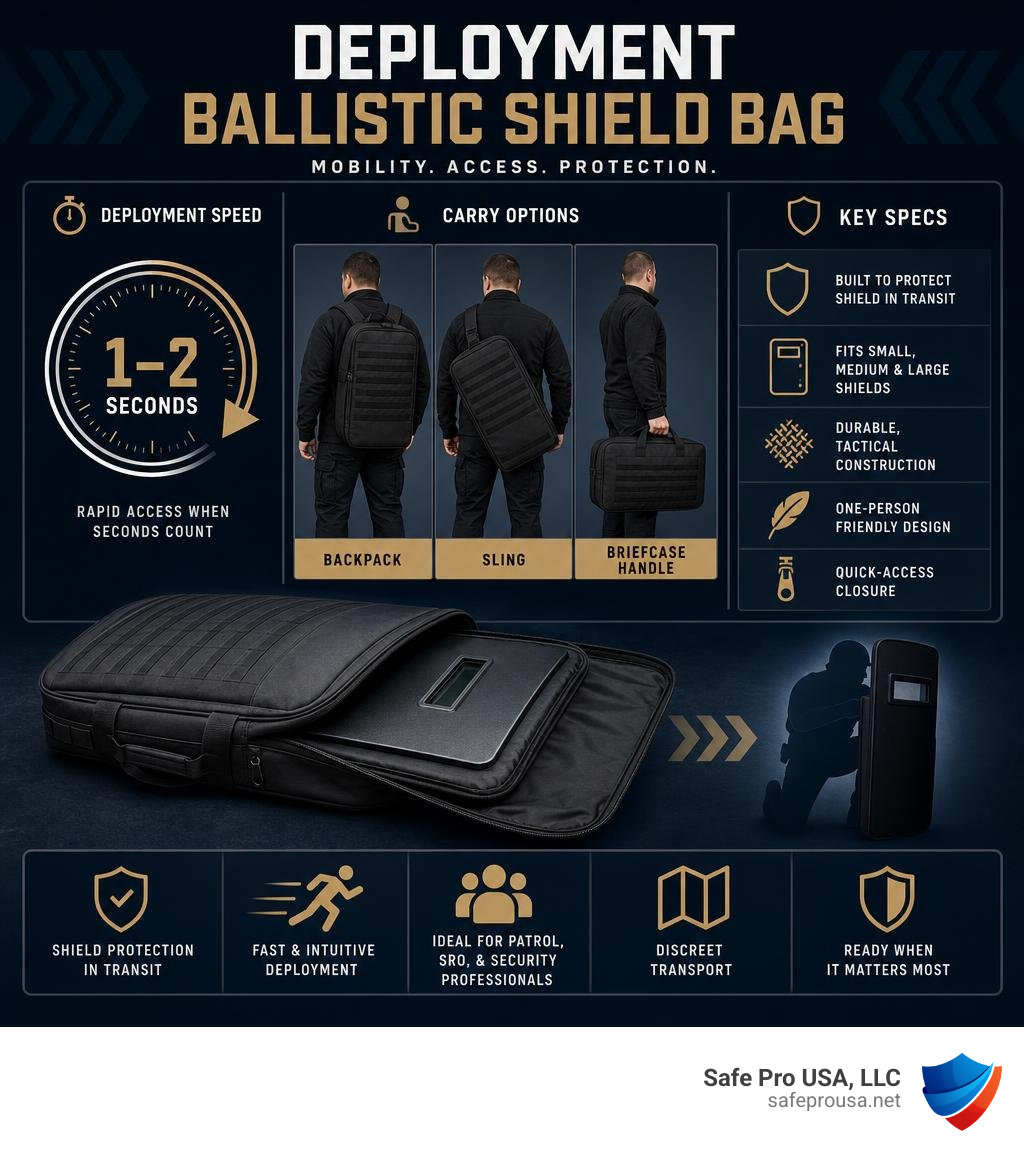
A deployment ballistic shield bag is purpose-built to get a ballistic shield into action fast — whether you're a patrol officer responding to an active shooter, a school resource officer working discreetly on campus, or an executive protection agent blending into a crowd.
Quick Answer: What Is a Deployment Ballistic Shield Bag?
| Feature |
What It Means for You |
| Purpose |
Carries and protects a ballistic shield for rapid field access |
| Typical carry options |
Backpack, sling, or briefcase-style handle |
| Ballistic protection |
Usually none — the bag transports the shield, which provides the protection |
| Who uses them |
Law enforcement, SROs, security professionals, protective detail operators |
| Common shield sizes |
Small (fits mini shields), Medium, Large (fits full-size tactical shields) |
| Key benefit |
One-person or two-person deployment in seconds, without fumbling with cases or straps |
Traditional ballistic shields are serious tools — but without the right bag, they're awkward to store, slow to access, and impossible to carry discreetly. The right deployment bag closes that gap. It keeps your shield protected in transit, ready to deploy the moment a threat appears.
Real-world feedback from law enforcement tells the story clearly. Officers have described deploying compact folding shields the same day they received them — directly into active search warrant operations. That kind of immediate readiness is exactly what a well-designed deployment bag is built to support.
I'm Michael Wratten, VP of Marketing & Sales at Safe Pro USA and a 20-year law enforcement veteran with the Los Angeles and West Covina police departments — experience that directly shapes how I evaluate every deployment ballistic shield bag on the market. In the roundup below, I'll walk you through the options worth your attention.
Understanding the Deployment Ballistic Shield Bag: Carrier vs. Bag
When shopping for protective gear, tactical terminology can quickly become confusing. You will often see the terms "ballistic shield carrier" and "deployment ballistic shield bag" used interchangeably, but they serve distinct operational purposes.
A standard ballistic shield carrier is typically a snug, form-fitting sleeve or harness. Its primary job is to hold the shield during storage or to provide a wearable interface (like a shoulder strap or rig) while the shield is actively in use. Carriers are designed to stay on the shield during operation, often featuring cutouts for viewports and handles.
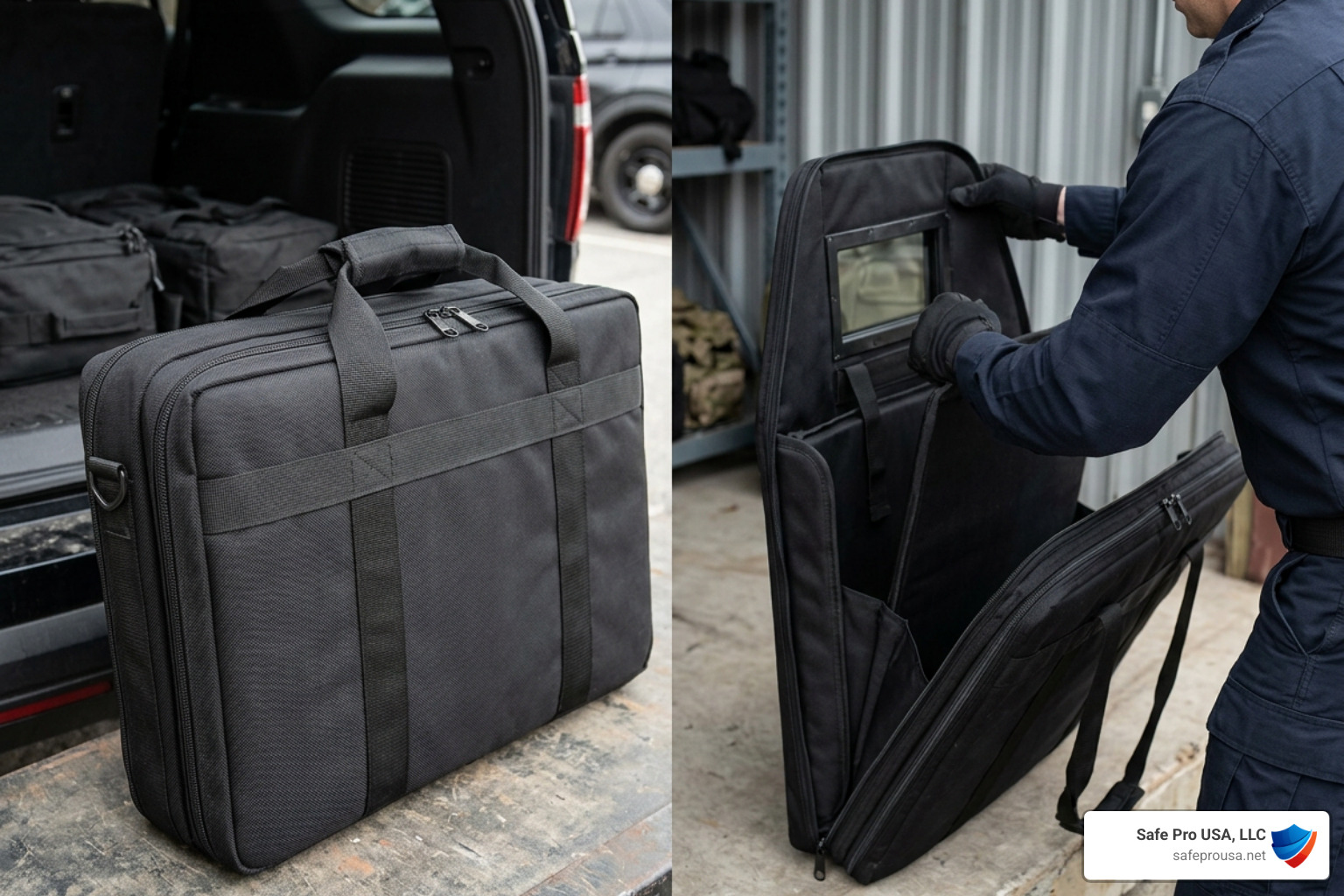
In contrast, a deployment ballistic shield bag is an active transport and deployment system. It is designed to safely house the shield during transit storage, keeping it clean, dry, and protected from UV degradation. More importantly, it is engineered for rapid extraction. Rather than keeping the shield wrapped up during a gunfight, a deployment bag allows the operator to whip the shield out in a single motion, or even deploy the bag itself as a defensive barrier if it is a convertible system.
For operations requiring low-profile movement, these bags are invaluable. Some are disguised as ordinary briefcases or civilian backpacks. This allows undercover officers, executive protection teams, or school resource officers to carry robust, rifle-rated protection in plain sight without causing public alarm.
Key Design Features and Materials for Tactical Durability
A ballistic shield is a heavy, dense piece of life-saving equipment. If you put a 15-pound steel or composite shield into a cheap, off-the-shelf nylon bag, the corners will tear through the fabric within a week. That is why professional-grade deployment bags rely on mil-spec materials and specialized construction techniques.
-
1000D Nylon: The industry standard for heavy-duty tactical gear. This material offers extreme abrasion resistance, ensuring that the sharp edges of a shield do not wear through the fabric.
-
DWR (Durable Water Repellent) Ripstop: Many premium bags utilize a ripstop weave treated with a water-resistant coating. This keeps rain, snow, and road grime off your shield.
-
Reinforced Stitching: Look for double-stitched seams and bar-tack reinforcements at high-stress areas like shoulder strap anchor points and carry handles.
-
Chemical and UV Resistance: High-quality exterior coatings protect the bag from fuel spills, cleaning solvents, and prolonged exposure to sunlight in patrol car trunks.
When evaluating a bag, look for features that minimize the time between identifying a threat and getting behind armor:
-
Exposed Handle Access: Some specialized bags feature a clever cutout or flap that leaves the shield's handle exposed. This allows you to grab the shield firmly with your primary hand and slide the bag off in one fluid motion, ensuring you never lose positive control of your armor.
-
Utility Pockets: High-threat situations require more than just a shield. Look for integrated pockets lined with loop fields to attach medical gear, spare magazines, or entry tools.
-
ID Panels: Large hook-and-loop sections on the exterior allow for rapid attachment of "POLICE," "SHERIFF," or "SECURITY" patches, minimizing the risk of blue-on-blue incidents during chaotic responses.
-
IFAK Compatibility: Having an Individual First Aid Kit attached directly to your shield bag ensures that trauma care is immediately available if a team member or bystander is injured.
For systems that integrate the shield and bag into a single unit, professional-grade rapid deployment ballistic shields show how manufacturers optimize dimensions (typically around 15.75" x 27.5") to balance protective coverage with vehicle storage limits.
Ballistic Protection vs. Pure Transport in a Deployment Ballistic Shield Bag
It is crucial to understand whether your deployment bag is a non-ballistic carrier or an integrated armor system:
-
Transport-Only Bags: These bags contain no ballistic material. Their sole purpose is to carry a separate rigid shield, such as a steel or composite Level III plate. The bag itself will not stop a bullet.
-
Integrated/Convertible Armor Bags: These systems are constructed with soft ballistic panels sewn directly into the fabric. When folded, they look like an ordinary briefcase or laptop bag. When unbuckled, they unfold via gravity to provide an instant, seamless wall of Level IIIA protection. Some models even feature internal pockets designed to accept Level III or IV rifle plates, allowing you to upgrade your protection on the fly.
Deployment Mechanics and Tactical Applications
In a high-threat environment, fine motor skills disappear. If a deployment bag requires you to thread a needle, unzip a complex track, or release three different safety straps, it is a liability.
| Carry Style |
Deployment Speed |
Best For |
Hands-Free Capability |
| Briefcase Handle |
Ultra-Fast (1-2 Sec) |
Executive Protection, VIP Escort |
Low (Requires one hand constantly) |
| Sling Carry |
Fast (2-4 Sec) |
Patrol Officers, Active Shooter Response |
Medium (Can swing to back when hands are needed) |
| Backpack Straps |
Moderate (3-5 Sec) |
School Resource Officers, K9 Operators |
High (Completely hands-free until deployed) |
One-Person vs. Two-Person Deployment
A high-quality deployment ballistic shield bag must accommodate different tactical doctrines:
-
One-Person Deployment: Designed for solo operators (like patrol officers or SROs). The bag is typically worn via a sling or backpack straps. The user can rapidly transition the bag to the front, open the quick-release buckles, and deploy the shield while keeping their dominant hand on their duty weapon.
-
Two-Person Deployment: In tactical stack formations, a secondary officer may deploy the shield from the primary operator's back. Some bags feature top-pull handles that allow a teammate to extract the shield instantly while the front officer maintains cover with a long gun.
Tactical Scenarios
-
Active Shooter Response: Patrol officers are often the first on the scene. Having a compact shield bag in the passenger seat allows them to exit the vehicle with immediate, mobile cover.
-
School Resource Officers (SROs): Carrying a traditional tactical shield down a school hallway would cause panic. A discreet briefcase-style folding shield allows an SRO to carry rifle-rated protection during daily rounds without drawing unwanted attention.
-
Executive Protection: When escorting a VIP through a crowd, a low-profile briefcase shield can be deployed instantly to cover the principal during an evacuation.
-
Patrol and Vehicle Interdictions: Traffic stops are inherently unpredictable. Storing a rapid-deploy shield bag within arm's reach of the driver's seat provides immediate protection against unexpected handgun or rifle threats.
While real-world operations demand certified, mil-spec gear, the tactical community's interest in rapid-folding designs is so widespread that it has even inspired recreational training replicas. For example, The DUMBAS (Deployable Unilateral Modular Briefcase & Shield) for Nerf – Gifts Keeper Pte Ltd mimics the gravity-drop deployment of professional briefcase shields, illustrating how intuitive these systems are to operate.
Similarly, the concept of "shielding" extends beyond physical armor. In the modern tactical space, protecting electronic assets is just as critical as protecting personnel. Tactical teams often deploy signal-blocking hardware, such as the Ultra Armor Faraday Bag - Tablet & Laptop RFID Shield | DefenderShield, to secure communication equipment and prevent remote hacking or tracking during sensitive operations.
Maintenance, Care, and Frequently Asked Questions
Like any life-saving equipment, your deployment bag requires regular inspection and maintenance to ensure it performs flawlessly when needed.
Do deployment shield bags offer built-in ballistic protection?
Most standard transport bags do not contain ballistic materials; they are simply heavy-duty nylon cases designed to carry rigid shields. However, convertible "briefcase" style bags do feature integrated soft armor panels (typically rated to NIJ Level IIIA) that unfold to provide immediate protection. Always verify the manufacturer specifications of your specific model.
What sizes of ballistic shields fit into these deployment bags?
Bags are generally divided into three categories:
-
Small (Mini): Designed for compact, highly maneuverable shields (typically around 12" x 18" or 12" x 24").
-
Medium: Fits standard patrol shields (typically around 20" x 30").
-
Large: Built for full-size tactical or SWAT entry shields (up to 24" x 48" or larger).
Always measure your shield's total thickness, handle projection, and viewport dimensions before purchasing a bag to ensure a proper fit.
How do you clean and maintain a tactical shield bag?
-
Cleaning: Wipe down the exterior with a soft, damp cloth and mild soap. Never submerge a bag containing integrated ballistic panels in water, and avoid harsh detergents, bleach, or chemical solvents.
-
Drying: Always air dry your bag away from direct heat sources.
-
Storage: Store the bag flat or hung properly in a cool, dry location. Avoid leaving it compressed under heavy gear or exposed to direct sunlight for extended periods.
-
Post-Impact Inspection: If the bag or the shield inside takes a hard drop or a ballistic impact, inspect all seams, buckles, and zippers immediately for structural damage.
Conclusion
A deployment ballistic shield bag is not just an accessory; it is a critical link in your defensive chain. By keeping your armor protected, portable, and ready for split-second deployment, these bags ensure that you can carry your cover wherever the threat takes you.
At Safe Pro USA, we are dedicated to manufacturing high-performance, American-made ballistic protection gear that tactical professionals can trust. As a subsidiary of the Nasdaq-listed Safe Pro Group (SPAI), we combine mil-spec quality with clean, innovative designs and honest materials to protect those who protect us.
If you are looking to round out your defensive setup with high-performance rifle protection, be sure to check out our comprehensive ballistic armor plates guide to choose the right inserts for your deployment system. Stay safe out there.


