Why Futuristic Military Body Armor Is Redefining Battlefield Survival
Obviously, we don't have Master Chief's level of armor... yet, but in general, futuristic military body armor is no longer science fiction — it's the next frontier in soldier survivability, and the options available in 2026 are closer to that vision than ever before.
If you're looking for a quick answer, here are the most important things to know:
| Feature |
What to Expect |
| Weight |
Next-gen armor targets significant reductions from today's 30-lb vests using graphene and nanotechnology |
| Protection |
Designed to defeat advanced threats including armor-piercing rounds and directed energy weapons |
| Smart tech |
Integrated sensors for vital signs, GPS, and situational awareness |
| Modularity |
Swappable plates and panels customized to mission type |
| Materials |
Graphene, high-molecular-weight polyethylene (HMW-PE), and nano-enhanced composites |
The stakes have never been higher. Today's soldiers and tactical professionals face a battlefield that is evolving faster than their gear. Current body armor vests can weigh up to 30 pounds — and that's before adding plates, communications gear, and load-bearing equipment. That weight slows operators down, drains endurance, and increases injury risk on extended missions.
Meanwhile, threats are advancing. Armor-piercing rounds, IEDs, and emerging directed energy weapons are pushing existing protection systems to their limits. The U.S. Army's X-SAPI program is already developing plates to defeat threats that haven't fully appeared on the battlefield yet — a clear signal that the armor industry must stay ahead of the threat curve, not react to it.
The good news? A new generation of materials, smart technologies, and modular designs is closing that gap fast.
I'm Michael Wratten, VP of Marketing & Sales at Safe Pro USA and a 20-year law enforcement veteran who has spent his career at the intersection of field operations and armor product innovation. My hands-on experience across ballistic protection, tactical gear, and defense procurement gives me a front-row seat to how futuristic military body armor is transitioning from concept to combat-ready reality — and I'll walk you through exactly what that means for your next mission.
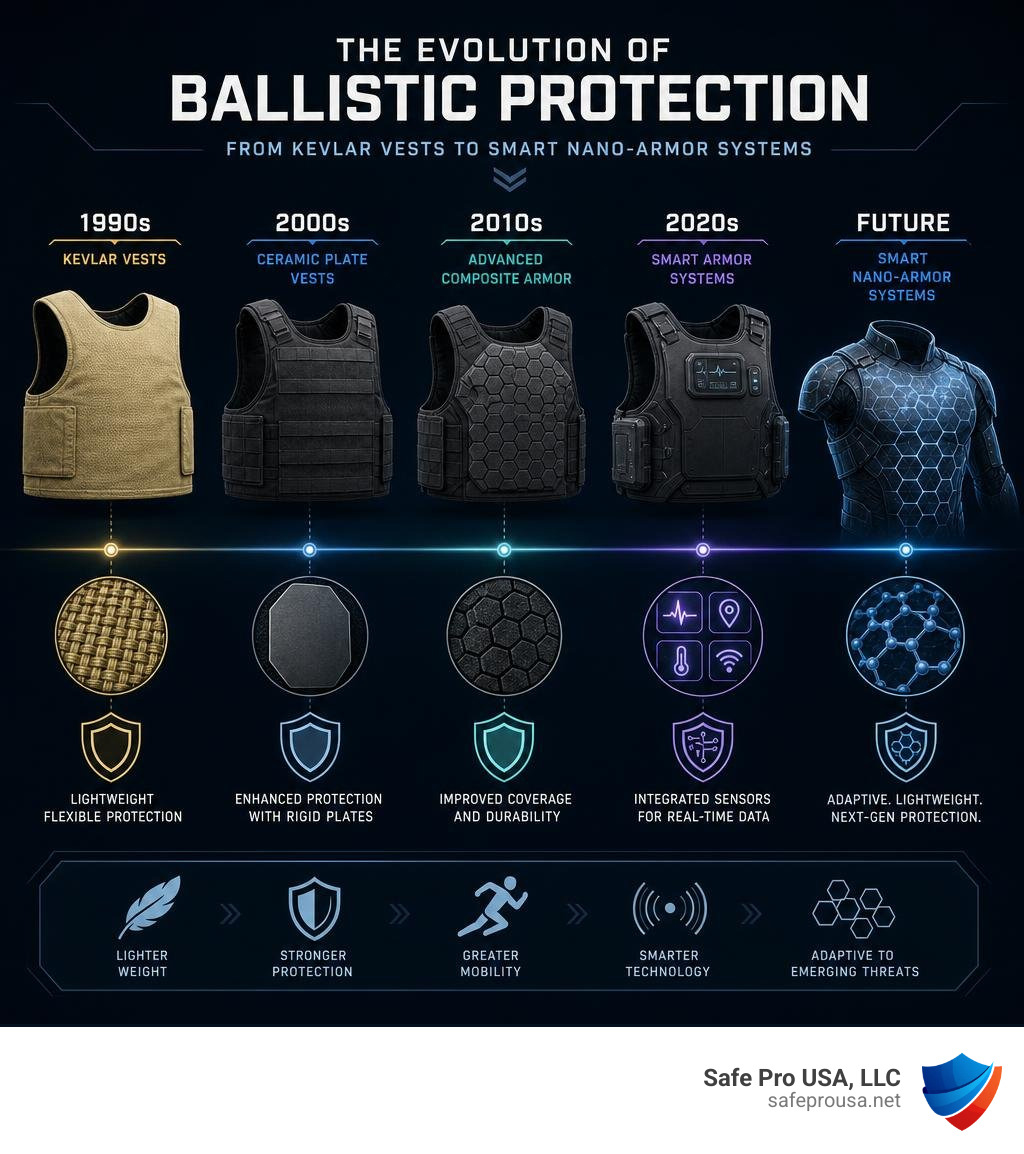
The Evolution of Futuristic Military Body Armor

Historically, personal defense was a brutal trade-off: you could either be a walking tank or a nimble scout, but never both. Medieval knights wore up to 80 pounds of heavy steel plate, sacrificing speed for protection. In contrast, the modern era introduced lightweight textile solutions like Kevlar (invented in 1965) and high-molecular-weight polyethylene (HMW-PE) fibers.
Yet, even in 2026, weight and mobility constraints remain the ultimate enemy of the modern warfighter. Standard-issue plate carriers equipped with Level IV ceramic inserts reliably stop high-velocity rifle rounds, but they force operators to carry up to 30 pounds on their torsos. Over extended missions, this weight degrades physical performance, limits tactical agility, and causes chronic musculoskeletal stress.
To solve this, US Army research on next-gen armor is pushing the envelope of ballistic science. The military's X-SAPI program is actively testing advanced plates designed to neutralize highly specialized "X-threats"—such as ultra-high-velocity or armor-piercing rounds—before they become common on the battlefield. The challenge is that these advanced plates often add extra weight when built with traditional materials. To break this cycle, designers are looking beyond conventional chemistry to unlock the true potential of advanced fibers. In fact, ballistics experts note that we have only tapped about 40% of the theoretical performance limit of HMW-PE fibers.
Bridging Sci-Fi and Reality: Lessons from Pop Culture
When we envision futuristic military body armor, our minds naturally drift to pop culture icons. We look at the legendary MJOLNIR Powered Assault Armor design from the Halo universe—a half-ton masterpiece featuring a titanium alloy outer shell, refractive coatings to disperse energy strikes, and a hydrostatic gel layer that reactively changes density to absorb impact. Or we marvel at the Mjolnir Powered Assault Armor's neural interface, which translates brain signals directly into movement via integrated piezoelectric layers.
In other media, concepts like The Nightingale Suits showcase segmented alloy plates paired with a layered mesh plating bodysuit running on a specialized operating system. Even digital artists selling a Sci-fi armor suit 3D model rigged on CGTrader emphasize the visual appeal of power panels that illuminate upon activation and nano-conductive fiber weaves that dynamically adjust to the wearer's body shape.
But how do these concepts translate to real-world biomechanics?
Historically, many fictional armor designs get the physics completely wrong. They extend rigid plates too far down the torso, preventing the wearer from bending at the waist, or they fail to articulate the shoulders properly. Real-world armor must respect human anatomy. To allow natural movement, rigid protection must terminate at the natural waist and utilize overlapping, telescoping plates (known historically as faulds or lames) to protect the lower abdomen and hips during movement. Furthermore, while sci-fi armor often covers the entire body in rigid plating, real combat data shows we must prioritize coverage based on threat profiles: the head, upper torso, and shoulders require the highest level of rigid protection, while the limbs require lighter, more flexible materials to preserve agility.
Next-Generation Materials and Smart Technologies

To build a true futuristic military body armor system, we must replace heavy, rigid materials with substances engineered at the molecular level. The goal is simple: maximize energy absorption while minimizing weight.
Next-Gen Materials: Graphene and Nanotechnology in Futuristic Military Body Armor
The transition from heavy steel and bulky ceramics to nano-engineered materials is the most significant leap in personal protection history. While traditional manufacturing of bulletproof vests and hard body armor plates has relied heavily on standard aramid and ceramic materials, the future belongs to nanotechnology.
-
Graphene: This single layer of carbon atoms arranged in a hexagonal lattice is famously known as the world's strongest material. It is incredibly light, highly flexible, and possesses a tensile strength-to-weight ratio that makes steel look like wet cardboard. By sandwiching graphene layers between ultra-strong plastic films or embedding them within aramid resins, we can create ultra-thin armor plates that disperse kinetic energy across a massive surface area almost instantly.
-
Nanotechnology & Shear Thickening Fluids (STF): Often referred to as "liquid armor," STF-treated fabrics remain completely flexible under normal conditions. However, the moment a bullet or shrapnel strikes the material, the nanoparticles within the fluid instantly lock together, transitioning the fabric into a rigid, highly protective barrier in milliseconds.
-
Optimized Aramid and Polyethylene Weaves: By redesigning the molecular structure and resin systems of aramid fibers, we can finally tap into that remaining 60% of unused fiber potential, creating vests that are thinner, lighter, and far more breathable.
Adaptive and Modular Armor Systems
No two missions are identical. A high-speed urban raid requires maximum mobility and lightweight front-and-back protection, while a high-threat static defense mission demands heavy, comprehensive coverage. Modern operations cannot rely on static gear configurations.
This is where adaptive and modular armor systems come into play. By utilizing scale armor designs—inspired by both historical lamellar armor and modern biomimicry—operators can customize their level of protection in real time.
| Feature |
Rigid Plate Systems (Standard) |
Adaptive Modular Systems (Futuristic) |
| Weight Distribution |
Concentrated heavily on the shoulders and upper torso |
Distributed evenly across the core using ergonomic load-bearing frames |
| Flexibility |
Static; restricts waist bending and rotational movement |
High; segmented plates slide and telescope to match body kinetics |
| Threat Adaptation |
Fixed protection level (e.g., Level IV only) |
Scalable; add or remove plates based on real-time threat profiles |
| Integration |
Passive; carrying gear requires separate MOLLE webbing |
Active; built-in power pathways and sensor mounts |
Smart Integration: The Digital Backbone of Futuristic Military Body Armor
Tomorrow's armor is more than a passive shield; it is a fully networked tactical platform. By integrating smart technologies directly into the fabric of our gear, we turn the armor carrier into a hub for communication and health monitoring.
Consider the advancements in networked soldier programs. For example, Russia's Future Soldier program—often compared to the high-tech gear seen in tactical video games—integrates a smart helmet, satellite uplink, and protective kit designed to process battlefield data in real time. Similarly, systems like Germany's Gladius 2.0 platform utilize smart textiles and integrated sensors to track vital signs, such as heart rate and respiration, using AI-supported data analysis. If an operator is injured, the armor can automatically trigger an encrypted rescue chain, transmitting the soldier's exact GPS coordinates and medical status to command.
Furthermore, heads-up displays (HUDs) integrated into the helmet display real-time situational awareness data, mapping friendly forces and potential threats directly onto the operator's field of vision. However, this level of digital integration introduces a new battlefield vulnerability: cybersecurity. Any wireless battle network can potentially be targeted by electronic warfare or hacking, meaning future smart armor must feature robust encryption and analog fail-safes to ensure the soldier is never left defenseless in a jammed environment.
Overcoming Implementation Challenges: Standards, Sustainability, and Cost
As exciting as these technological leaps are, bringing futuristic military body armor to the field requires overcoming massive regulatory, environmental, and financial hurdles.
Regulatory Standards and Testing Evolution
The National Institute of Justice (NIJ) sets the gold standard for ballistic testing, but current protocols are designed for static, passive materials like traditional ceramics and soft aramid fibers. How do you certify a smart armor vest that uses liquid armor technology or integrated biometric sensors?
Testing agencies must evolve. New certification protocols must evaluate how active materials perform under extreme environmental conditions—such as high heat, sub-zero temperatures, and prolonged moisture exposure. Additionally, standards must address how integrated electronics behave when struck by projectiles, ensuring that a bullet impact doesn't cause a battery fire or send electrical currents through the wearer's body.
Sustainability and Global Accessibility
Traditional armor manufacturing is resource-intensive and environmentally taxing. The chemical synthesis of aramid fibers and the firing of high-density ceramics release significant carbon emissions. As we look to the future, sustainability is a operational necessity.
Researchers are actively exploring biodegradable ballistic materials, recycled high-strength polymers, and greener manufacturing processes that reduce chemical waste.
Beyond sustainability, cost remains a massive barrier to global adoption. High-tech systems incorporating graphene, smart sensors, and advanced micro-displays can cost upwards of tens of thousands of dollars per unit. While elite special operations units will always receive the latest gear first, scaling these advanced systems to standard infantry forces requires massive defense budgets and highly scalable manufacturing processes. For many global military forces, highly durable, honest, and cost-effective American-made armor plates will remain the practical standard for years to come.
Frequently Asked Questions about Futuristic Armor
How much does futuristic military body armor weigh compared to current gear?
While a fully loaded modern plate carrier with Level IV plates can easily weigh up to 30 pounds, next-generation systems utilizing graphene and nano-composites aim to cut that weight by 30% to 50% without sacrificing ballistic integrity. The goal is to bring the total weight of a fully protective vest down to under 15 pounds, significantly reducing soldier fatigue.
Can futuristic armor protect against directed energy weapons?
Yes. Future armor designs are incorporating refractive coatings and specialized thermal dispersion layers specifically engineered to scatter and dissipate the intense heat generated by lasers and other directed energy weapons, protecting the underlying materials and the wearer from severe burns.
When will smart body armor be widely deployed?
While elite units are already testing early iterations of smart textiles and modular plates in 2026, widespread deployment across standard military forces is expected to roll out gradually over the next decade as manufacturing costs decrease and testing standards adapt to certify smart technologies.
Conclusion
The future of tactical protection is a balance of advanced materials science, biomechanical engineering, and smart integration. At Safe Pro USA, LLC (a proud subsidiary of the Nasdaq-listed Safe Pro Group: SPAI), we are dedicated to bringing mil-spec quality, clean design, and honest, highly durable materials to the tactical professionals who need them most.
While the fully powered hardsuits of science fiction are still on the horizon, the steps we take today in material innovation and modular design are saving lives right now. Ready to upgrade your kit with the best in modern ballistic engineering? Choose the right ballistic protection plates for your next mission and experience the ultimate blend of lightweight mobility and uncompromising protection.


