Why Your Mag Pouch Plate Carrier Setup Can Make or Break Your Mission
Choosing the right mag pouch plate carrier setup is one of the most critical decisions when building out a tactical kit. The wrong choice costs time, causes fumbled reloads, and in a real scenario — much more.
Here are the top mag pouch plate carrier setups at a glance:
| Setup Type |
Best For |
Key Benefit |
| Single mag pouch |
Minimalist / secondary carry |
Low profile, light weight |
| Double mag pouch |
Law enforcement patrol |
Balanced capacity and access |
| Triple placard |
Military / direct action |
Max capacity, fast reloads |
| Kangaroo pouch |
Mixed rifle + pistol carry |
Combines calibers on one panel |
| Stackable pouch |
High-volume operations |
Expandable without added bulk |
The front panel of a plate carrier is prime real estate. How it is configured determines how fast the wearer can get back in the fight.
Whether the loadout is built around 5.56, .308, pistol mags, or a mixed-magazine setup, pouch choice affects retention, reload speed, noise discipline, and comfort under load. Getting it right matters before the kit ever leaves the wire.
This guide breaks down the most effective mag pouch plate carrier configurations for military, law enforcement, security, and serious training applications, with practical considerations for retention, placement, materials, and mission-specific loadouts.
Understanding the Mag Pouch Plate Carrier System
At its core, a mag pouch plate carrier is more than just a vest with some pockets slapped on the front. It is an integrated system engineered to balance life-saving ballistic protection with high-efficiency load carriage.

Standard plate carriers are designed primarily to hold hard armor plates (such as Level III or Level IV ceramic or steel plates) to protect your vital organs. However, a bare plate carrier is just armor; to make it a fighting rig, you must integrate ammunition storage.
Historically, tactical vests featured permanently sewn-on pouches. While these integrated setups were incredibly durable, they lacked versatility. If your mission changed from carrying 5.56 AR-15 magazines to carrying .308 battle rifle magazines, you had to swap out your entire vest.
Modern modular plate carriers solve this issue by serving as a blank canvas. By utilizing heavy-duty attachment systems, operators can customize their front panels, cummerbunds, and sides to match their specific loadout requirements. When you choose high-performance armor systems like our Safe Pro USA Tactical Plate Carriers, you gain a platform built to handle heavy combat loads without sagging, shifting, or restricting your range of motion.
The ultimate goal of a well-configured mag pouch system is to distribute weight evenly across your torso while ensuring that your magazines are exactly where your muscle memory expects them to be during a high-stress reload.
Single vs Multi-Caliber Mag Pouch Plate Carrier Options
When selecting your ammunition carry gear, one of the first decisions you will face is choosing between single-caliber (dedicated) pouches and multi-caliber (universal) pouches.
-
Single-Caliber Pouches: These are molded or sewn to fit one specific type of magazine, such as a standard 5.56 NATO AR-15 magazine or a .308 SR-25 magazine. The benefit here is absolute precision. Because the pouch is tailored to the exact dimensions of the magazine, there is zero rattle, and the retention is perfectly tuned. The downside is a complete lack of flexibility; you cannot fit a wider .308 magazine into a dedicated 5.56 pouch.
-
Multi-Caliber Pouches: Built with elastic side panels, adjustable shock cords, or proprietary polymer brackets, multi-caliber pouches expand and contract to fit a wide range of magazines. A single high-quality multi-caliber pouch can hold a 5.56 PMAG, a metal 7.62x39 Kalashnikov magazine, or even submachine gun/PCC magazines. This versatility is highly valued by tactical professionals who operate different weapon systems depending on the mission profile.
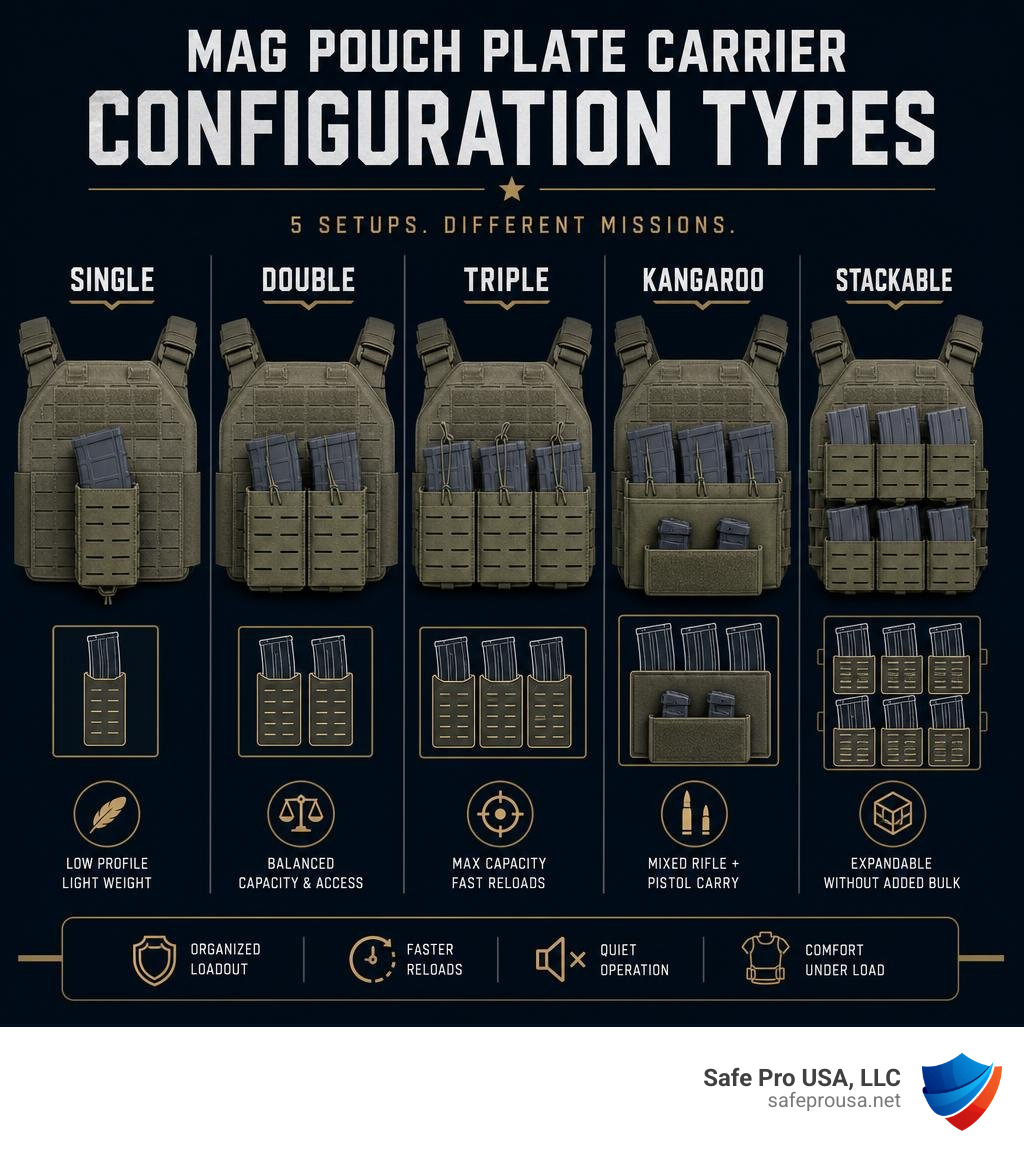
Double, Triple, and Kangaroo Mag Pouch Plate Carrier Configurations
How many magazines do you need on your chest, and how should they be arranged? The layout of your front panel dictates your physical profile when prone and your total ammunition capacity.
-
Single Pouches: Typically mounted on the cummerbund or off-center on the front panel, single pouches are excellent for keeping a very low profile. They are also widely used on battle belts to supplement the plate carrier.
-
Double Pouches: A favorite among law enforcement patrol officers who need a balanced loadout. Double-pouch setups provide enough ammunition to resolve most immediate threats without making the front of the carrier so thick that it interferes with driving a patrol vehicle or mounting a long gun.
-
Triple Placards: The gold standard for military and direct-action operations. A triple placard mounts three rifle magazines side-by-side across the chest. This configuration maximizes your immediate ammo supply (90 rounds of 5.56) while keeping the magazines in a single, easily accessible layer.
-
Kangaroo Pouches: These are integrated directly into the front flap of the plate carrier itself. By using a hook-and-loop kangaroo insert, you can slip two or three magazines inside the carrier’s built-in front pocket. This is the absolute lowest-profile way to carry rifle ammunition, as it eliminates the bulk of external pouch walls.
-
Stackable Designs: For high-volume operations, stackable pouches feature laser-cut MOLLE or laminate webbing on their front faces. This allows you to stack pistol mag pouches, utility pockets, or tourniquet holders directly on top of your rifle magazines, keeping your gear streamlined and centered.
Retention, Materials, and Attachment Systems
To keep your ammunition secure through running, jumping, and crawling, you must choose the right retention mechanism.
| Retention Type |
Speed |
Security |
Debris Protection |
Noise Level |
| Open-Top (Kydex/Polymer) |
Ultra-Fast |
High |
Low |
Completely Silent |
| Bungee Cord |
Moderate |
Very High |
Low |
Nearly Silent |
| Covered Flap |
Slower |
Absolute |
High |
Loud (Velcro) |
-
Open-Top (Friction/Insert Retention): These pouches rely on tight elastic material or internal polymer/Kydex inserts to grip the magazine. They offer the fastest reload speeds and silent draws, making them highly popular for close-quarters battle (CQB).
-
Bungee Retention: Utilizing an elastic shock cord that loops over the top of the magazine, bungee systems offer excellent security during dynamic movement. To reload, you simply pull the tab to the side and draw.
-
Covered Flap: Classic military-style pouches featuring a top lid secured by hook-and-loop or buckles. These offer the ultimate protection against mud, sand, and snow, and they ensure you will never lose a magazine, even during airborne or maritime operations.
Materials Matter: Cordura vs. Laminates
The durability of your gear is directly tied to its base materials.
-
500D Cordura Nylon: The industry standard for tactical nylon. It offers an exceptional balance of tear resistance, abrasion resistance, and lightweight performance.
-
Squadron Laminate: A modern, laser-cut material consisting of two layers of Cordura laminated together. It allows manufacturers to cut precise MOLLE slots directly into the fabric, eliminating the need for heavy sewn-on webbing and significantly reducing the weight of the pouch.
-
HANK (High Abrasion Neoprene Kevlar): Often used as a lining material inside high-end pouches. HANK provides an incredibly grippy surface that assists in magazine retention while resisting the extreme wear caused by the sharp metal feed lips of magazines.
Attachment Systems
A mag pouch is only as secure as its connection to your plate carrier. Standard systems include classic MOLLE straps, heavy-duty snap-in polymer sticks, and modern placard systems. Placards utilize male side-release buckles or G-hooks at the top of the panel paired with a full hook-and-loop backing. This allows you to peel an entire triple-mag setup off your chest in seconds and swap it for a completely different kit.
For a comprehensive selection of rugged, field-ready options built with these premium materials, check out our Safe Pro USA Tactical Pouches and Accessories.
Choosing the Right Setup for Your Mission
Your mission dictates your gear. A setup that is perfect for a SWAT officer conducting a high-risk warrant service may be completely inadequate for an infantryman on a multi-day patrol.
Law Enforcement
Police officers typically operate in urban environments where engagements are fast and highly violent but short in duration. Law enforcement setups favor clean, low-profile designs. A double rifle mag pouch paired with one or two pistol mag pouches on the front panel is common. This keeps the chest clear for mounting body-worn cameras, radio push-to-talk (PTT) buttons, and administrative tools.
Military Operations
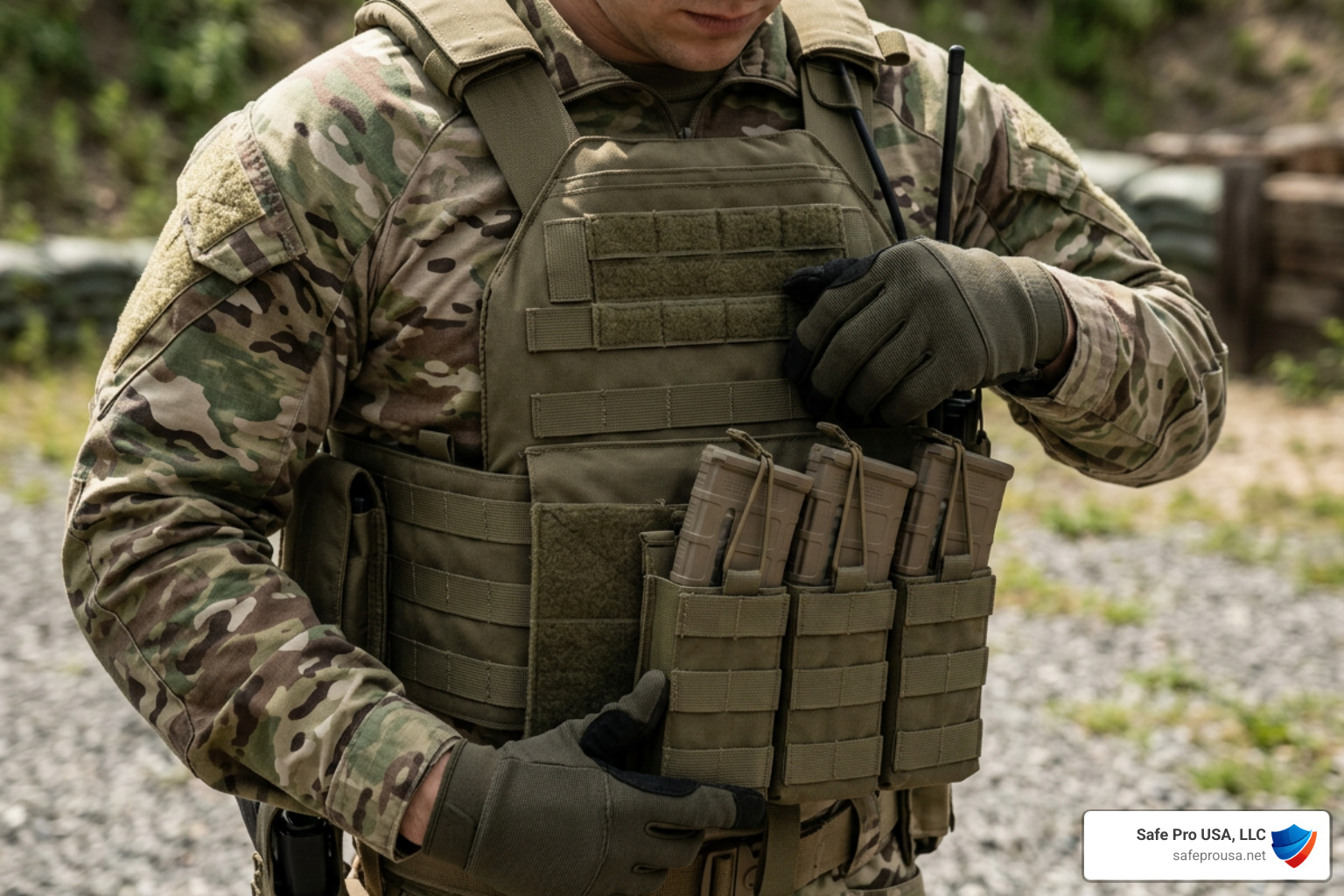
Military personnel require high ammunition capacity, extreme durability, and protection against harsh environmental conditions. A triple rifle placard, often supplemented by additional single pouches on the cummerbund, is the standard. Because military operations can last for days, comfortable weight distribution and compatibility with rucksacks are paramount. Camouflage patterns like MultiCam and classic solid colors like Ranger Green are essential for signature reduction.
Civilian Defense and Range Use
For home defense or training at the range, modularity and ease of use are key. A placard-based system is highly recommended, as it allows you to easily scale your kit up or down. If you are practicing with a 9mm pistol-caliber carbine one weekend and an AR-15 the next, a quick-change placard system saves you from spending hours re-weaving MOLLE straps.
No matter your role, scaling your kit to match your operational environment is critical. Explore our customizable loadout options at Safe Pro USA Tactical Gear and Customization.
Frequently Asked Questions About Plate Carrier Mag Pouches
Elastic mag pouches are incredibly low-profile when empty, as they lay completely flat against your carrier. They provide excellent passive retention. However, because they collapse when the magazine is drawn, re-indexing (putting a partially spent magazine back into the pouch) with one hand is extremely difficult.
Polymer-reinforced magwells (such as those found in high-end multi-caliber pouches) feature a rigid, funneled opening. This rigid structure keeps the pouch open at all times, allowing for effortless, one-handed re-indexing while still providing rock-solid friction retention during movement.
What is the difference between a placard and a traditional MOLLE pouch?
Traditional MOLLE pouches are woven directly into the PALS webbing of your plate carrier using nylon straps. This creates an incredibly secure, semi-permanent attachment, but it takes several minutes to install or remove.
A placard is a dedicated front panel that attaches to the chest of a plate carrier using two quick-release buckles (or G-hooks) and a large hook-and-loop field. This system allows you to swap out your entire front loadout (e.g., transitioning from a three-magazine 5.56 setup to a medical/utility setup) in under ten seconds.
Can I run both rifle and pistol mags on the front of my carrier?
Yes, this is a highly popular configuration often referred to as a "stacked" or "kangaroo" setup. Many manufacturers offer triple rifle placards that have elastic pistol mag pouches mounted directly to their front faces. Alternatively, you can use a kangaroo insert that accommodates both rifle and pistol magazines within the same internal pocket.
While this maximizes your immediate firepower, be mindful of the added depth; stacking pouches too deep on your chest can make it difficult to get low to the ground when shooting from the prone position.
Conclusion
Your mag pouch plate carrier setup is the bridge between your armor and your weapon system. Optimizing this interface ensures that when high-stress situations arise, your reloads are smooth, intuitive, and lightning-fast. By understanding the trade-offs between different retention styles, configurations, and materials, you can build a loadout tailored perfectly to your mission.
At Safe Pro USA, we are dedicated to manufacturing high-performance, American-made ballistic protection and tactical gear that meets the rigorous demands of military, law enforcement, and security professionals worldwide. Our commitment to honest materials, innovative designs, and battle-proven durability ensures that your gear will perform flawlessly when it matters most.
Ready to optimize your tactical loadout? Read more tactical guides and news to stay ahead of the curve, or explore our full lineup of premium plate carriers and accessories today.


