Why a Mil Spec Armor Plate Carrier Is the Standard That Matters Most
Choosing a mil spec armor plate carrier is one of the most important decisions a tactical professional can make. The difference between military-grade and commercial-grade gear isn't just a label — it can determine whether your protection holds up when it counts most.
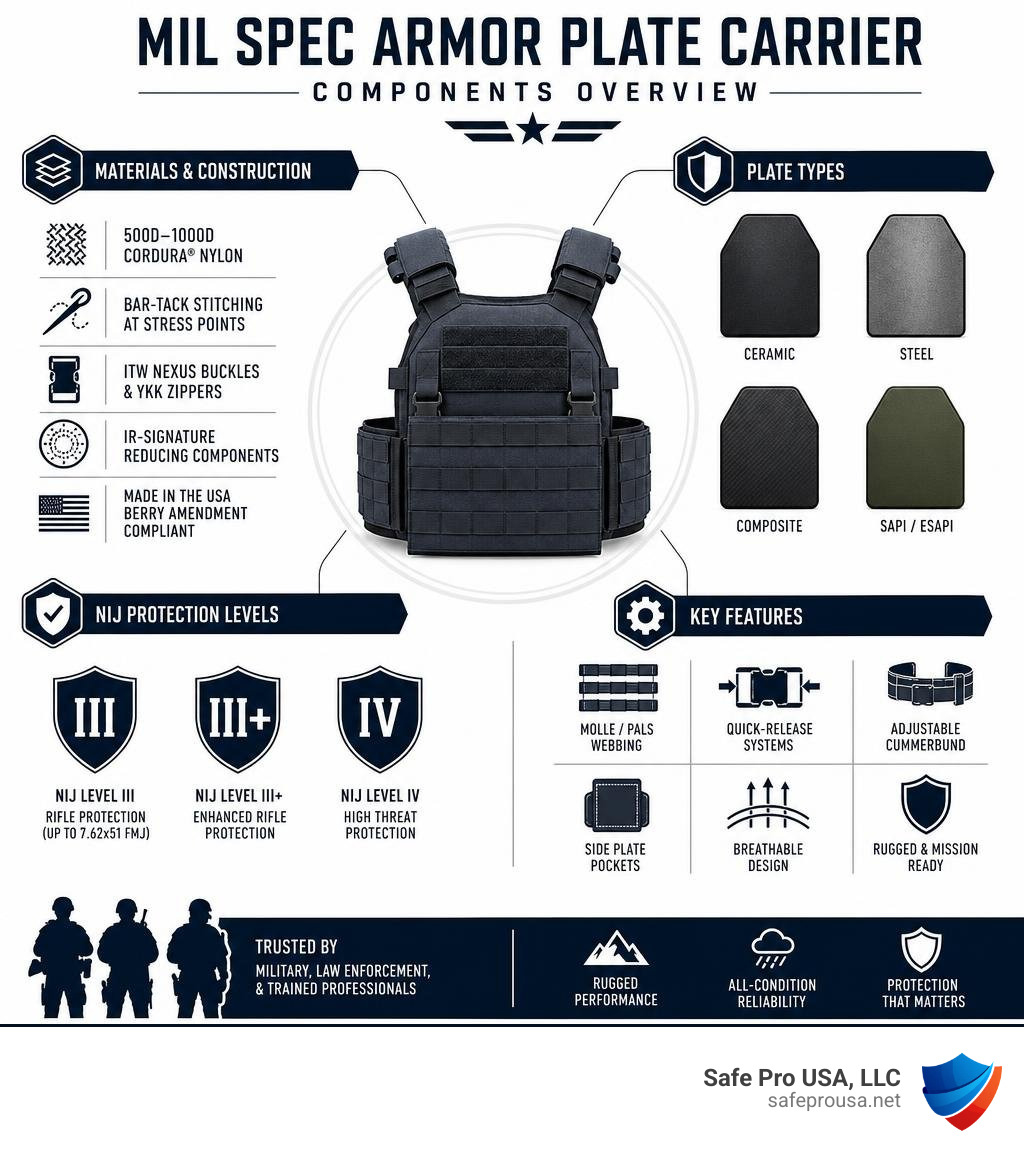
Quick Answer: What Is a Mil Spec Armor Plate Carrier?
| Feature |
What It Means |
| Construction |
500D–1000D Cordura nylon, bar-tack stitching at stress points |
| Hardware |
ITW Nexus buckles, YKK zippers, IR-signature-reducing components |
| Compliance |
Berry Amendment (USA-made materials and labor) |
| Plate Compatibility |
Accepts SAPI, ESAPI, ceramic, steel, and composite hard armor plates |
| Protection Standard |
NIJ-certified armor inserts (Level III, III+, or IV) |
| Key Features |
MOLLE/PALS webbing, quick-release systems, adjustable cummerbund, side plate pockets |
| Who Uses Them |
U.S. military, law enforcement, federal agencies, trained civilians |
The U.S. Army's Soldier Plate Carrier System (SPCS) — issued to over 60,000 troops in Afghanistan — set the benchmark: the lightest carrier with the highest ballistic performance for rugged, high-altitude terrain. That standard is what separates real mil-spec gear from the imitations flooding the market.
This guide breaks down exactly what makes a carrier truly military-grade, which plate types work best, how to fit one correctly, and which American-made options are worth your money.
I'm Michael Wratten, VP of Marketing & Sales at Safe Pro USA, with over 20 years in the defense and protective equipment industry — including founding and serving in executive roles at leading tactical and body armor brands — giving me hands-on expertise in every dimension of the mil spec armor plate carrier market. That experience is what shapes every recommendation in this roundup.
What Defines a True Mil Spec Armor Plate Carrier?

In the tactical gear world, "mil-spec" gets thrown around more than a hot potato at a backyard barbecue. But what does it actually mean when we talk about a mil spec armor plate carrier?
A true military-specification (mil-spec) carrier is built to satisfy rigorous manufacturing, material, and performance standards dictated by the Department of Defense. Unlike commercial or airsoft-grade carriers--which are often constructed from cheap polyester, weak single-thread stitching, and non-rated plastic buckles--mil-spec carriers are engineered to survive the absolute worst conditions on earth.
One of the most critical legal and quality benchmarks for military-grade gear in the United States is the Berry Amendment (USC Title 10 Section 2533a). This federal regulation mandates that the Department of Defense give absolute preference to domestically produced, manufactured, or grown products.
When you purchase a Berry-compliant carrier, you are guaranteed a product that is 100% designed, sourced, and manufactured in the USA. This ensures that every single thread, buckle, and piece of hook-and-loop fastener meets stringent American quality control standards. At Safe Pro USA, we take pride in manufacturing premium, American-made protective gear that stands up to these exact standards, ensuring our defense and law enforcement professionals receive nothing less than life-saving reliability.
If you are looking for highly durable, duty-ready platforms built to these rigorous standards, exploring Safe Pro USA Tactical Gear is the best place to start.
Key Standards of a Mil Spec Armor Plate Carrier
To separate the professional-grade gear from the tactical fashion statements, look for these specific engineering standards:
-
National Institute of Justice (NIJ) Standards: While the NIJ body armor standards technically certify the ballistic armor plates themselves rather than the fabric carrier, a true mil-spec carrier is designed to hold NIJ-certified Level III, III+, or Level IV plates perfectly secure. It ensures the plates do not shift, sag, or sit too low during rapid movement.
-
Infrared (IR) Signature Reduction: Under modern night-vision devices (NVDs), standard commercial nylon glows like a neon sign. Mil-spec fabrics and webbing are treated to reduce their near-infrared signature, allowing operators to blend seamlessly into the dark even when viewed through hostile night-vision optics.
-
ITW Nexus GhillieTEX Hardware: Cheap plastic buckles will crack when stepped on or freeze and shatter in sub-zero temperatures. Mil-spec carriers utilize heavy-duty hardware like ITW Nexus GhillieTEX buckles, which offer IR signal reduction and extreme impact resistance.
-
YKK Zippers and Mil-Spec Hook-and-Loop: Zippers and Velcro are common failure points on cheap gear. Military standards require heavy-duty YKK zippers and high-cycle hook-and-loop fasteners that retain their grip even when caked in mud, sand, or water.
Materials and Construction of Military-Grade Carriers
The backbone of any mil spec armor plate carrier is the fabric and construction methods used to hold your heavy ballistic plates. If the stitching fails, your armor drops, leaving your vital organs exposed.
The industry standard for military-grade carriers is Cordura nylon, specifically in 500-Denier (500D) or 1000-Denier (1000D) weights. Denier measures the textile measurement of fiber thickness. While you might assume higher is always better, modern military design heavily favors 500D Cordura because it strikes the perfect balance between extreme durability and weight savings.
| Feature |
500D Cordura Nylon |
1000D Cordura Nylon |
| Weight |
Lightweight, highly flexible |
Heavy, rigid |
| Abrasion Resistance |
Excellent (more than enough for active duty) |
Maximum (virtually indestructible) |
| Water Absorption |
Low (dries quickly) |
Moderate (holds more water weight when wet) |
| Best Suited For |
High-mobility operations, active shooter response |
Heavy-duty vehicle operations, static defense |
Beyond the base fabric, look closely at how the carrier is put together:
-
Bar-Tack Reinforcement: At every major stress point—such as where the shoulder straps and cummerbund attach to the plate bags—you should see tight, repeated rows of zig-zag stitching known as bar-tacks. This is the same stitching used to reinforce climbing harnesses and military parachutes.
-
Laser-Cut MOLLE vs. Traditional Webbing: Traditional PALS/MOLLE webbing consists of nylon straps sewn onto the carrier. While incredibly strong, it adds bulk and weight. Modern mil-spec carriers often feature laser-cut MOLLE, where the slots are burned directly into a laminated Cordura face. This reduces weight, keeps a lower profile, and prevents water absorption.
-
3D Spacer Mesh and Ventilation: Wearing heavy plates causes rapid heat build-up. Quality carriers utilize specialized interior linings featuring 3D spacer mesh or advanced thermal management technologies. These systems channel air across your chest and back, wicking away moisture and preventing heat rash during long patrol shifts.
Armor Plate Compatibility and Sizing Options
A plate carrier is only as good as the armor plates you put inside it. To ensure maximum protection, your carrier must be perfectly compatible with the shape, cut, and thickness of your ballistic plates.
Most military-grade carriers are designed around the SAPI (Small Arms Protective Insert) or ESAPI (Enhanced SAPI) sizing standards. These plates feature a distinct "triple-curve" design that conforms to the human torso, along with angled top corners (known as a shooter's cut or SAPI cut) that allow you to properly pocket a rifle stock into your shoulder.
When choosing armor plates, you have three primary material options:
-
Ceramic/Composite Plates: These are the modern military standard. They combine a hard ceramic strike face (like silicon carbide or alumina) with a composite backing (like UHMWPE). They excel at stopping high-velocity, armor-piercing rounds by shattering the bullet on impact, while the composite backing catches the fragments.
-
Ultra-High-Molecular-Weight Polyethylene (UHMWPE): These ultra-lightweight plates are incredibly popular for maritime or high-mobility operations because they float and weigh a fraction of what ceramic or steel plates weigh. However, they are typically rated for Level III threats and may struggle against specialized armor-piercing rifle rounds.
-
Steel Plates: While steel plates are incredibly durable and have a maintenance-free shelf life of up to 20 years, they are incredibly heavy (often weighing 8 to 9 pounds per plate) and carry a high risk of "spalling"—where the bullet shatters against the steel and sends razor-sharp shrapnel upward into your neck, chin, and arms.
To find the perfect balance of weight and maximum threat protection, check out our selection of American-Made Armor Plates - Safe Pro USA.
Pairing your carrier with elite-tier ballistic protection—such as our advanced composite plates—is what truly guarantees your safety in high-threat environments.
Pro Tip: Always use trauma pads behind your hard armor plates. While trauma pads do not provide ballistic protection on their own, they are crucial for absorbing the massive kinetic energy of a bullet impact, drastically reducing non-penetrating injuries like broken ribs or internal bleeding.
Sizing and Adjusting Your Mil Spec Armor Plate Carrier
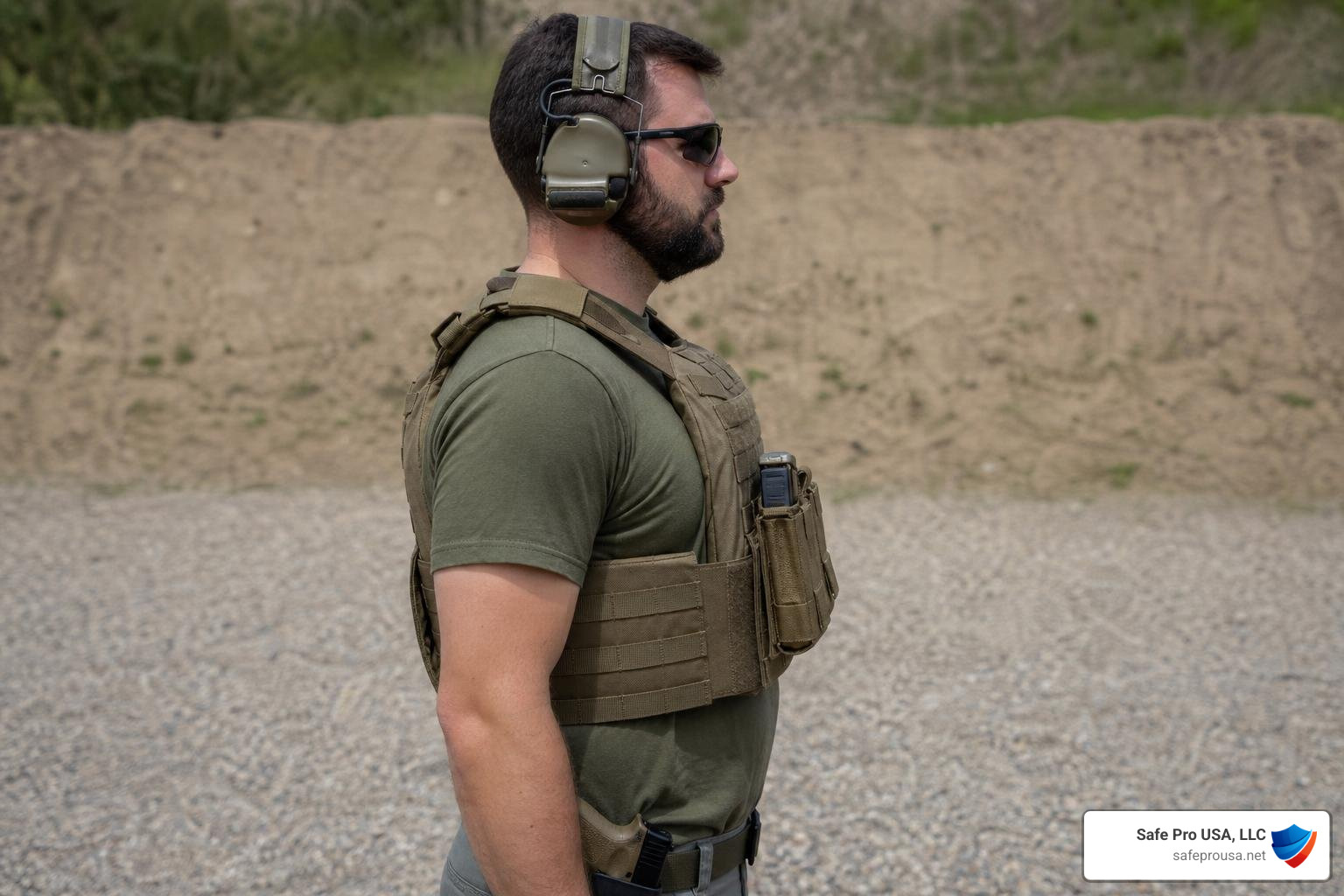
One of the most common mistakes people make is sizing their plate carrier to their clothing size. Your plate carrier size is determined by the size of your armor plates, not your t-shirt size.
To find your correct size, you must measure your torso to find the right plate dimensions.
-
Measure Plate Size: Measure the distance between your collarbones (specifically the suprasternal notch) down to about two inches above your belly button. Then, measure the distance between your nipples. These dimensions will tell you if you need a Small, Medium, Large, or Extra-Large SAPI plate.
-
Adjust the Ride Height: The front plate bag must sit high enough to protect your vital organs (heart, lungs, and surrounding major arteries). The top of the front plate should align exactly two fingers below your collarbone. If it sits too low, your heart is exposed; if it sits too high, it will choke you when you sit or bend over.
-
Adjust the Cummerbund: The cummerbund (the side straps that connect the front and back bags) should be adjusted so the carrier fits snugly against your chest. You should be able to take a deep breath without feeling restricted, but the carrier should not bounce or shift when you jump, run, or perform a burpee.
-
Test Your Mobility: Once adjusted, put on your carrier and practice mounting your rifle, reaching for your belt gear, and bending at the waist. A properly fitted mil spec armor plate carrier maximizes your protective coverage without sacrificing your ability to fight and move.
Frequently Asked Questions About Tactical Armor
Navigating tactical gear can be confusing. Here are the answers to some of the most common questions we receive about plate carriers and body armor.
Is it legal for civilians to own a mil spec armor plate carrier?
Yes. In the United States, it is completely legal for law-abiding citizens to purchase, own, and wear a mil spec armor plate carrier and ballistic plates. Body armor is legal in all 50 states, though there are a few important legal caveats:
-
Felon Restriction: Under federal law, it is illegal for anyone convicted of a violent felony to purchase or possess body armor.
-
State-Specific Regulations: Some states have unique restrictions. For example, certain states prohibit the purchase of body armor online, requiring face-to-face transactions, or restrict wearing body armor on school grounds or during the commission of a crime. Always check your local and state laws.
-
TSA and Air Travel: According to the TSA, body armor is generally allowed in both carry-on and checked baggage. However, the final decision always rests with the TSA officer at the security checkpoint. If you travel internationally, be aware of ITAR (International Traffic in Arms Regulations) restrictions, as exporting military-grade armor outside the US without a license is a serious federal offense.
How do you clean and maintain a military-grade carrier?
To maximize the lifespan of your carrier, proper maintenance is essential. Sweat, salt, mud, and UV rays can degrade nylon fibers over time if left uncleaned.
-
Remove the Plates: Never wash your carrier with the armor plates inside. Remove all hard plates, soft armor inserts, and electronic gear first.
-
Hand Wash Only: Do not throw your carrier into a washing machine or dryer—this can ruin the stitching, stretch out elastic components, and damage the hook-and-loop fields. Wash it in a tub or sink using cold water and a mild detergent (like baby shampoo or specialized gear wash).
-
Scrub Gently: Use a soft-bristled brush to gently scrub away stubborn dirt, mud, or salt stains.
-
Air Dry: Hang the carrier to dry in a well-ventilated indoor area or in the shade. Never dry your carrier in direct sunlight, as UV rays can rapidly break down nylon fibers and fade camouflage patterns.
-
Inspect Regularly: Every time you clean your gear, inspect the seams, bar-tacks, and buckles for signs of wear, fraying, or cracking. Replace damaged components immediately.
What are the advantages of advanced ceramic and composite armor plates?
While steel plates are often marketed as a budget-friendly option, modern tactical professionals almost universally prefer advanced ceramic and composite armor plates for several critical reasons:
-
Weight Distribution: Modern ceramic and composite plates (such as those utilizing lightweight UHMWPE) are significantly lighter than steel. For example, a high-end composite Level IV plate can weigh under 6 pounds, whereas an equivalent steel plate with spall coating can easily exceed 9 pounds. Reducing weight on your torso saves your spine, knees, and joints during long missions.
-
No Spall Hazard: When a high-velocity rifle round hits a ceramic plate, the ceramic strike face shatters the bullet, and the composite backing catches the fragments. When a bullet hits steel, it splashes outward (spalls), sending high-velocity copper and lead fragments into your neck, arms, and groin.
-
Multi-Hit Capability: High-quality modern composite plates are engineered to absorb multiple hits without shattering entirely, maintaining their structural integrity even in intense, dynamic threat environments.
Conclusion
When the dust settles, your gear is the only thing standing between you and a worst-case scenario. A genuine, American-made mil spec armor plate carrier is not a luxury—it is an absolute necessity for military personnel, law enforcement officers, and prepared citizens who refuse to compromise on their personal defense.
By choosing a carrier built to Berry Amendment standards with premium 500D Cordura, reinforced bar-tack stitching, and reliable hardware, you ensure your loadout is ready for whatever challenges lie ahead in June 2026 and beyond.
At Safe Pro USA, we are dedicated to protecting those who protect our communities and our country. Our high-performance, American-made tactical gear and ballistic armor are engineered to the highest military standards, providing elite operators with the ultimate combination of durability, comfort, and life-saving protection.
Equip yourself with the best in American craftsmanship and explore our complete line of American-Made Armor Plates today. Stay safe, stay prepared, and carry on.


