Why Civilians Are Turning to Military Gear for Personal Protection
Military gear for civilians has moved well beyond niche prepper culture — today it's a serious topic for anyone who wants to be prepared for emergencies, outdoor adventures, or personal protection.
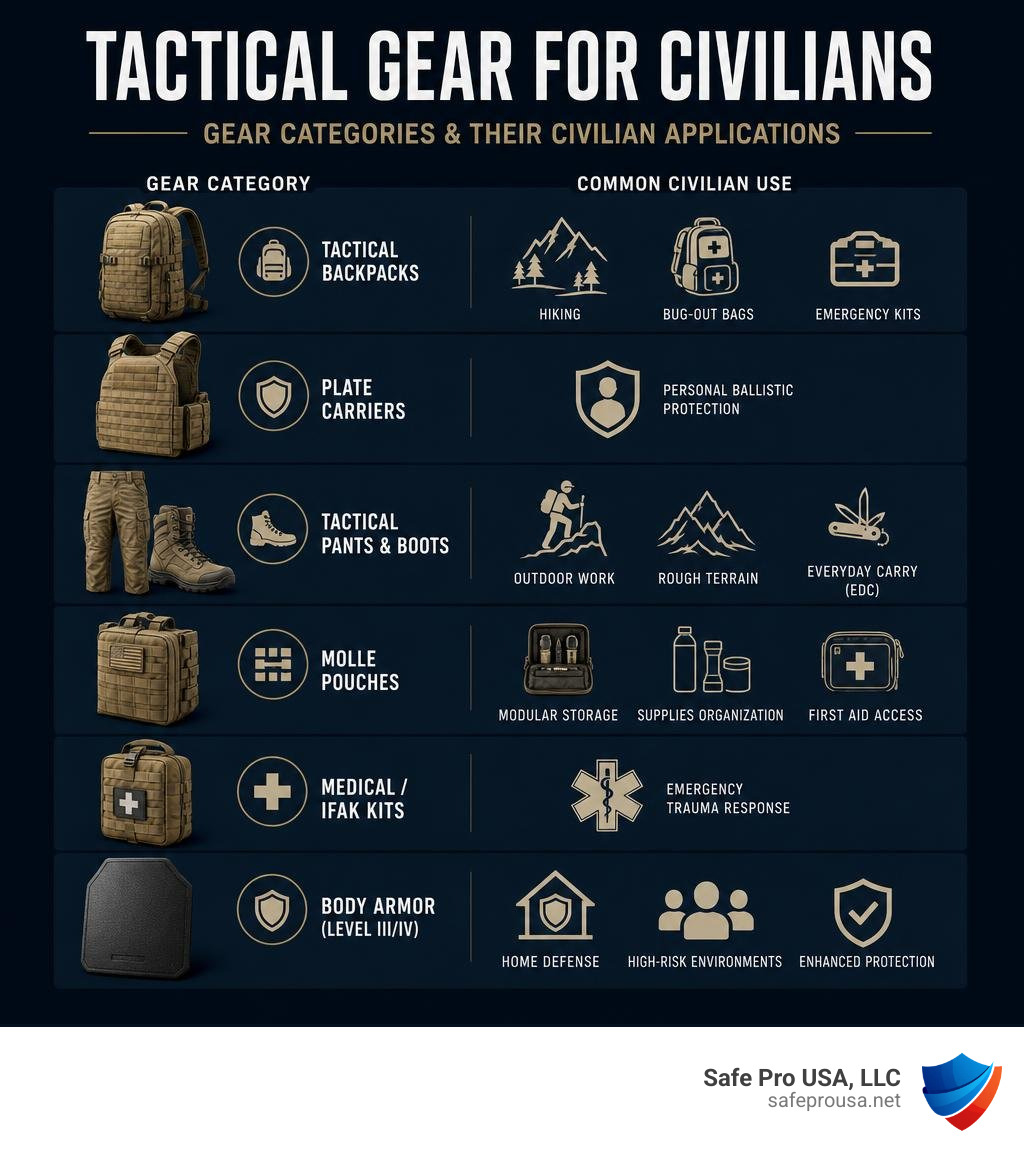
Here's a quick overview of the most common civilian tactical gear categories:
| Gear Category |
Common Civilian Use |
| Tactical backpacks |
Hiking, bug-out bags, emergency kits |
| Plate carriers |
Personal ballistic protection |
| Tactical pants & boots |
Outdoor work, rough terrain, EDC |
| MOLLE pouches |
Modular storage for supplies and first aid |
| Medical/IFAK kits |
Emergency trauma response |
| Body armor (Level III/IV) |
Home defense, high-risk environments |
The global tactical gear market is projected to reach $22.6 billion by 2027, driven in large part by civilians — not just military and law enforcement. Natural disasters, civil unrest, and a growing culture of self-reliance have pushed everyday people to ask: what gear do I actually need, and how do I use it?
This guide answers exactly that. Whether you're new to tactical equipment or looking to upgrade your loadout, you'll find clear, practical answers here.
Safe Pro USA brings more than 20 years of defense and protective equipment experience to the civilian tactical gear market, helping military, law enforcement, and everyday civilians find the right military gear for civilians — gear that actually performs when it matters most.
What is Tactical Gear and Why Do Civilians Need It?
At its core, tactical gear refers to clothing, footwear, and equipment designed to help professionals perform high-stakes tasks under extreme stress. Unlike standard consumer goods, tactical gear is built for survivability, efficiency, and heavy utility.
One of the defining features of this equipment is the MOLLE (Modular Lightweight Load-carrying Equipment) system. This heavy-duty webbing allows you to attach customized pouches, medical kits, and utility tools exactly where you need them.
But why are civilians buying it? The answer lies in durability and adaptability. If a backpack can survive an active-duty deployment in a desert, it will easily withstand a grueling multi-day mountain hike or years of duty as a family emergency "bug-out" bag.
For civilians, investing in military gear for civilians is about personal protection and disaster readiness. When a hurricane knocks out power for two weeks or civil unrest makes local supply chains unstable, having rugged, reliable gear can be the difference between thriving and struggling.
Tactical Gear vs. Standard Outdoor Equipment
While high-end camping gear is excellent for recreation, it is designed with different priorities in mind. Outdoor gear focuses heavily on weight reduction, which often means using thinner materials that can tear under extreme stress. Tactical gear, on the other hand, prioritizes absolute structural integrity.
| Feature |
Tactical Gear |
Standard Outdoor Equipment |
| Primary Material |
Heavy-duty Cordura nylon (500D to 1000D) |
Lightweight ripstop nylon or polyester |
| Modularity |
High (MOLLE webbing, hook-and-loop panels) |
Low (Fixed pockets, zippered compartments) |
| Color Schemes |
Earth tones, solid neutrals, camouflage |
Bright, highly visible safety colors |
| Durability |
High impact, abrasion, and tear resistance |
Moderate tear resistance, focused on weight |
| Load Bearing |
Reinforced frames, thick padded shoulder straps |
Light, flexible internal frames |
The Rise of Military Gear for Civilians in Everyday Preparedness
The civilian tactical market is experiencing unprecedented growth. Statistically, the U.S. tactical apparel and gear market for civilians is projected to expand at a Compound Annual Growth Rate (CAGR) of 6.5% through 2028. This surge is fueled by a mix of outdoor enthusiasts, homesteaders, and everyday citizens who want to take their family's safety into their own hands.
Over 300,000 police, military, and civilian users have adopted advanced tactical comfort solutions like specialized ventilation vests in recent years. This proves that civilian users are no longer just buying basic surplus items; they are actively seeking out professional-grade, high-performance equipment.
At Safe Pro USA, we believe that civilians deserve the exact same level of protection as active-duty soldiers. Our mission is to provide honest, American-made ballistic protection that bridges the gap between professional-grade security and civilian accessibility. You can explore our mission and design philosophy directly at Safe Pro USA Tactical Gear.
Essential Military Gear for Civilians: Clothing, Packs, and Armor

Building a tactical loadout requires balancing three critical elements: functionality, comfort, and discretion. If your gear is too heavy, you won't wear it. If it looks too aggressive, you will draw unwanted attention in a public emergency. The goal is to build a modular system that works for your specific environment.
Tactical Clothing: Pants, Boots, and Outerwear
Your clothing is your first line of defense against the elements. Tactical apparel is engineered to allow a full range of motion while protecting your skin from abrasions, punctures, and extreme weather.
-
Tactical Pants: Unlike standard denim jeans, tactical pants are constructed from lightweight, tear-resistant ripstop fabrics. They feature reinforced seat and knee areas (often with pockets for removable neoprene knee pads), a high waistline to support heavy duty belts, and specialized pockets designed to carry everything from spare magazines to pocket knives without sagging.
-
Tactical Boots: Footwear must provide ankle stability, slip resistance, and puncture protection. Look for boots with composite or steel shanks, waterproof membranes, and deep rubber lugs for traction on wet or uneven terrain.
-
The Layering System (ECWCS): Inspired by the military's Extended Cold Weather Clothing System, effective tactical outerwear relies on layering. Combine a moisture-wicking base layer with an insulating mid-layer (like a fleece or softshell) and a windproof, waterproof outer shell. This allows you to adapt instantly to changing weather conditions.
Tactical Backpacks, Pouches, and Load-Bearing Carriers
A tactical backpack is the foundation of any civilian preparedness kit. When choosing a pack, look for thick, padded shoulder straps, a heavy-duty waist belt to distribute weight to your hips, and a dedicated compartment for a hydration bladder.
For those looking for highly specialized, progressive designs tailored specifically for non-military environments, brands like Civilian Progressive Packs, Bags and Gear US - Military 1st offer excellent modular configurations. These include chest packs and shoulder holster bags that blend seamlessly into urban settings.
By utilizing MOLLE-compatible pouches, you can customize your backpack or chest rig to hold survival equipment, navigation tools, and communication devices without cluttering the main compartment of your bag.
Choosing Plate Carriers, Holsters, and Mag Pouches
If your preparedness goals include personal defense, selecting the right ballistic protection is paramount.
-
Plate Carriers: A plate carrier is a load-bearing vest designed to hold ballistic armor plates. Look for carriers made of 500D or 1000D Nylon with robust bar-tack reinforcement at stress points. High-quality carriers, like those featured on Tactical Gear | Tactical Equipment and Plate Carrer Vests, offer quick-detach systems that allow you to shed the vest rapidly in an emergency.
-
Armor Plate Levels:
-
Level III+ / III++: These plates are typically made of steel alloy or ultra-high-molecular-weight polyethylene (UHMWPE). They are designed to stop common rifle rounds like 5.56mm M193 and 7.62x51mm NATO M80 ball.
-
Level IV: Built from ceramic/composite materials, Level IV plates offer the maximum level of protection, designed to stop armor-piercing rifle rounds (such as .30-06 M2 AP).
-
Holsters and Mag Pouches: Ensure your holsters feature active retention to keep your sidearm secure during physical movement. Multi-caliber mag pouches are highly recommended for civilians, as they can adapt to hold different magazine sizes depending on the platform you are running.
For a comprehensive selection of tactical apparel and accessories, you can browse trusted retailers like Tactical Gear Superstore | TacticalGear.com. To find premium, American-made ballistic plates and carriers engineered to the highest standards, check out Safe Pro USA Ballistic Protection.
Tactical Preparedness: Medical Kits and Thermal Comfort

You are far more likely to use a first aid kit than a firearm. No tactical setup is complete without a dedicated Individual First Aid Kit (IFAK) designed to treat severe trauma.
Your IFAK should be mounted in an easily accessible location on your pack or plate carrier and should contain:
-
Coaptive Tourniquets (e.g., CAT Gen 7): To stop life-threatening arterial bleeding in limbs.
-
Chest Seals: To treat open chest wounds (sucking chest wounds).
-
Hemostatic Gauze: To accelerate blood clotting in deep wounds.
-
Pressure Bandages: To keep constant pressure on severe lacerations.
Thermal Management and Body Armor Comfort
One of the biggest complaints from body armor users is heat buildup. Wearing heavy ballistic plates against your chest and back traps body heat, leading to rapid dehydration, fatigue, and severe discomfort.
To combat this, modern tactical gear incorporates advanced thermal management systems. Airflow liners and ventilation vests utilize patented 3D honeycomb structures to create a physical gap between your body and the plate carrier. This gap allows trapped heat and perspiration to escape while drawing in cooler ambient air. Investing in quality ventilation panels makes wearing protective gear highly bearable, even during extended physical exertion or high-temperature scenarios.
Legal and Practical Considerations for Civilian Tactical Gear
While owning tactical gear is highly beneficial, civilians must navigate a complex web of legal and practical realities.
Legal Restrictions and Export Controls
In the United States, body armor is legal to purchase and own for law-abiding citizens in the vast majority of states. However, there are crucial exceptions:
-
State-Specific Bans: States like New York and Connecticut have strict bans on the civilian purchase and sale of body armor. In Connecticut, for example, purchases must be conducted in a face-to-face transaction rather than shipped online.
-
Felon Prohibitions: Under federal law, it is a felony for individuals convicted of a violent crime to own or possess body armor.
-
Export Controls (ITAR & EAR): High-level tactical equipment, particularly Level IV armor plates and advanced night vision devices, are strictly controlled under the International Traffic in Arms Regulations (ITAR) and Export Administration Regulations (EAR). Attempting to take these items out of the United States without explicit government authorization is a serious federal offense.
The "Gray Man" Concept
When selecting gear, it is highly recommended to balance functionality with discretion. Walking down a suburban street during a power outage clad in full multicam camouflage, a military helmet, and an exposed plate carrier will make you stand out. You may be perceived as a threat by law enforcement or as a high-value target by bad actors.
This has led to the rise of the "Gray Man" philosophy. The goal is to blend in completely with your surroundings while maintaining full tactical capability.
- Choose solid, neutral colors like charcoal gray, navy blue, coyote brown, or olive drab instead of military camouflage.
- Opt for low-profile backpacks that hide their MOLLE webbing under clean fabric flaps.
- Wear tactical pants that feature internal pockets rather than bulky, external cargo pouches.
Frequently Asked Questions About Tactical Gear
Is it legal for civilians to own body armor and military gear?
Yes, in most of the United States, it is entirely legal for law-abiding citizens to purchase and own body armor, plate carriers, and military surplus gear. However, New York and Connecticut heavily restrict civilian sales, and convicted felons are prohibited by federal law from owning body armor. Always check your local and state regulations before purchasing.
How does military gear for civilians differ from active-duty military issue?
While active-duty military gear is built to strict military specifications (mil-spec) to survive combat deployments, civilian-targeted gear often focuses on optimized weight, improved comfort, and more discreet aesthetics. Active-duty gear is typically issued in camouflage patterns, whereas civilian tactical gear is widely available in solid, neutral colors to facilitate low-profile carrying.
What is the most essential piece of tactical gear for a civilian beginner?
We always recommend starting with a high-quality, modular tactical backpack and a fully stocked Individual First Aid Kit (IFAK). These items provide immediate, practical utility for everyday emergencies, hiking, and travel without the legal complexities or weight of ballistic armor.
Conclusion
Investing in military gear for civilians is a powerful step toward securing your family's safety and building personal self-reliance. From rugged tactical clothing and modular backpacks to life-saving medical kits and ballistic plate carriers, having professional-grade equipment ensures you are ready for whatever the future holds.
At Safe Pro USA, LLC, we are committed to providing you with the highest-performing, American-made ballistic protection on the market. As a subsidiary of Safe Pro Group, we bring honest materials, clean designs, and military-grade durability directly to responsible citizens.
To stay informed on the latest trends in tactical preparedness, equipment care, and defense technology, explore our regular updates at Safe Pro USA News. Protect what matters most with gear you can trust.


