The Best Plate Carriers Compared: Top Picks for Tactical Professionals
If you need a quick answer, here are the top plate carrier configurations by use case:
| Use Case |
Recommended Style |
Key Strength |
| Best Overall |
Lightweight Modular |
High mobility, mission-adaptable |
| Best Minimalist |
Ultra-Low Profile |
Concealable, extremely lightweight (~0.8 lbs) |
| Best Heavy-Duty |
Structured Load-Bearing |
Maximum load capacity, weight distribution |
| Most Versatile |
Fully Modular System |
Scalable from low-vis to direct action |
| Best Low-Vis |
Slick / Concealable |
Disappears under civilian clothing |
| Best for Patrol |
Standard Assault Carrier |
Balanced protection, quick-donning |
Plate carriers have gone from strictly military issue to a go-to choice for law enforcement, security professionals, and serious tactical operators across the country. And with good reason — the global body armor market was valued at $2.1 billion in 2023 and is growing fast, driven by real demand for real protection.
But with dozens of options on the market, picking the right one isn't simple. Weight, materials, plate compatibility, quick-release systems, and intended use all matter — and the wrong choice can cost you mobility, comfort, or worse.
This guide cuts through the noise. It compares the top configurations side by side so readers can make a fast, confident decision.
Safe Pro USA brings field-informed experience to the plate carrier category, serving law enforcement, security professionals, and tactical operators with protective equipment built for real-world performance. Its perspective is shaped by decades of defense and protective equipment experience, practical gear evaluation, and a focus on what actually performs when protection, mobility, and durability matter.
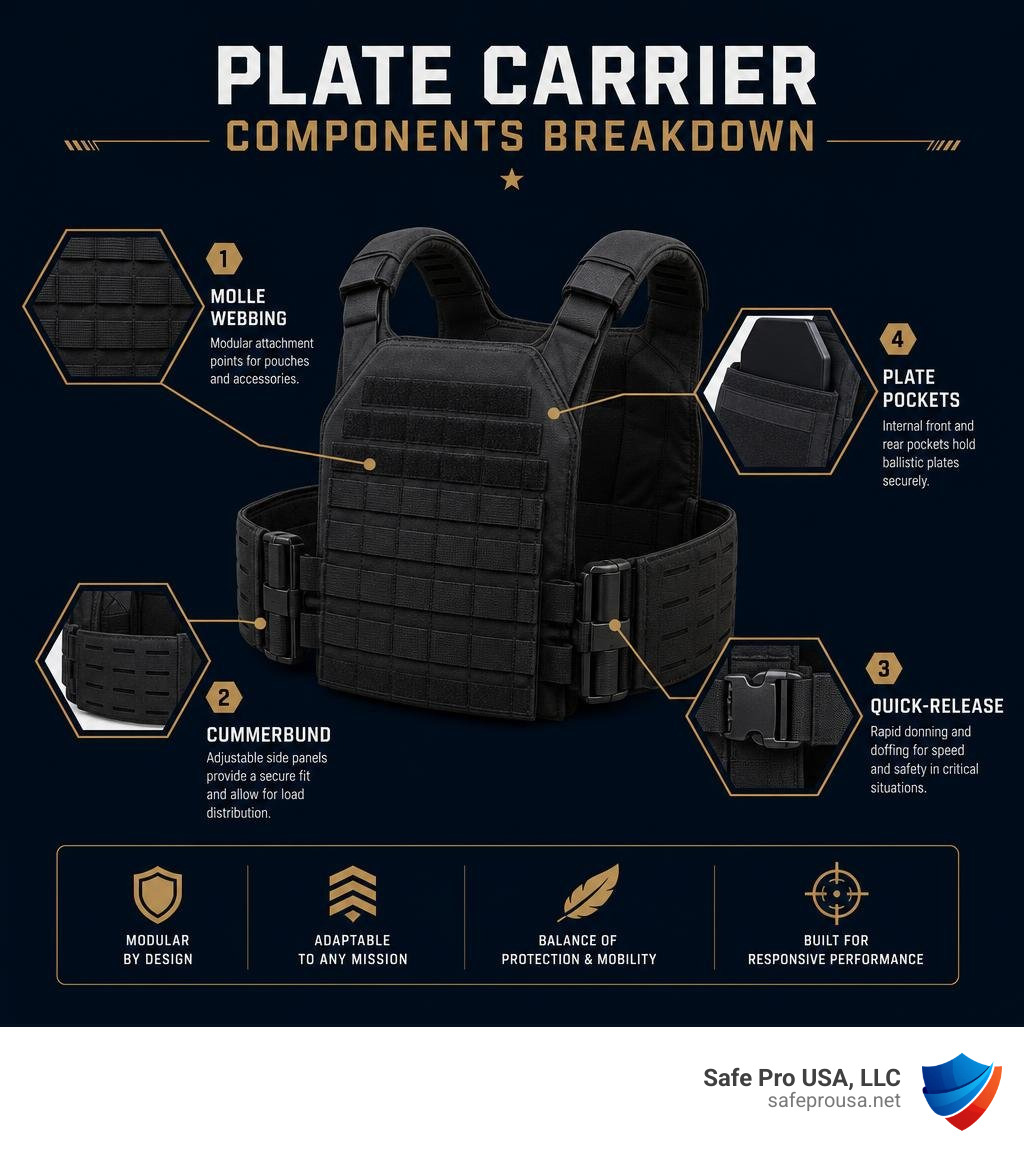
What Are Plate Carriers and How Do They Differ From Bulletproof Vests?
To understand why plate carriers have become the industry standard for tactical operations, it helps to look at how they differ from traditional soft armor bulletproof vests.
Traditional bulletproof vests are typically constructed with soft armor panels made of woven aramid fibers (like Kevlar) or ultra-high-molecular-weight polyethylene (UHMWPE). These vests are designed to wrap entirely around your torso, providing comprehensive coverage against handgun threats up to Level IIIA. They are highly flexible and excel at daily, low-profile patrol use, but they have a major limitation: they cannot stop rifle rounds.
This is where plate carriers come in. A plate carrier is a highly durable fabric vest specifically engineered to hold heavy, rigid hard armor plates made of ceramic, steel, or advanced composite materials. When outfitted with NIJ-certified Level III or Level IV plates, these systems are capable of stopping high-velocity rifle rounds up to 7.62x51mm NATO and 30-06 Springfield armor-piercing threats.
Beyond ballistic protection, plate carriers offer superior weight savings and modularity. Instead of trapping heat with a full wrap of heavy soft material, modern carriers focus protection over your vital organs (heart and lungs) to maximize mobility. They also feature robust mounting systems like MOLLE webbing, allowing you to scale your loadout with ammunition pouches, medical kits, and communication gear.
For those looking to explore high-quality options, Safe Pro USA Tactical Gear provides American-made, mil-spec equipment designed to handle these extreme demands without sacrificing comfort.
Choosing the Right Armor Carrier for Your Mission
Selecting the perfect setup requires analyzing your specific mission requirements. You must strike a careful balance between load carriage, protection levels, and your operational environment. If you buy a heavy-duty, fully padded tactical vest for a low-profile surveillance detail, you will end up hot, bulky, and highly conspicuous. Conversely, taking an ultra-minimalist carrier into an extended rural patrol with zero mounting space for water or extra ammunition is a recipe for disaster.
Modern tactical gear generally falls into a few distinct categories to match these varying demands. Let's look at how they break down.
Minimalist and Low-Vis Plate Carriers for Concealment
Minimalist and low-vis carriers are built for covert operations, vehicle patrols, and rapid-response situations where speed and concealment are paramount.

These carriers strip away all unnecessary bulk. They typically feature slick front and rear plate bags, elastic cummerbunds with built-in magazine slots, and low-profile shoulder straps that lie flat against your body. Weighing as little as 0.8 pounds without plates, these platforms are designed to disappear under a loose jacket or button-down shirt.
While they offer incredible mobility and comfort, their load-carrying capacity is limited. They are ideal for holding just your front and back armor plates, a couple of spare magazines, and a compact medical kit. If you need a low-profile solution that keeps you fast on your feet, Safe Pro USA Concealable Armor offers streamlined designs engineered for maximum discretion and protection.
Heavy-Duty and Full-Size Plate Carriers for Duty Use
When your mission dictates an overt, high-threat response—such as SWAT operations, active shooter response, or extended military patrols—you need a heavy-duty, full-size plate carrier.
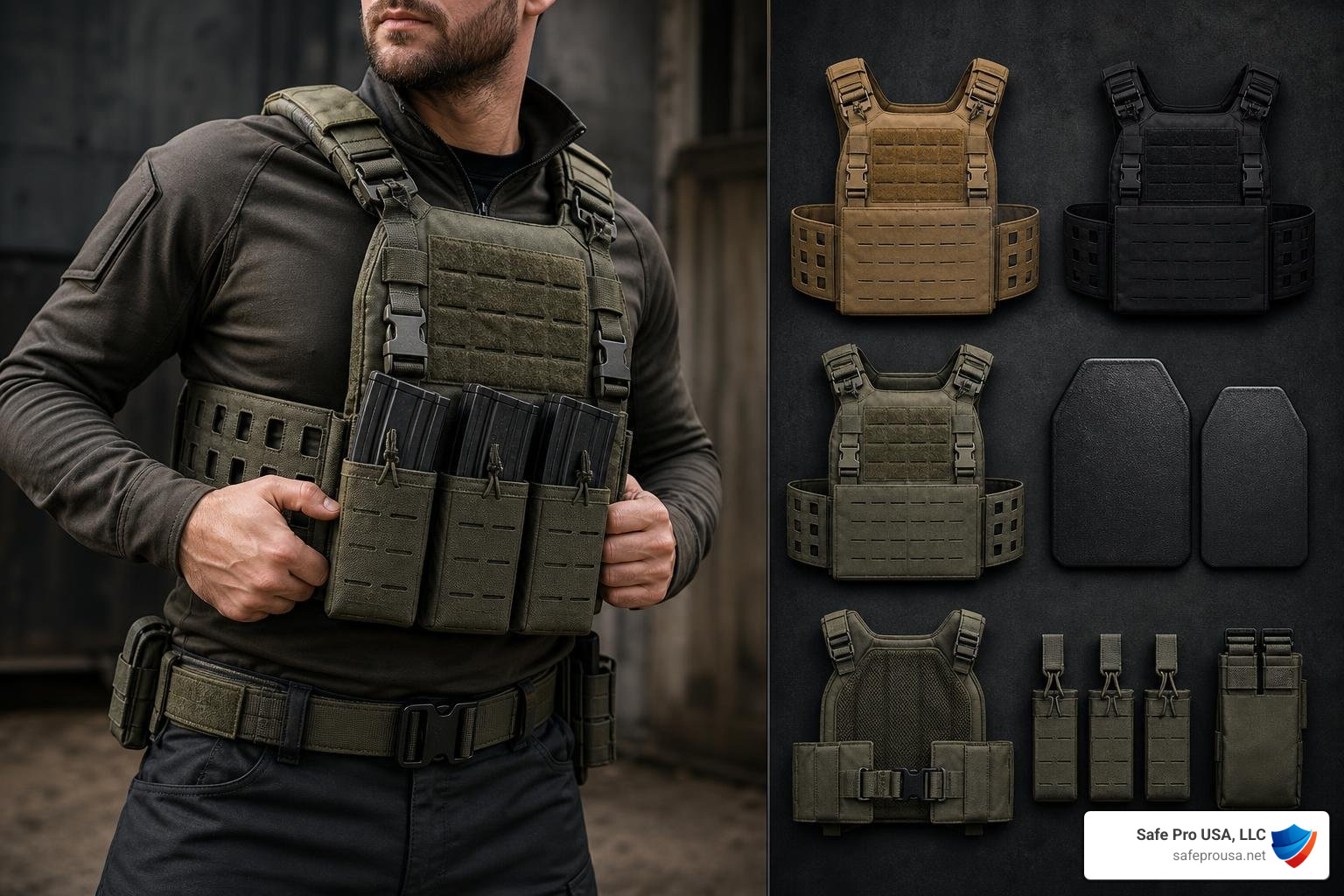
These carriers are built to distribute heavy loads across your shoulders and hips. They feature robust, padded shoulder straps, ventilated interior mesh liners to prevent heat rash, and structured cummerbunds that can support side armor plates, radios, and heavy breaching tools. With extensive laser-cut or traditional MOLLE webbing, these systems allow you to fully customize your gear layout.
While they are naturally heavier and bulkier than minimalist alternatives, their load-bearing capability ensures you have all mission-essential gear within arm's reach. For those who require rugged, battle-tested durability, Safe Pro USA Plate Carriers deliver the uncompromising quality and structural integrity needed for high-risk duty wear.
Key Features to Evaluate Before Buying
When evaluating different plate carriers, it is easy to get distracted by aesthetic designs or marketing buzzwords. To find a carrier that will truly perform under pressure, you need to look closely at the materials, construction methods, and hardware.
| Feature |
What to Look For |
Why It Matters |
| Base Material |
500D to 1000D CORDURA® Nylon |
Balances lightweight flexibility with extreme abrasion resistance. |
| Cummerbund |
Structural or Elastic with Quick-Release |
Distributes weight around the torso; allows rapid donning and doffing. |
| Fasteners |
Quick-Release Tubes or ROC Buckles |
Eliminates loud hook-and-loop noise; enables emergency egress. |
| Interior Lining |
3D Spacer Mesh or Ventilation Channels |
Promotes airflow, reduces hot spots, and cushions the load. |
Let's break down these critical components in more detail:
-
Materials: Look for high-performance fabrics like 500D CORDURA® nylon, which offers the perfect sweet spot between weight savings and rugged durability. Some heavy-duty carriers use 1000D nylon for maximum tear resistance, while ultra-lightweight models utilize proprietary laminated materials.
-
Cummerbund Systems: The cummerbund holds the carrier tight to your body. Elastic cummerbunds are excellent for low-vis use because they hug your torso and expand as you breathe. Structural cummerbunds, often reinforced with thermoplastic materials, are necessary for carrying heavy side loads without sagging.
-
Quick-Release Systems: In an emergency—such as falling into deep water or needing immediate medical attention—you must be able to shed your carrier instantly. Modern carriers feature quick-detach buckles (like specialized tubes or ROC buckles) on the shoulders and cummerbund, replacing loud, wear-prone Velcro.
-
Padding and Ventilation: Padded shoulder straps with integrated cable/hydration routing loops prevent the carrier from digging into your neck. Interior 3D spacer mesh or specialized cooling liners (such as advanced thermal management systems) help manage heat during extended operations in hot climates.
Frequently Asked Questions about Body Armor
Navigating tactical gear can be confusing, especially with the wide variety of sizing standards and legal guidelines. Here are answers to the most common questions buyers face.
How do you properly size and fit armor plates?
A common mistake is sizing a plate carrier to fit your clothing size (e.g., buying a Large carrier because you wear a Large t-shirt). In reality, your plate carrier size is determined entirely by the size of your ballistic plates.
To find your correct plate size, measure your torso from nipple to nipple (width) and from the top of your sternum to approximately one to two inches above your belly button (height) while sitting down. Your armor plates should cover your vital organs without restricting your movement.
Once you have your plate dimensions, match them to standard SAPI sizes:
-
Small: 8.75” x 11.75”
-
Medium: 9.5” x 12.5”
-
Large: 10.25” x 13.25”
-
Extra Large: 11” x 14”
Your plate carrier should fit snugly against your body. The front plate should sit high enough to cover your sternal notch, and the rear plate should be level with the front to protect your spine and lungs.
What are the legal restrictions on owning body armor?
In the United States, body armor is federally legal for law-abiding adults (18 years and older) to purchase and own. However, there are a few important legal caveats:
-
Felony Convictions: Under federal law, it is illegal for anyone convicted of a violent felony to purchase or possess body armor.
-
State-Specific Restrictions: While legal in most states, certain jurisdictions have unique rules. For example, New York and Connecticut restrict the online sale and shipment of body armor directly to civilians, requiring face-to-face transactions or verification of specific professional roles (such as law enforcement or first responders).
-
TSA and Airline Travel: According to the TSA, you are legally allowed to bring plate carriers and ballistic plates in either your carry-on or checked baggage when traveling domestically. However, the final decision always rests with the TSA officer on duty. If you are traveling internationally, always verify the local laws of your destination country, as some nations strictly regulate military-grade gear.
How should tactical nylon gear be cleaned and stored?
Tactical nylon is incredibly tough, but sweat, dirt, and salt from your body can break down the fibers and stitching over time if left uncleaned.
To clean your plate carrier, follow these steps:
-
Remove all ballistic plates and soft armor panels. Never machine wash or submerge ballistic inserts.
- Remove all attached pouches and accessories.
- Pre-treat heavy mud or sweat stains using a soft-bristled brush and mild soap.
- Hand wash the nylon carrier in lukewarm water with a gentle, non-bleach detergent.
- Rinse the carrier thoroughly with clean water to remove all soap residue.
- Hang the carrier to air-dry completely in a well-ventilated indoor space. Never put your carrier in a commercial dryer or leave it in direct sunlight to dry, as UV rays can degrade the fabric.
For storage, lay your carrier flat or hang it on a heavy-duty, wide-hanger designed to support tactical gear. Keep it in a cool, dry place away from direct sunlight and extreme temperatures (avoid leaving it in a hot car trunk for weeks on end).
Conclusion
Whether you are a patrol officer looking for a reliable daily duty setup, a tactical professional preparing for high-risk operations, or a prepared citizen focusing on home defense, choosing the right plate carrier is a decision that directly impacts your safety and performance. By matching your carrier to your specific mission profile and ensuring a perfect plate fit, you can operate with absolute confidence.
At Safe Pro USA, we are dedicated to providing tactical professionals with the highest caliber of protective equipment. As a proud subsidiary of the Nasdaq-listed Safe Pro Group (SPAI), we manufacture high-performance, American-made ballistic protection gear built to uncompromising mil-spec standards. Our clean designs, honest materials, and focus on real-world durability ensure that your gear will perform flawlessly when it matters most.
To stay informed on the latest tactical gear releases, ballistic technology advancements, and industry insights, be sure to check out the Safe Pro USA News blog.


