Why Body Armor Steel Plates Are Still a Top Choice for Tactical Professionals
Body armor steel plates remain one of the most proven, affordable, and durable options for rifle-rated ballistic protection available today. Here's a quick breakdown of what you need to know:
Top Steel Plate Options at a Glance:
| Feature |
What to Expect |
| Protection Level |
NIJ Level III, III+, or III++ |
| Common Sizes |
10x12" and 11x14" |
| Weight Range |
5.5 lbs to 11 lbs per plate |
| Shelf Life |
Up to 20-25 years |
| Key Advantage |
Multi-hit capability without shattering |
| Main Trade-off |
Heavier than ceramic or polyethylene |
| Civilian Legal? |
Yes, except New York and Connecticut |
Steel plates have been trusted by law enforcement, military personnel, and prepared civilians for decades. While newer materials like ceramic and polyethylene have gained ground, steel still holds a strong place in the market — especially for buyers who prioritize durability, cost-effectiveness, and multi-hit performance over raw weight savings.
I'm Michael Wratten, Vice President of Marketing & Sales at Safe Pro USA, and with over 20 years in the defense and protective equipment industry, body armor steel plates are a category I know inside and out. In this guide, I'll walk you through everything you need to make a confident, informed purchase.
Understanding the Ballistic Performance of Body Armor Steel Plates
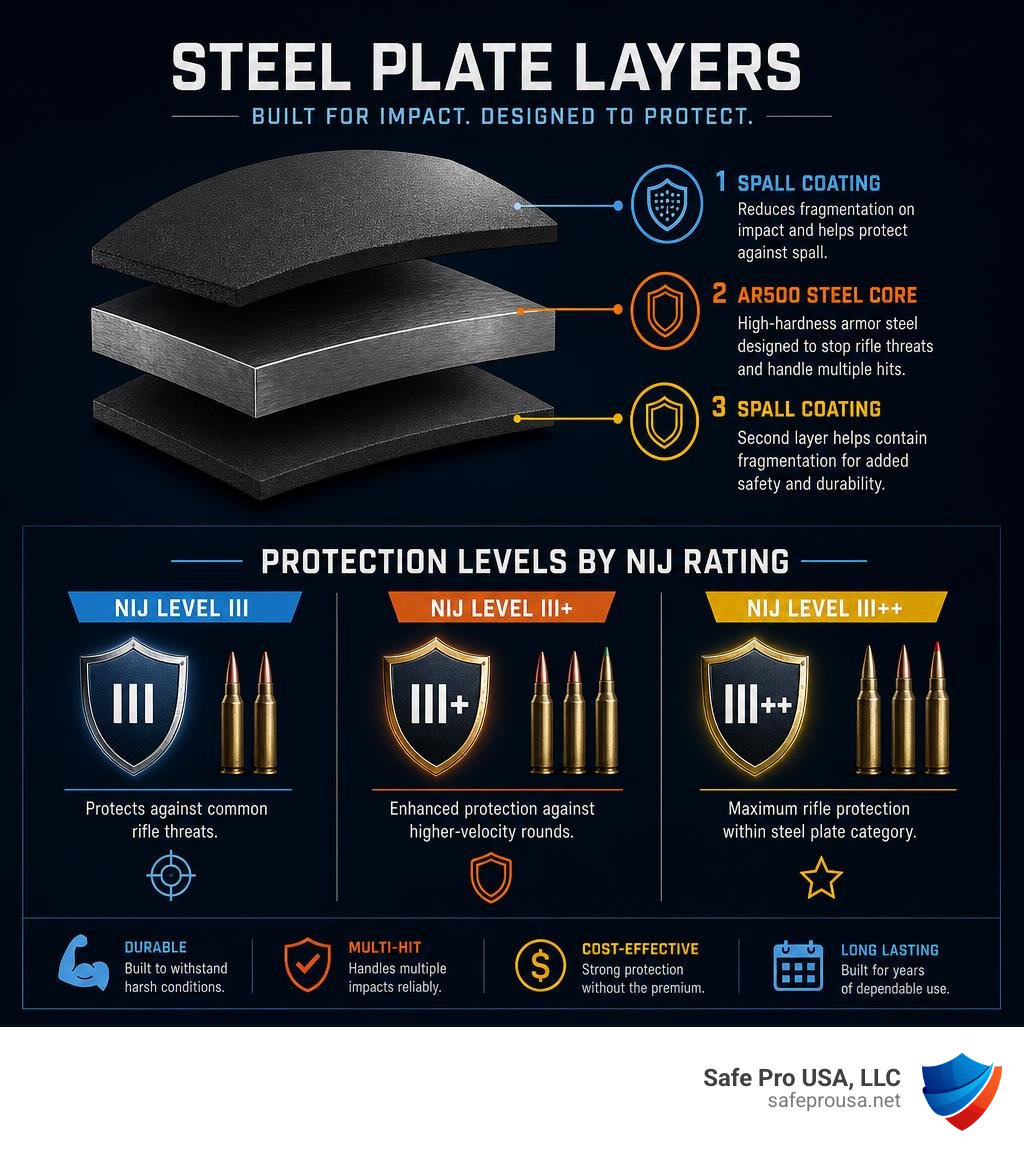
To understand why steel remains a viable option in 2026, we have to look at the metallurgy. Modern ballistic steel plates are not made from standard structural steel. Instead, they are constructed from specialized, high-hardness alloy steels, typically categorized by their Brinell Hardness Number (BHN).

The most common ballistic steels used in armor manufacturing are:
-
AR500 Steel (approx. 500 BHN): The traditional baseline for steel armor. It is highly reliable, cost-effective, and rated to stop standard rifle threats like 7.62x51mm M80 Ball at standard velocities.
-
AR550 Steel (approx. 550 BHN): A harder alloy designed specifically to defeat higher-velocity threats. The increased hardness helps shatter penetrators on impact, making it highly effective against high-velocity 5.56mm rounds (like XM193 and M855 Green Tip) up to 3,100 feet per second (FPS).
-
AR600 Steel (approx. 600 BHN): An ultra-hard steel alloy, often blended with trace elements like titanium. This extreme hardness allows manufacturers to make the plates thinner and lighter while maintaining exceptional multi-hit protection against advanced special threats.
When a high-velocity rifle bullet strikes a hard steel target, the kinetic energy is transferred instantly. Because the steel is harder than the lead and copper of the bullet, the projectile is forced to deform and break apart.
To explore the wider world of ballistic materials, check out our comprehensive guide on High-Quality Steel Body Armor.
Key Advantages of Body Armor Steel Plates
There are several reasons why tactical professionals and citizens continue to choose body armor steel plates over composite alternatives:
-
Extreme Multi-Hit Capability: Unlike ceramic plates, which fracture and lose integrity after a few closely spaced impacts, steel can take dozens of rounds in the same general area without failing. It does not shatter, crack, or delaminate.
-
Unmatched Durability and Drop Resistance: You can drop a steel plate on concrete, throw it in the trunk of a patrol car, or run it over with a truck, and its ballistic integrity remains completely unchanged. It requires zero delicate handling.
-
Incredible Shelf Life: While ceramic and polyethylene plates typically carry a 5-to-10-year warranty due to the potential degradation of adhesives and composite backing materials over time, steel plates protected by a quality coating easily boast a maintenance-free shelf life of 20 to 25 years.
-
Ultra-Thin Profile: Steel plates are incredibly thin, often measuring between 0.25 and 0.35 inches thick (excluding the spall coating). This low profile makes them excellent for low-visibility operations or tight plate carrier setups.
To compare how these benefits stack up against other armor types, take a look at our breakdown of Body Armor options.
Disadvantages and Mitigation Strategies
While steel is incredibly tough, it does have two major drawbacks that buyers must consider: weight and the risk of spall/fragmentation. Fortunately, modern manufacturing has developed highly effective ways to mitigate these issues.
The Weight Factor
There is no getting around the laws of physics: steel is heavy. A standard 10x12-inch steel plate can weigh anywhere from 8 to 10 pounds. Carrying 16 to 20 pounds of armor in a plate carrier requires physical conditioning. To mitigate this, modern alloy blends (such as titanium-steel alloys) allow for thinner profiles that drop the weight of a standard plate down to a more manageable 5.5 to 6.5 pounds while maintaining Level III+ protection.
The Spall and Fragmentation Risk
When a bullet strikes a steel plate, it does not penetrate; instead, it splashes. The bullet disintegrates, sending high-velocity copper and lead fragments outward along the face of the plate at a 90-degree angle. If unmitigated, these fragments can strike the wearer's neck, jaw, arms, or groin.
To solve this, reputable manufacturers apply a thick, specialized polyurea coating (often referred to as an anti-fragmentation or spall build-up coating). This elastomeric coating acts as a containment envelope. When the bullet impacts the steel and fragments, the elastic properties of the polyurea stretch and trap the high-velocity debris, keeping it safely contained within the coating and away from your body.
Steel vs. Ceramic and Polyethylene Plates
When choosing armor, you are always balancing three variables: weight, cost, and protection level. Steel, ceramic, and ultra-high-molecular-weight polyethylene (UHMWPE) each have their own distinct strengths.
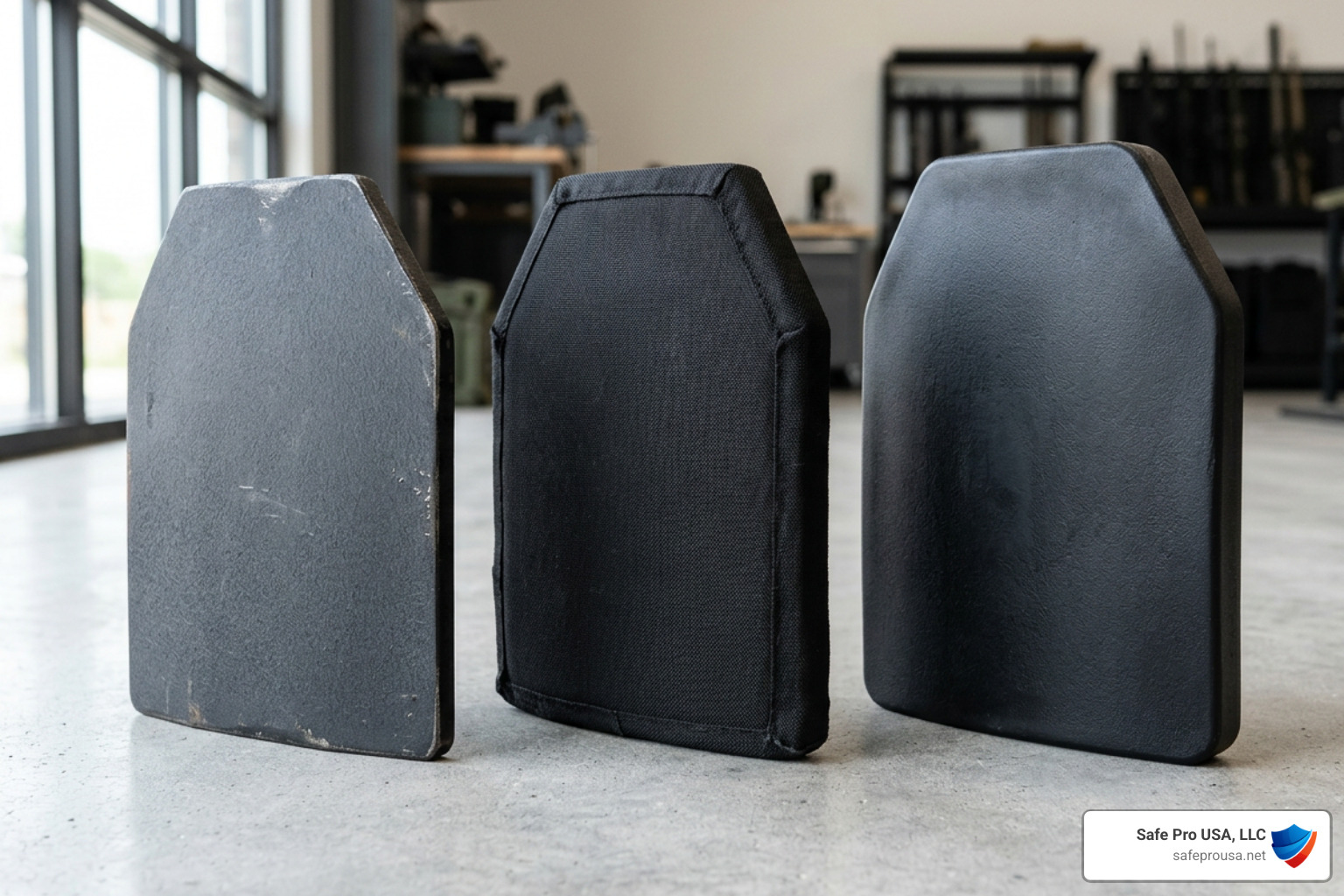
Here is a direct comparison to help you understand the trade-offs:
| Feature |
Steel Plates |
Ceramic Plates |
Polyethylene (UHMWPE) |
| Weight |
Heavy (5.5 - 11 lbs) |
Moderate (4.5 - 8 lbs) |
Extremely Light (2.0 - 4.5 lbs) |
| Thickness |
Very Thin (0.25" - 0.5") |
Thick (0.75" - 1.2") |
Very Thick (1.0" - 1.3") |
| Multi-Hit |
Excellent (Virtually unlimited) |
Limited (1 to 3 closely spaced hits) |
Good (Stops multiple non-AP rounds) |
| Durability |
Indestructible |
Fragile (Can crack if dropped) |
Durable (Sensitive to extreme heat) |
| Shelf Life |
20 - 25 Years |
5 - 10 Years |
5 - 10 Years |
| Cost |
Budget-Friendly |
Moderate to Expensive |
Expensive |
| AP Protection |
Poor (Unless extremely heavy) |
Excellent (Stops Level IV AP rounds) |
None (Cannot stop steel penetrators) |
-
Steel is the king of budget, durability, and shelf life, but it demands that you carry the extra weight.
-
Ceramic is the go-to for stopping armor-piercing (AP) rounds at a moderate weight, but it must be handled with care to avoid internal cracking.
-
Polyethylene is incredibly light and floats in water, but it is bulky, expensive, and cannot stop common steel-core threats like M855 "Green Tip" rounds.
For a deeper dive into these materials, read our full article on Armor Plates.
NIJ Protection Levels and Threat Ratings
The National Institute of Justice (NIJ) sets the standard for ballistic resistance in the United States. When shopping for body armor steel plates, you will typically see three ratings: Level III, Level III+ (an unofficial but widely accepted industry standard), and Level IV.
NIJ Level III
To achieve a certified Level III rating under NIJ Standard 0101.06, a plate must stop six impacts of 7.62x51mm NATO M80 Ball (.308 Winchester) at a velocity of approximately 2,780 FPS. Standard AR500 steel plates easily meet this requirement.
NIJ Level III+ (Special Threat Rated)
While Level III plates stop heavy, slower-moving .308 rounds, high-velocity 5.56mm rounds (like the M193 at 3,200 FPS or the M855 Green Tip with its mild steel penetrator) can sometimes slip through standard Level III steel due to the sheer heat and speed of the impact.
To bridge this gap, manufacturers created the "Level III+" designation. These plates are typically made of harder AR550 or AR600 steel and are special-threat tested to defeat:
- 5.56x45mm M193 at velocities up to 3,250 FPS
- 5.56x45mm M855 (SS109) Green Tip at velocities up to 3,100 FPS
- 7.62x39mm (AK-47) mild steel core rounds
Level III++ (Advanced Alloy)
Some premium alloy plates on the market blend steel with titanium to create a Level III++ rating. These ultra-tough plates are tested to defeat highly aggressive, modern military rounds like the M80A1 Enhanced Performance Round (EPR) at 2,800 FPS, which easily punches through standard composite armor systems.
NIJ Level IV
Level IV is the highest NIJ rating, designed to stop a single hit from a .30-06 Springfield M2 Armor Piercing (AP) round at 2,880 FPS. Because steel is homogeneous, stopping a true armor-piercing round with steel alone requires a plate so thick and heavy (often over 15 pounds) that it is completely impractical for human wear. Therefore, almost all practical Level IV plates are made of ceramic composite materials rather than steel.
To learn more about matching your armor to specific ballistic threats, check out our guide on Hard Armor Rifle Plates.
Sizing, Cuts, and Weight Specifications
To get the most out of your armor, it must fit your body correctly. Armor plates are designed to protect your vital organs — specifically your heart, lungs, and surrounding major blood vessels — not your entire torso. If your plates are too large, they will restrict your mobility, prevent you from shouldering a rifle properly, and make crouching incredibly uncomfortable.
For a complete guide on how to choose the right size and fit for your gear, check out Body Armor and Plate Carriers.
Sizing and Weight of Body Armor Steel Plates
Steel plates are typically sold in two standard sizes:
-
10" x 12" (Medium): The industry standard that fits the vast majority of adults (roughly 5'7" to 6'2"). A standard 10x12 steel plate with a base coat weighs around 8 to 8.5 pounds. With a full anti-spall build-up coat, the weight increases to approximately 8.5 to 9.5 pounds, and the thickness expands to about 0.5 inches.
-
11" x 14" (Large): Designed for larger individuals or those requiring extra coverage. An 11x14 steel plate is significantly heavier, often weighing between 10 and 11.5 pounds for a base coat, and up to 12.5 pounds with a full spall-containment coating.
Standard Armor Cuts and Mobility
The shape of your plate plays a massive role in how well you can move, run, and shoot. There are four primary cuts available:
-
SAPI Cut (Small Arms Protective Insert): The standard military cut. It features gently sloped top corners and a rounded bottom, offering an excellent balance of vital organ coverage and arm movement.
-
Shooter's Cut: Very similar to the SAPI cut, but with more aggressive diagonal cuts at the top corners. This design is highly popular because it provides extra clearance for your shoulders, making it much easier to shoulder a rifle and present a handgun.
-
Swimmer's Cut: Features the most aggressive cuts at both the top and bottom corners. It prioritizes maximum upper-body mobility and arm movement over maximum coverage. It is ideal for active operations where shooting, climbing, and swimming are required.
-
Full Cut: A simple square or rectangular plate. It offers the maximum square inches of protection but severely limits your ability to shoulder a weapon or move your arms dynamically. Full-cut plates are typically reserved for vehicle backing, backpacks, or static guard posts.
Frequently Asked Questions about Steel Plates
Are steel body armor plates legal for civilians to purchase?
Yes, in the vast majority of the United States, it is completely legal for law-abiding civilians to purchase, own, and wear body armor. However, there are a few important legal restrictions to keep in mind:
-
Federal Law: Under federal law, it is illegal for convicted felons to purchase or possess body armor.
-
New York: Since 2022, New York state law prohibits the sale of bullet-resistant vests and hard armor plates to civilians. Sales are restricted strictly to active law enforcement, military, and specific registered professions.
-
Connecticut: Connecticut law requires that all body armor purchases by civilians be completed in a face-to-face transaction. Online sales and shipping of body armor to Connecticut residents are prohibited.
How should steel body armor plates be stored and maintained?
One of the greatest benefits of steel plates is that they require almost zero maintenance. However, to maximize their 20-to-25-year lifespan, we recommend following these simple storage guidelines:
-
Temperature Control: Store your plates in a climate-controlled environment (ideally between 50°F and 80°F). Avoid leaving your plate carrier in the trunk of a hot car for months at a time, as extreme heat can slowly degrade the polyurea spall coating over several years.
-
Moisture Control: While the steel itself is sealed, keep your plates in a dry place to prevent any moisture from creeping under the coating if it ever gets nicked or scratched.
-
Positioning: Store your plates flat or vertically in a dedicated armor rack. Never stack heavy equipment on top of them for extended periods, which could compress the spall coating.
-
Annual Inspection: Once a year, take your plates out of their carrier and inspect the outer coating for any deep cuts, cracks, or peeling that could expose the raw steel to corrosion.
How does spall coating affect the thickness and weight of steel plates?
A raw, uncoated steel plate is incredibly thin — typically just 0.25 inches thick. However, a raw plate offers zero protection against bullet fragmentation.
If you choose a Base Coat, the manufacturer applies a micro-thin layer of paint or polyurea solely to protect the steel from rust and environmental moisture. This keeps the plate ultra-thin and light, but you will need to run a separate spall sleeve or accept the risk of fragmentation.
If you choose a Build-Up Coat (often called a full spall-mitigation coat), the manufacturer sprays a thick, heavy layer of polyurea (usually 0.25 to 0.35 inches thick) onto the strike face of the plate. This increases the total thickness of the plate to about 0.5 to 0.6 inches and adds roughly 1 to 1.5 pounds of weight per plate. Despite the added weight, a build-up coat is highly recommended for anyone running steel plates in a standard plate carrier setup.
Conclusion
In 2026, body armor steel plates remain a highly reliable option for those who need rugged, multi-hit rifle protection that will last for decades without breaking the bank. While they require you to carry more weight than ceramic or polyethylene composites, their sheer durability, low profile, and budget-friendly price point make them a classic choice for emergency preparedness, patrol officers, and tactical training.
At Safe Pro USA, LLC, we are dedicated to manufacturing high-performance, American-made ballistic gear designed to meet the rigorous demands of military, law enforcement, and tactical professionals. If you are ready to find the perfect armor system for your mission, take the next step and Choose the Right Protection today.


