When Rifle Rounds Are the Threat, Hard Armor Is the Answer
Hard armor rifle plates are rigid ballistic inserts worn inside a plate carrier to stop high-velocity rifle rounds that soft body armor simply cannot handle.
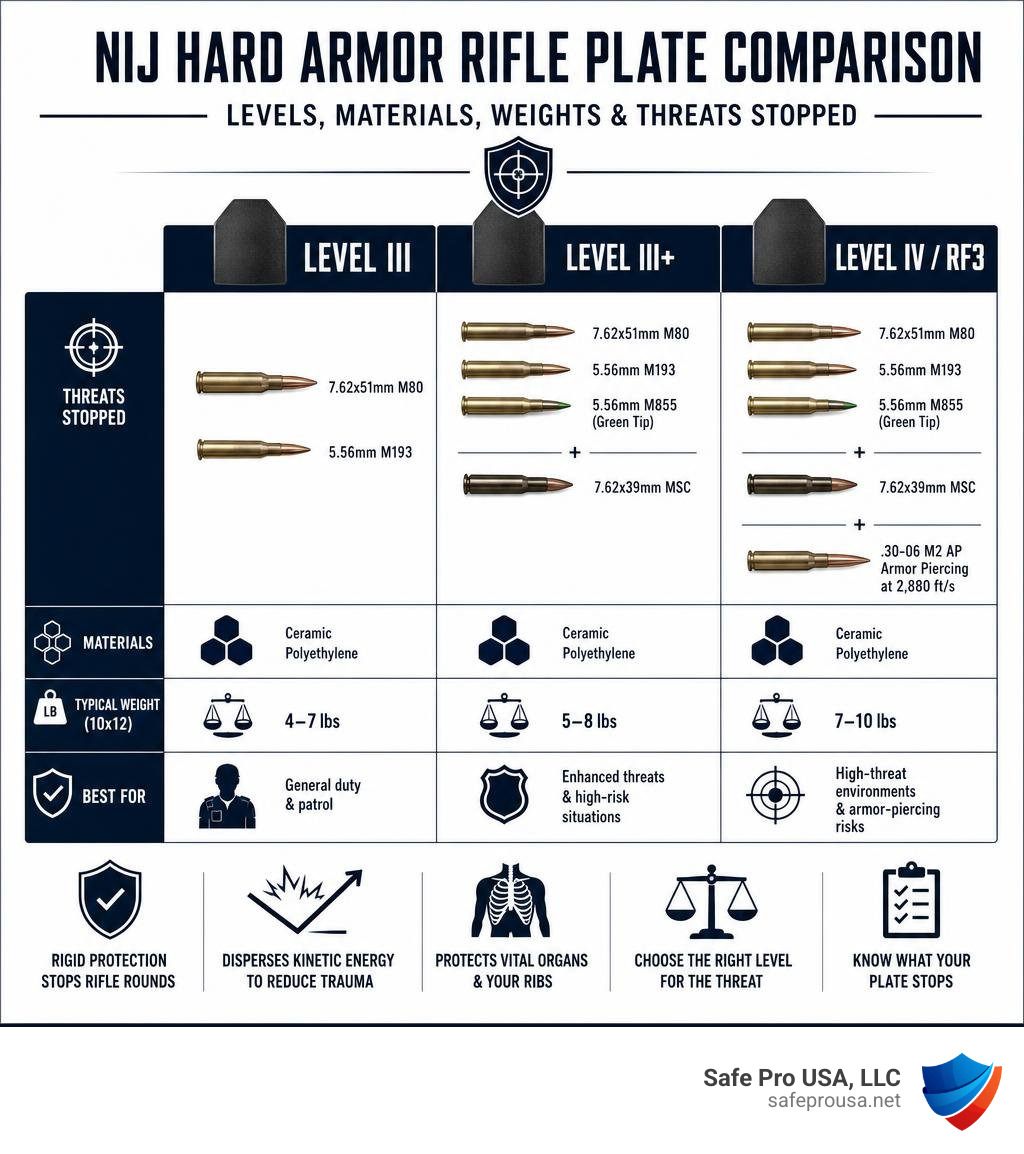
Quick answer for tactical professionals:
| Protection Level |
Threats Stopped |
Typical Weight (10x12) |
| Level III |
7.62x51mm M80, 5.56mm M193 |
4–7 lbs |
| Level III+ |
Adds M855 green tip, 7.62x39mm MSC |
5–8 lbs |
| Level IV / RF3 |
Adds .30-06 M2 AP armor-piercing at 2,880 ft/s |
7–10 lbs |
The difference between the right plate and the wrong one isn't academic — it's the difference between a round stopping at your chest and passing through it. Rifle rounds travel at velocities that overwhelm flexible armor. Hard plates disperse that kinetic energy across a rigid surface, protecting your vital organs from both penetration and blunt force trauma.
Choosing the wrong plate — or not understanding what yours actually stops — is a risk no serious tactical professional can afford to take.
I'm Michael Wratten, VP of Marketing & Sales at Safe Pro USA and a 20-year law enforcement veteran who has spent two decades evaluating, sourcing, and advising on hard armor rifle plates for military, law enforcement, and tactical professionals. In this guide, I'll break down everything you need to make a confident, informed decision.
What Are Hard Armor Rifle Plates?
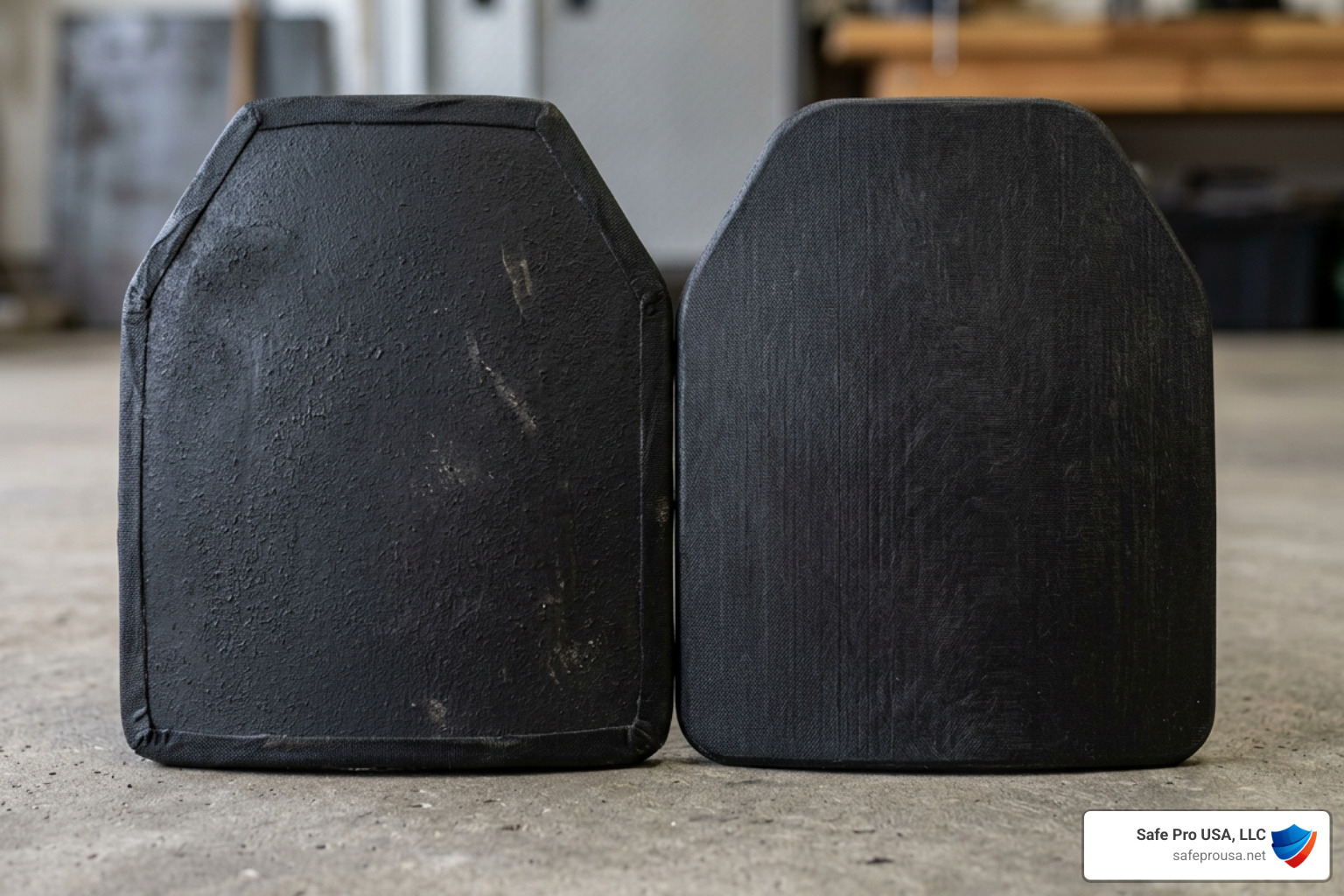
At its most basic level, a hard armor rifle plate is a rigid, dense slab of ballistic material designed to do what soft armor cannot: stop high-velocity rifle bullets. While soft armor relies on flexible woven fabrics to "catch" slower, blunt handgun rounds, a rifle round travels at two to three times that speed. To stop a projectile moving at 3,000 feet per second, you need a rigid barrier that can immediately shatter, deform, or capture the round upon impact.
These plates are engineered from highly specialized materials like advanced ceramics, ultra-high-molecular-weight polyethylene (UHMWPE), or ballistic-grade steel. When integrated into a plate carrier, they provide robust, life-saving protection over your torso's most critical vital organs—specifically your heart, lungs, and surrounding major blood vessels.
Beyond preventing direct penetration, these rigid inserts are critical for deformation reduction. When a bullet strikes body armor, the energy must go somewhere. If the armor flexes too deeply into your body—a phenomenon known as back-face signature or back-face deformation—it can cause severe, life-threatening blunt force trauma, such as broken ribs, punctured lungs, or ruptured arteries. High-quality Armor Plates absorb and disperse this kinetic energy across their entire rigid surface area, keeping the impact force far away from your ribcage.
Hard Armor vs. Soft Body Armor
To understand why hard armor is necessary, we have to look at the physics of ballistics. Soft body armor is typically constructed from layers of flexible aramid fibers or lightweight laminates. It excels at stopping pistol calibers (like 9mm, .40 S&W, and .44 Magnum) by acting like a heavy-duty catcher's mitt, stretching and absorbing the bullet's energy.
However, rifle rounds are a completely different beast. Not only are they traveling much faster, but they are also smaller, sharper, and designed to concentrate all their kinetic energy onto a tiny, piercing point. If a rifle round hits soft aramid armor, it will slice right through the fibers as if they weren't even there.
Hard armor plates solve this by introducing rigid composites. Instead of trying to "catch" the bullet with fabric, the hard strike face of a rifle plate immediately forces the bullet to deform, fragment, or dump its velocity. The rigid backing material then catches the remaining energy and fragments, ensuring complete containment of the threat.
Understanding NIJ Protection Levels and Threat Matrices
The National Institute of Justice (NIJ) is the governing body that sets the standard for ballistic resistance in the United States. When shopping for industry-standard hard plates, you will run into several ratings.
Currently, the industry is transitioning between two primary standards: NIJ 0101.06 (the legacy standard that defined Levels III and IV) and NIJ 0101.07 (the modern standard introduced to clarify rifle threats using "RF" designations).
Here is a quick look at how these standards map out:
| NIJ 0101.06 Rating |
NIJ 0101.07 Equivalent |
Primary Test Threats |
Back-Face Signature Limit |
| Level III |
RF1 |
7.62x51mm M80 NATO Ball (6 shots) |
44mm |
|
Level III+ (Industry standard, not official NIJ .06) |
RF2 |
7.62x51mm M80, 5.56mm M855 (Green Tip), 7.62x39mm MSC |
44mm |
| Level IV |
RF3 |
.30-06 M2 Armor Piercing (AP) (1 shot) |
44mm |
During testing protocols, plates are mounted to a specialized block of calibrated oil-based clay. When shot, the depth of the dent left in the clay is measured. This "back-face signature" cannot exceed 44mm (approximately 1.73 inches) for the plate to pass certification, ensuring that the wearer survives the blunt force transfer of the impact.
Level III and III+ Hard Armor Rifle Plates
Standard Level III plates are rated to stop six hits of 7.62x51mm M80 NATO ball ammunition traveling at roughly 2,780 feet per second. While this is formidable protection, standard Level III plates - especially those made of pure polyethylene - often have a blind spot: high-velocity 5.56mm rounds, particularly the M855 "green tip" which features a mild steel penetrator core.
To bridge this critical gap, manufacturers developed the "Level III+" designation. Although not an official level under the older NIJ 0101.06 standard, Level III+ is widely recognized in the industry as indicating that a plate stops standard Level III threats plus common high-velocity steel-core threats like the M855 and 7.62x39mm Mild Steel Core (MSC) rounds. Under the newer NIJ 0101.07 standard, this protection level is officially codified as RF2. If you are looking for highly versatile, everyday tactical protection, exploring rifle-rated plate options in the III+/RF2 category is often the sweet spot for balancing weight and defense.
Level IV and RF3 Hard Armor Rifle Plates
For the absolute highest level of personal protection, Level IV (or RF3 under the new standard) is the ultimate shield. These plates are specifically engineered to defeat armor-piercing rifle ammunition.
The benchmark test for a Level IV plate is stopping a .30-06 M2 AP (Armor Piercing) round - a massive, hardened-steel penetrator bullet weighing 166 grains and traveling at 2,880 feet per second. To defeat this, Level IV plates utilize robust ceramic strike faces that literally shatter the hardened steel core of the bullet on contact. While they are generally heavier than Level III options, they provide unmatched peace of mind when facing unknown, high-powered threats.
Materials Matter: Ceramic vs. Polyethylene (UHMWPE)
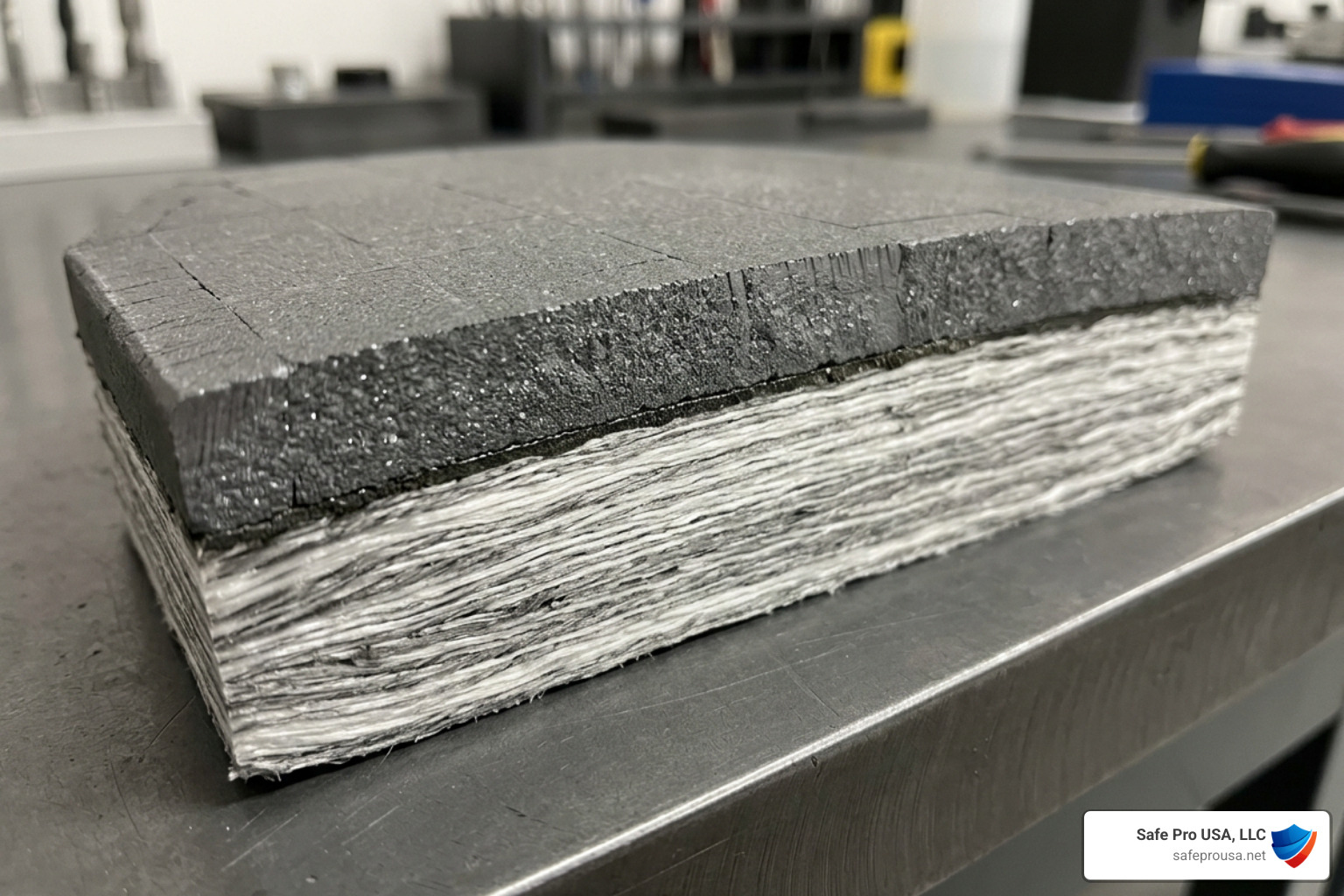
When selecting hard armor rifle plates, the material you choose dictates the weight you carry, how many hits your plate can take, and how much abuse the plate can withstand in the field. Let's look at the two primary modern materials used in high-quality plates today, as well as a brief look at legacy steel.
Ceramic Plates (Alumina/Silicon Carbide)
Ceramic plates are the industry standard for defeating high-penetration and armor-piercing threats. They are typically constructed as a composite: a hard ceramic strike face (often made of Alumina Oxide, Silicon Carbide, or Boron Carbide) bonded to a composite backing material like UHMWPE or aramid.
-
How They Work: When a high-velocity bullet strikes the plate, the incredibly hard ceramic tile acts as a sacrificial barrier. It shatters the bullet's hardened core, stripping away its aerodynamic shape and velocity. The softer composite backing then catches the flattened fragments and absorbs the remaining kinetic energy.
-
Weight & Thickness: Ceramic Level IV plates typically weigh between 7 to 10 lbs for a standard 10x12 plate, with a thickness of roughly 0.75 to 1.2 inches.
-
Multi-Hit Capability: Modern manufacturing allows for advanced ceramic configurations—such as mosaic tile layouts or highly pure monolithic sheets—that restrict crack propagation to a small 1-to-1.5-inch radius. This means high-quality Ceramic Rifle Plates can easily survive multiple hits, provided the impacts aren't directly on top of one another.
Polyethylene Plates (UHMWPE)
Ultra-High-Molecular-Weight Polyethylene is an incredibly strong, lightweight thermoplastic.
-
How They Work: Instead of shattering the bullet, UHMWPE plates work through friction and heat. Layers of polyethylene fibers are pressed together under immense pressure. When a high-speed bullet strikes the plate, the spin and friction of the round melt the plastic layers. The bullet becomes trapped and bound within the melting plastic, which quickly cools and solidifies around the projectile, capturing it completely.
-
Weight & Thickness: Polyethylene plates are incredibly light. A Level III+ poly plate can weigh as little as 3 to 4 lbs—roughly half the weight of a ceramic Level IV plate. They can also be manufactured to be incredibly thin, with some high-performance models coming in at just 0.5 inches thick.
-
The Trade-offs: Because polyethylene relies on melting and friction, it cannot stop armor-piercing or steel-core rounds like the M855 green tip or M855A1. The hardened steel cores of these rounds cut right through the plastic layers without generating the necessary friction to stop them.
(Note: While steel armor plates made of materials like AR600 steel exist and are highly durable and inexpensive, they are incredibly heavy—typically weighing 7 to 8 lbs for a basic Level III+ plate—and carry a significant risk of "spall" or fragmentation, where bullet fragments slice upward into the wearer's neck and arms upon impact unless wrapped in heavy polyurea coatings.)
Sizing, Cuts, and Curvature: Finding the Right Fit
No matter how strong your armor is, it won't save your life if it's sitting in your closet because it's too uncomfortable to wear. Ergonomics, mobility, and coverage area are crucial factors when selecting your plates.
The cut of the plate determines your range of motion:
-
SAPI Cut: The military standard (Small Arms Protective Insert). It features moderately chamfered upper corners to balance vital organ coverage with arm mobility.
-
Shooters Cut: Features more aggressive corner cuts at the top, allowing you to shoulder a rifle easily and move your arms forward without the plate pinching your chest.
-
Swimmers Cut: Features the most aggressive top cuts, maximizing upper body mobility and arm clearance for dynamic movement, though it offers slightly less coverage over the upper chest.
Plate curvature is equally vital for comfort.
-
Single-Curve Plates: These bend only along the horizontal axis, wrapping around your torso like a cylinder. While cheaper to manufacture, they tend to press uncomfortably against your chest and collarbones during extended wear.
-
Multi-Curve Plates: These are ergonomically molded to match the natural, three-dimensional contours of the human chest and ribcage. By distributing the weight evenly across your shoulders and torso, multi-curve plates eliminate painful pressure points on your ribs—making them well worth the investment for long shifts.
Standalone vs. ICW (In-Conjunction-With) Plates
When selecting your armor system, you must choose between Standalone and ICW plates:
-
Standalone Plates: These are engineered to stop their rated ballistic threats completely on their own, without requiring any additional backing. They are highly convenient but are typically thicker and heavier.
-
ICW (In-Conjunction-With) Plates: These plates are designed to be worn specifically in front of a soft armor vest (typically Level IIIA). By offloading some of the back-face deformation absorption to the soft armor, ICW plates can be made significantly thinner, lighter, and more comfortable.
Legal Considerations, Maintenance, and Care
In the United States, body armor is legal for law-abiding civilians to purchase and own in 48 states. Federal law prohibits convicted felons from purchasing or possessing body armor. However, if you reside in New York or Connecticut, you face strict state-level restrictions. Connecticut prohibits the online purchase of body armor (transactions must be completed face-to-face), while New York heavily restricts civilian purchase and possession of ballistic protective gear. Always verify your local and state regulations before purchasing hard body armor solutions.
To ensure your plates remain life-saving tools throughout their 5-to-10-year warranty periods, proper care and maintenance are non-negotiable:
-
Storage: Store your plates flat or vertically in a dedicated rack in a cool, dry place. Avoid stacking heavy objects on top of them.
-
Temperature Control: Never store your plates in the trunk of a vehicle. Summer temperatures inside a car can easily exceed 140°F, which can degrade the adhesives and composite backings over time.
-
Inspections: Perform an annual visual and tactile inspection. Feel the edges of ceramic plates to ensure there is no delamination, and check for any internal rattling, which could indicate a cracked ceramic core.
-
Drop Care: While modern ceramic plates are drop-conditioned to meet rigorous mechanical durability standards, treating them with care is vital. Avoid dropping your plate carrier onto hard concrete surfaces.
Frequently Asked Questions About Rifle Plates
Are hard armor rifle plates legal for civilians to own?
Yes. Under federal law, law-abiding citizens over the age of 18 who have not been convicted of a felony can legally purchase and own body armor. However, state-specific restrictions apply in New York and Connecticut, where online sales to civilians are heavily restricted or prohibited.
How long do hard armor plates last and how should they be stored?
Most high-quality hard armor plates carry a manufacturer's warranty of 5 to 10 years on the ballistic materials. To maximize their lifespan, store them in a climate-controlled environment (50–80°F) away from direct sunlight. Do not store them in hot vehicles, and keep them dry.
How do I choose the right plate size for my body?
Your plate should cover your vital organs, not your entire torso. To find your size, measure the distance from collarbone to about two inches above your belly button (vertical), and from nipple to nipple (horizontal). The standard 10x12 inch plate fits the vast majority of medium-framed adults, but always ensure your plate carrier is compatible with the exact size and thickness of your chosen plates.
Conclusion
When you are in the line of fire, compromise is not an option. At Safe Pro USA (a subsidiary of Safe Pro Group, Nasdaq-Listed: SPAI), we are dedicated to manufacturing mil-spec quality, American-made ballistic protection gear for military, law enforcement, and tactical professionals. We believe in honest materials, clean design, and relentless innovation to keep you safe.
If you are ready to upgrade your protection and ensure your gear is up to the task, explore our comprehensive guide on choosing the right ballistic armor plates to find the perfect fit for your mission.


