Excerpt
Learn how corrections officer ballistic shields improve safety in high-threat facility scenarios with proven two-officer tactics.
Why Corrections Officer Ballistic Shields Need a Mission-Based Plan
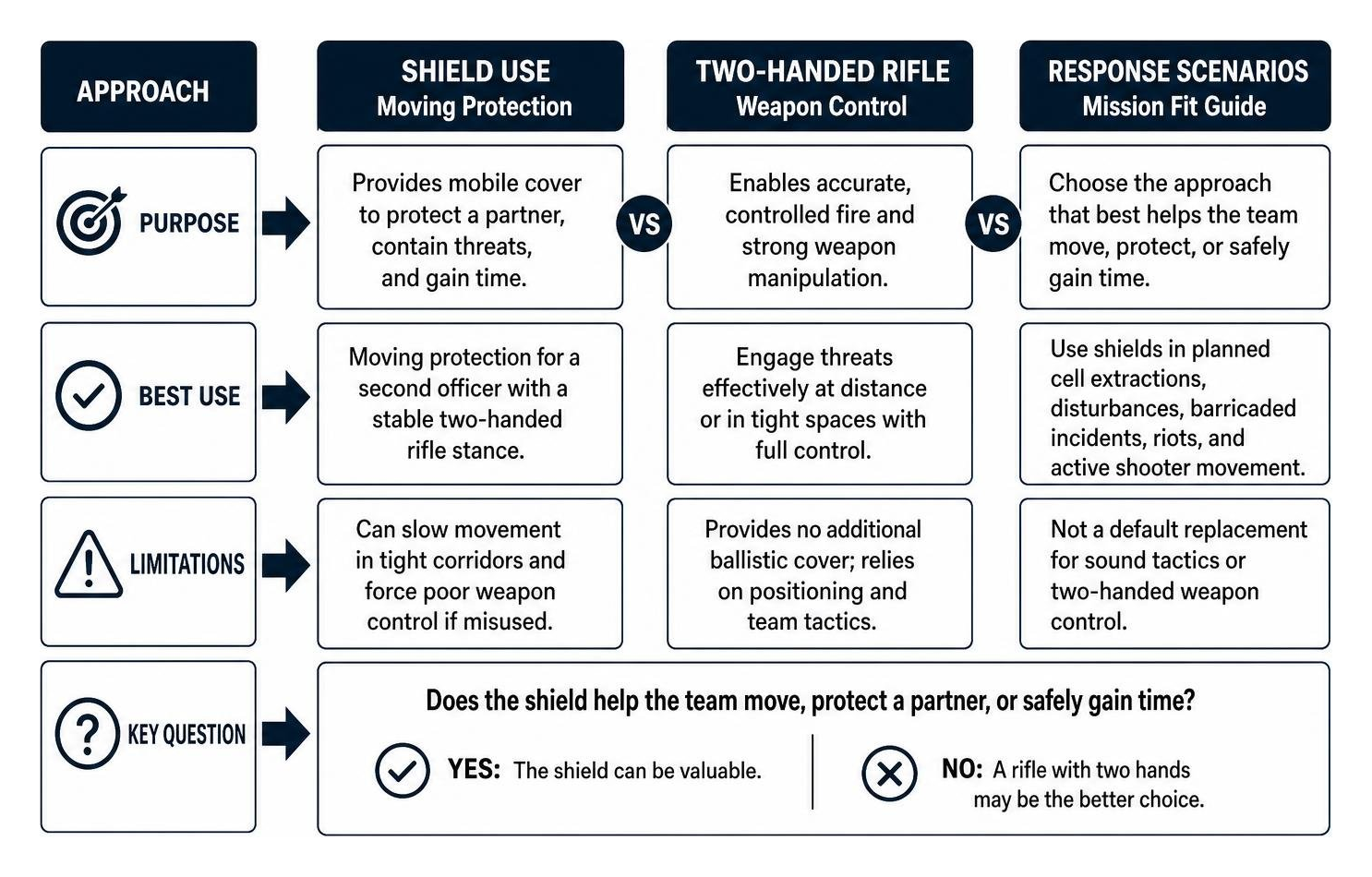
Corrections officer ballistic shields are most useful when they solve a specific protection problem, not as a default replacement for sound tactics and two-handed weapon control. Facilities should consider shields for planned cell extractions, armed disturbances, barricaded-subject incidents, riot response, and active shooter movement where officers may need mobile cover.
The key question is simple: Does the shield help the team move, protect a partner, or safely gain time? If the answer is yes, it can be valuable. If it forces an officer into poor weapon control or slows a response in a tight corridor, a rifle held with two hands may be the better choice.
Experienced tactical operators often argue that accurate, controlled fire and strong team tactics end threats more effectively than trying to absorb rounds behind a shield. In corrections, however, the mission is not identical to a military direct-action assault. Officers may need to protect staff, contain a threat, evacuate people, or advance through narrow institutional spaces with limited cover.
A shield can therefore serve as moving protection for a second officer who maintains a stable two-handed rifle stance. Its value depends on the threat, the layout, the team size, and training.
Tactical Evaluation of Corrections Officer Ballistic Shields
Deploying defensive barriers within a correctional facility requires balancing dynamic close-quarters battle (CQB) realities with institutional safety constraints. The architecture of modern detention centers presents unique hazards: long concrete corridors, hard acoustic environments, zero natural ballistic cover, and tight choke points. Integrating dedicated Ballistic Shields into emergency response units offers a distinct layer of defense, but tactical teams must evaluate equipment based on precise operational needs rather than treating gear as an all-in-one fix.
Institutional encounters often occur at extremely close ranges where reaction times are measured in fractions of a second. Armor systems constructed from modern materials like ultra-high-molecular-weight polyethylene (UHMWPE) and advanced ceramics provide strong multi-hit resilience without adding excessive bulk. For procurement and threat-rating alignment, agencies can reference the National Institute of Justice's ballistic protection levels and associated test threats when comparing ballistic-resistant equipment. Evaluating these barriers also involves assessing team composition, corridor clearance widths, and lighting conditions inside housing tiers.
Tactical Debates: Weapon Control vs Moving Cover with Corrections Officer Ballistic Shields
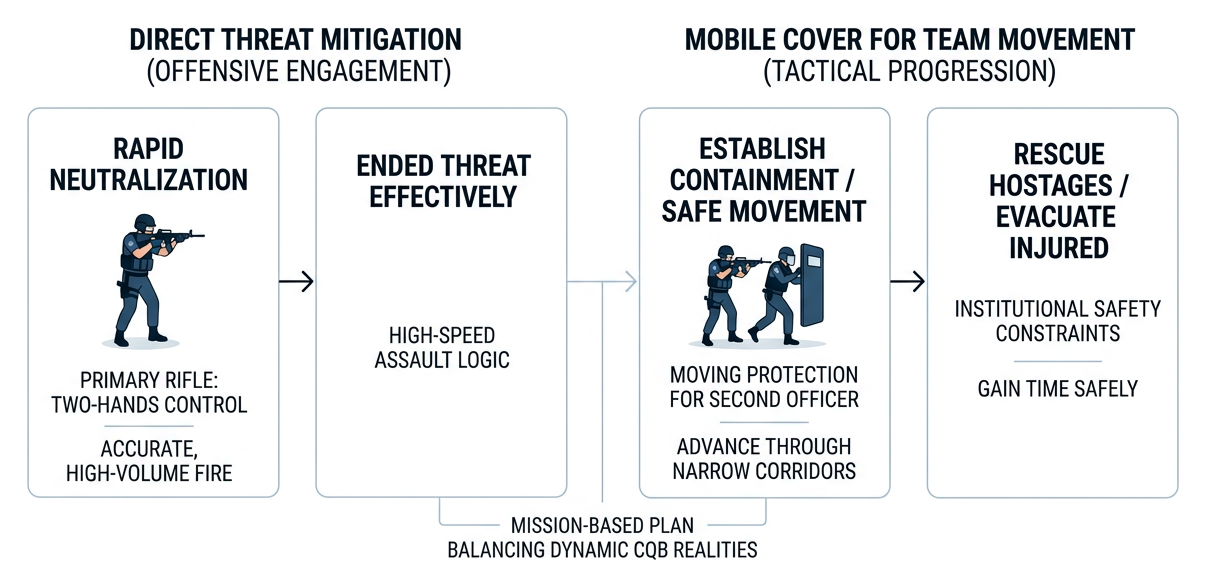
A prominent tactical debate centers on whether armor barriers help or hinder direct-action response. Special operations veterans from units such as Delta Force (CAG) and Commander's In-Extremis Force (CIF) have noted that catching rounds behind defensive barriers is less effective during high-speed assaults than using two hands on a primary rifle. Their logic is grounded in direct threat mitigation: accurate, high-volume fire ends a lethal engagement faster than static defense.
While direct assault teams focus on rapid neutralization, correctional operations often manage different tactical goals. Officers must establish containment, evacuate injured staff, rescue hostages, and negotiate through reinforced sally ports. A ballistic shield provides mobile cover in bare concrete hallways that lack natural concealment. Just as chest compressions support vital function during CPR without replacing definitive cardiac intervention, a ballistic barrier supports tactical movement while a secondary officer brings accurate fire onto the threat.
High-Threat Facility Scenarios for Corrections Officer Ballistic Shields
Defensive barriers are not designed for everyday facility walk-throughs; they are purpose-built for defined, high-risk scenarios. Standard polymer impact gear offers blunt-force mitigation during disturbances, but understanding Riot Shield Ballistic Protection is vital when weapons, zip guns, or smuggled firearms are present inside housing units.
Key deployment scenarios include:
-
Cell Extractions: Subduing barricaded subjects armed with improvised edged weapons, projectile launchers, or blunt instruments inside confined cell quarters.
-
Active Shooter and Inmate Firearms Incidents: Navigating open dayrooms or perimeter zones where an armed assailant poses a direct lethal hazard to staff.
-
Hostage Rescue and Containment: Forming dynamic holding lines across narrow tier walkways to isolate armed groups during coordinated facility disturbances.
-
Staff Extraction Under Fire: Moving across unprotected corridors to recover downed personnel from medical bays or control pods.
| Scenario Type |
Primary Threat Profile |
Minimum Armor Rating |
Primary Operational Objective |
| Planned Cell Extraction |
Edged weapons, blunt objects, bodily fluids |
Handgun / Fragmentation rated |
Containment and subject restraint |
| Barricaded Inmate (Tier) |
Improvised projectile weapons, heavy blunt impacts |
Level IIIA UHMWPE |
Controlled forward advance and visual isolation |
| Armed Disturbance |
Handguns, illicit firearms, perimeter breaches |
Level III Polyethylene / Ceramic |
Hallway clearance and secondary team cover |
| Active Lethal Threat |
High-velocity carbines or rifles |
Level III / IV Rifle Rated |
Rapid threat neutralization and escort |
Two-Officer Tactics and Weapon Stance Trade-Offs
When an officer carries a defensive barrier alone, firing a handgun one-handed severely compromises weapon stability, recoil management, and follow-up shot accuracy. Operating defensive equipment creates a physical burden that can degrade dynamic maneuverability in narrow spaces.
To mitigate this drawback, facilities utilize a coordinated two-officer stack:
-
The Shield Operator (Point Cover): Focuses solely on spatial awareness, barrier orientation, corridor angles, and team movement.
-
The Covering Officer (Engagement Element): Stages directly behind the point operator's shoulder, utilizing a stable, two-handed platform over or around the barrier.
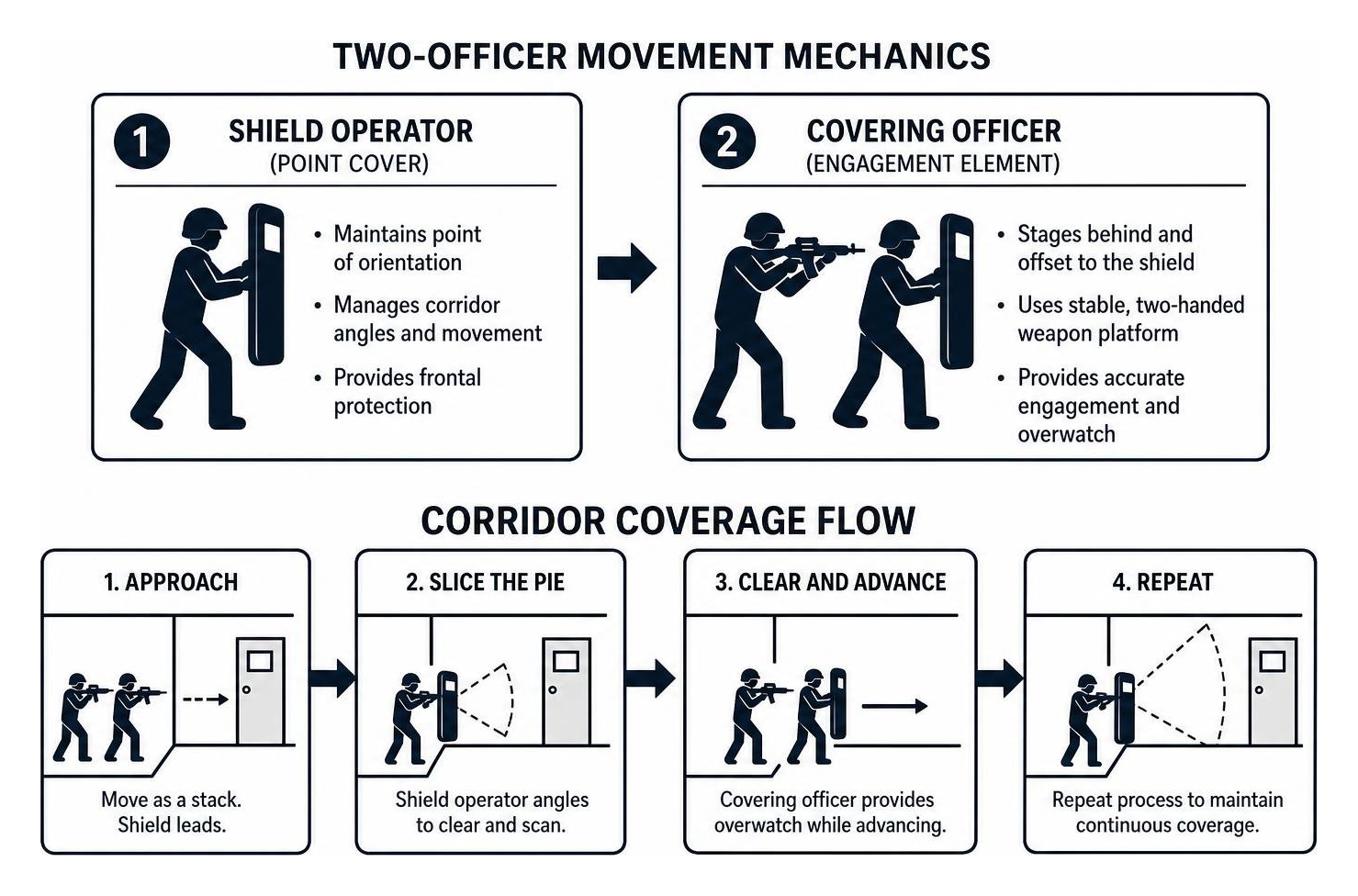
Using a lightweight rigid barrier such as the Kore Rifle Rated Polyethylene Level III Ballistic Shield 24 x 36 allows the team to maneuver down corridors with rifle-rated multi-hit protection. This division of labor ensures the point officer stays balanced while the covering shooter maintains accurate fire control.
Policy, Training, and Institutional Deployment Standards
Deploying defensive barriers across a correctional institution requires clear policy architecture and continuous tactical training. Facilities must establish standard operating procedures that dictate authorization thresholds, equipment staging areas, and incident-command integrations.
Every department utilizing these systems must address:
-
Quarterly Live-Fire and Movement Drills: Requiring two-officer stacks to move through simulated cell corridors, clear corners, and shoot on the move.
-
Weapon Retention Protocols: Training operators to counter inmate grab attempts through barrier deflection and secondary officer intervention.
-
Storage and Rapid Staging: Maintaining gear in quick-access lockers or a protective Deployment Ballistic Shield Bag to shield composite UHMWPE structures from UV exposure and industrial cleaning chemicals.
-
Post-Incident Decontamination and Inspection: Outlining rigorous inspection schedules to identify structural degradation, edge delamination, or hardware fatigue before return to service.
Implementing Duty-Rated Armor in Institutional Protocols
Institutional safety depends on equipment that performs consistently during critical incidents. Safe Pro USA, a subsidiary of Safe Pro Group (Nasdaq-Listed: SPAI), manufactures American-made ballistic systems engineered to meet rigid defense and corrections specifications. Prioritizing ultra-high-molecular-weight polyethylene (UHMWPE) and ceramic composite layers ensures that operators receive maximum protection without unmanageable weight penalties.
Selecting a verified USA Made Ballistic Shield gives command staff confidence that duty gear will perform under extreme pressure. Balancing structural durability with streamlined maneuverability allows emergency response teams to hold the line effectively. For deeper operational reviews and equipment breakdowns, explore additional tactical industry insights to equip your team with mission-proven protection.


