Why a USA Made Ballistic Shield Belongs in Every Tactical Kit
A usa made ballistic shield is one of the most critical pieces of protective equipment a law enforcement officer, SWAT operator, or tactical professional can carry. When lives are on the line, the quality of your gear is not a variable you want to leave to chance.
Here is a quick overview of what American-made ballistic shields offer across the most common protection levels:
| NIJ Protection Level |
Threats Stopped |
Typical Use Case |
| Level IIIA |
9mm, .357 SIG, .44 Magnum, shotgun slugs |
Patrol officers, first responders |
| Level III / RF1 |
7.62mm FMJ, 5.56mm M193, 7.62x39mm |
Tactical entry, SWAT teams |
| Level III+ |
5.56mm M855 Green Tip, 7.62x39mm MSC |
Active shooter response |
| Level IV / RF3 |
.30-06 M2 AP, armor-piercing rifle rounds |
High-threat entries, military ops |
Unlike body armor, a ballistic shield does not contact your body. That means impacts transfer as a physical push rather than direct trauma — a meaningful tactical advantage in close-quarters engagements.
The U.S. ballistic shield market has grown significantly, with agencies ranging from local sheriff's offices to federal law enforcement standardizing shields as part of their active shooter and tactical response protocols. School resource officers increasingly carry them. SWAT teams rely on them for building clearance. And more civilians are turning to them for home defense.
Not all shields are equal. Materials, tested to NIJ standards, construction quality, and country of manufacture all affect real-world performance. American-made shields are built to domestic testing standards and are subject to rigorous quality controls that matter when it counts most.
This guide breaks down everything you need to know — protection levels, materials, configurations, legal considerations, and the top U.S. manufacturers — so you can make a confident, informed decision.
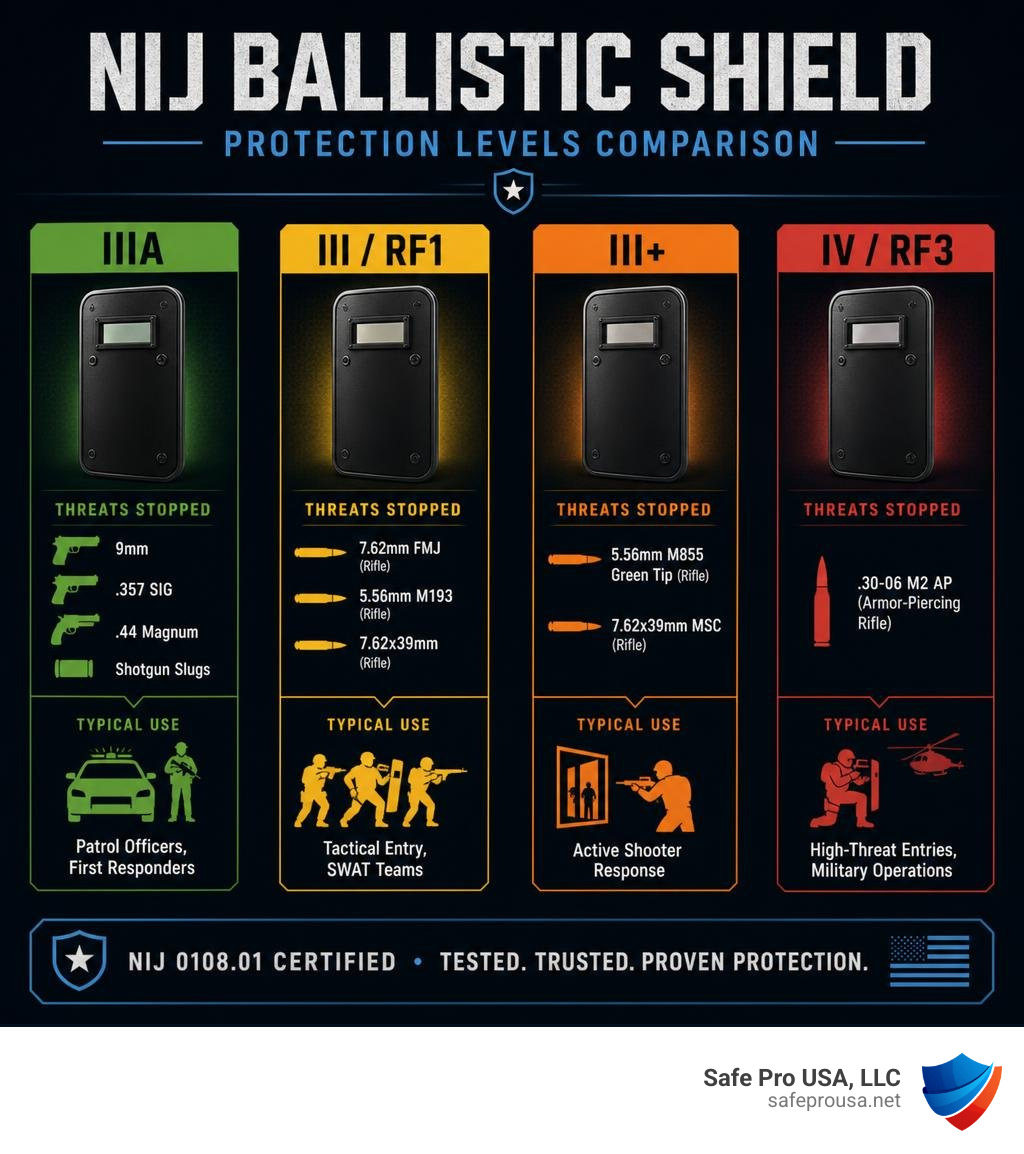
Understanding NIJ Protection Levels for a USA Made Ballistic Shield
When selecting a usa made ballistic shield, the first and most critical specification to evaluate is its National Institute of Justice (NIJ) protection level. The NIJ sets the gold standard for ballistic testing in the United States. For shields, the governing standard is NIJ 0108.01, which specifically tests defensive barriers, unlike the NIJ 0101.06 or newer NIJ 0101.07 standards designed for wearable body armor.
To ensure absolute reliability in the field, operators must source a high-performance Ballistic Shields & Armor Panels – Made in USA that has undergone rigorous laboratory validation. Understanding how these standards apply to portable barriers prevents catastrophic errors during deployment.
Level IIIA Handgun Protection
Level IIIA shields represent the most common choice for everyday patrol operations and first responders. Under NIJ 0108.01, Level IIIA barriers are tested to defeat common handgun threats, including high-velocity 9mm Full Metal Jacket (FMJ), .357 SIG, and heavy-hitting .44 Magnum rounds, as well as 12-gauge shotgun slugs.
Because handgun threats make up the vast majority of street-level violent encounters, Level IIIA shields are standard equipment in patrol vehicle trunks. Their primary advantage lies in their maneuverability. Since they do not require heavy rifle-rated plates, they remain highly portable, allowing a single officer to hold the shield with one arm while navigating tight hallways or staging a perimeter. To protect these vital assets during transport and rapid deployment, tactical teams utilize specialized storage solutions such as a Deployment Ballistic Shield Bag.
Rifle-Rated Protection: Level III, III+, and IV/RF1–RF3
When the threat environment escalates to long guns, Level IIIA barriers are no longer sufficient. Rifle-rated protection is mandatory for tactical entry teams, SWAT units, and active shooter response forces facing carbines and hunting rifles.
-
Level III (RF1): Rated to defeat standard centerfire rifle rounds, specifically 7.62x51mm NATO FMJ (M80 Ball) traveling at approximately 2,750 feet per second, alongside 5.56mm M193 and Russian 7.62x39mm rounds. Under the updated NIJ 0101.07 standard, this is equivalent to the RF1 rating, which formally expands testing to include modern intermediate rifle threats.
-
Level III+: While not an official NIJ-certified category, the "III+" designation is an industry-standard term indicating that a shield has been validated against "special threats" that fall between Level III and Level IV. Most notably, a Level III+ shield is engineered to stop 5.56mm M855 "Green Tip" penetrator rounds. Standard polyethylene Level III shields often fail against these steel-core rounds due to the high-velocity friction that melts the plastic fibers. Level III+ composite barriers solve this vulnerability.
-
Level IV (RF3): The ultimate level of portable protection. These shields are designed to withstand armor-piercing rifle threats, specifically the devastating .30-06 Springfield M2 Armor Piercing (AP) round. Level IV shields are heavy, highly specialized tools deployed during high-risk warrant executions and military operations.
To better understand how different materials and designs stop these high-velocity rifle projectiles, operators can consult Ballistic Armor Plates The Essential Guide To Choosing The Right Protection.
Advanced Materials in American Shield Manufacturing
Sourcing a usa made ballistic shield ensures access to the world's most advanced material science. American manufacturers utilize cutting-edge aerospace and defense composites to achieve the delicate balance between structural integrity and weight reduction.
When choosing a shield, the materials used directly dictate how long an operator can carry the barrier before muscle fatigue sets in, as well as how the shield reacts to multiple impacts. Sourcing American Made Body Armor and shields guarantees that the raw fibers and manufacturing processes meet strict military-grade quality controls.
| Material Type |
Relative Weight |
Multi-Hit Capability |
Ideal Threat Rating |
Primary Advantage |
| UHMWPE |
Extremely Light |
Excellent |
Level IIIA to Level III+ |
Maximum mobility, no fragmentation |
| Ceramic Composite |
Moderate to Heavy |
Good (Design Dependent) |
Level IV |
Stops armor-piercing rifle rounds |
| Aramid (Kevlar) |
Moderate |
Excellent |
Level IIIA |
Highly durable, flexible backing |
| Armor Steel |
Heavy |
Outstanding |
Level III+ |
Full surface protection, thin profile |
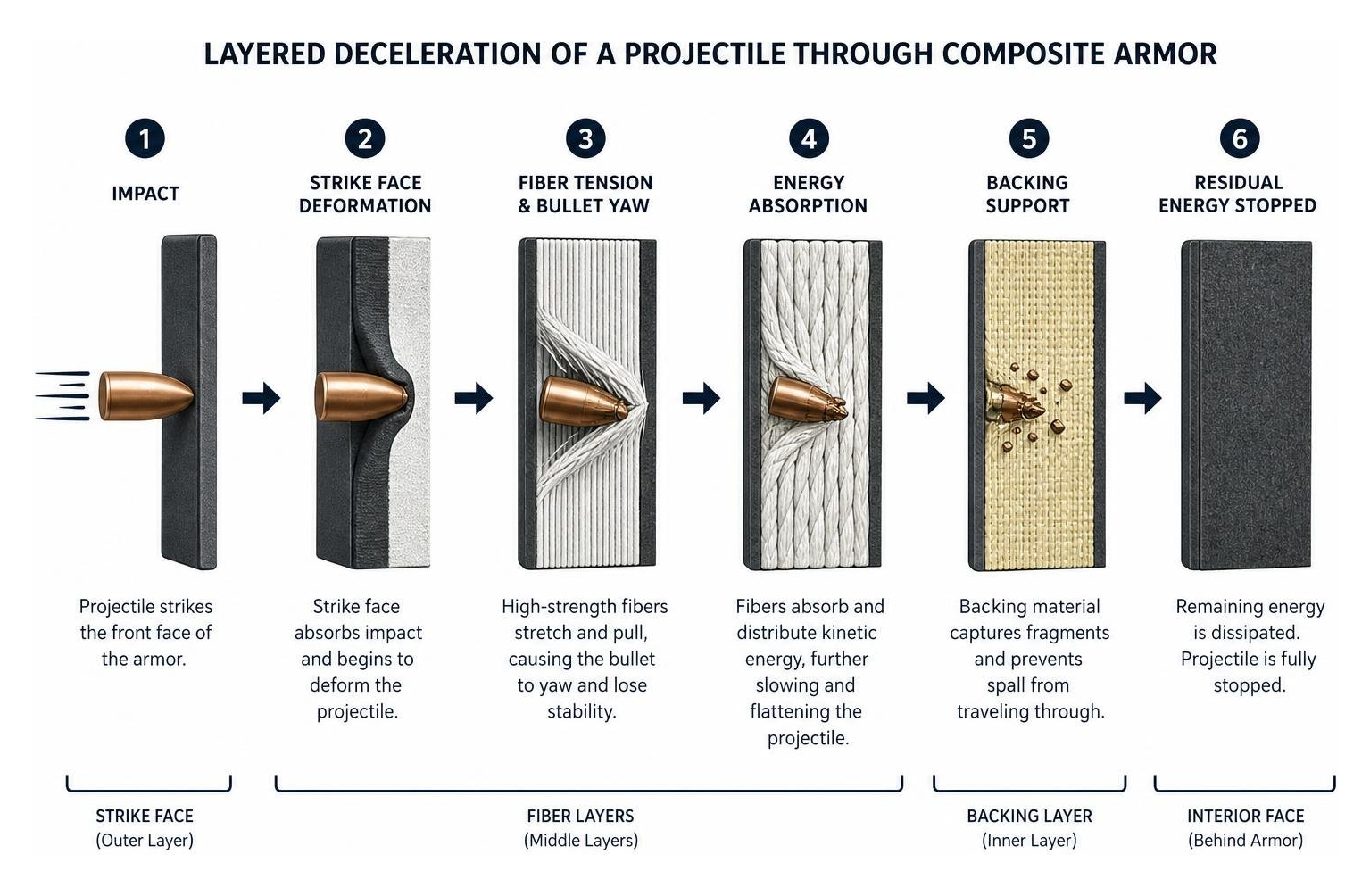
To visualize how these advanced materials perform when a projectile impacts the face of the shield, refer to the mechanical breakdown below:
Ultra-High-Molecular-Weight Polyethylene (UHMWPE) in a USA Made Ballistic Shield
Ultra-high-molecular-weight polyethylene (UHMWPE) represents the absolute pinnacle of lightweight performance in modern armor manufacturing. This advanced thermoplastic is composed of extremely long chains of polyethylene, which transfer kinetic energy far more efficiently than standard polymers.
When a bullet strikes a UHMWPE shield, the friction of the spinning projectile melts the plastic fibers locally. As the bullet attempts to push through, the surrounding high-tensile fibers catch, wrap, and deform the round, stripping away its kinetic energy.
-
Weight Savings: UHMWPE shields are up to 30% to 50% lighter than traditional steel or early composite alternatives.
-
Multi-Hit Performance: Because the material deforms locally rather than cracking, UHMWPE offers outstanding multi-hit capability.
-
Durability: Modern American-made UHMWPE shields are encapsulated in a rugged, military-grade polyurea or Rhino Extreme coating. This protective envelope prevents water absorption, chemical degradation, and UV damage, ensuring the internal fibers remain pristine.
Ceramic and Composite Systems in a USA Made Ballistic Shield
For maximum protection against armor-piercing threats (Level IV), material engineers combine ceramic matrices with high-strength composite backings (such as UHMWPE or aramid).
Ceramic materials, such as silicon carbide, boron carbide, or alumina, are incredibly hard. When an armor-piercing bullet strikes the ceramic face of the shield, the extreme hardness of the ceramic shatters the hardened steel or tungsten penetrator core of the projectile. The residual energy and fragmented pieces of the bullet are then caught and absorbed by the ductile UHMWPE or aramid backing layers.
To prevent spalling (the dangerous spraying of ceramic and metal fragments upon impact), these composite systems are finished with specialized anti-spall layers. This ensures that fragments are contained within the shield's outer shell, protecting both the operator and nearby team members.
Tactical Configurations and Operational Deployment of Ballistic Shields
A ballistic shield is only as effective as its ergonomic design. If a shield is too awkward to carry, blocks the operator's field of view, or lacks proper weapon integration, it becomes a liability in high-stress environments. High-performance American shields are engineered with operator input to maximize situational awareness and control.
Viewports and Lighting Systems
Modern tactical engagements require clear visibility and the ability to dominate dark environments.
-
Ballistic Glass Viewports: A high-quality viewport allows the operator to maintain visual contact with a threat while remaining fully protected behind the shield. Crucially, the ballistic glass in the viewport must be rated to the exact same protection level as the main shield body. Advanced American designs utilize boltless viewport installations. Traditional viewports rely on bolts drilled through the armor plate, creating structural weak points; boltless systems integrate the glass seamlessly, eliminating vulnerability.
-
Integrated LED Lighting Systems: High-output tactical lights (often delivering 1,200 lumens or more) can be mounted directly to the front of the shield. These systems feature ambidextrous pressure switches on the handle, allowing the operator to illuminate dark rooms while keeping both hands on their gear. Many systems include a strobe function operating at 10 to 15 Hz, which physically disorients suspects without requiring the operator to break their defensive posture.
Portable Handheld Shields vs. Wheeled Push Shields
Choosing the right shield footprint depends entirely on the operational environment and the anticipated threat level.
-
Portable Handheld Shields: These compact, highly maneuverable barriers are designed for rapid deployment. Weighing anywhere from 8 to 30 pounds, they are ideal for active shooter response, quick building clearances, and patrol use. Handheld shields often feature specialized weapon cutouts or curved profiles, allowing operators to rest their long guns or sidearms securely while maintaining full coverage. These systems are designed to integrate seamlessly with a Military Portable Ballistic Shield setup and can be carried alongside a high-quality Mil Spec Armor Plate Carrier for comprehensive personal safety.
-
Wheeled Push Shields: When facing sustained rifle threats or armor-piercing rounds, the weight of a Level IV shield can exceed 50 to 100 pounds, making handheld carry impossible for extended periods. Wheeled push shields (or trolley systems) mount these heavy rifle-rated plates onto rugged, wheeled chassis. These systems are utilized by SWAT teams during slow, methodical stack entries, barricaded suspect scenarios, and hostage rescue operations where maximum physical coverage is paramount.
Regulations, Lifespan, and Maintenance of Ballistic Shields
Legal Restrictions and State Laws
Under United States federal law (specifically 18 U.S.C. § 931), anyone convicted of a violent felony is strictly prohibited from purchasing, owning, or possessing body armor, which legally includes ballistic shields.
For law-abiding citizens, purchasing a ballistic shield is legal in 48 states without a permit. However, local regulations vary significantly:
-
New York: The state has enacted strict bans on the sale and possession of body armor and protective shields to civilians, restricting purchases almost exclusively to active law enforcement and approved professional industries.
-
Connecticut: State law mandates that all purchases of body armor and ballistic shields by civilians must take place in person. Online sales and shipping of these items to Connecticut residents are heavily restricted.
Always verify your local and state statutes before initiating a purchase.
Warranty, Shelf Life, and Post-Impact Care
A ballistic shield is a life-saving investment, and understanding its operational lifespan is critical for fleet managers and individual owners alike.
-
Shelf Life and Warranty: The standard industry warranty for ballistic materials is five years from the date of manufacture. However, some advanced American manufacturers utilizing high-grade UHMWPE composites offer extended shelf-life warranties of up to ten years. This warranty guarantees that the ballistic materials will perform to their rated NIJ standard under normal storage conditions.
-
Environmental Degradation: Shields must be stored in temperature-controlled environments away from direct UV sunlight. Prolonged exposure to extreme heat (such as the trunk of a patrol car in desert climates) can weaken the adhesives and polymer bonds over time, potentially leading to delamination. Regular visual inspections should check for soft spots, warping, or peeling coatings.
-
Post-Impact Protocol: Ballistic shields are designed to be single-use defensive items during active engagements. If a shield takes a direct hit from a projectile—or suffers a severe physical impact, such as a high drop from a tactical vehicle—it must be retired immediately. Micro-fractures in ceramic or delamination in UHMWPE layers may not be visible to the naked eye, but they will severely compromise the shield's ability to stop subsequent rounds.
Frequently Asked Questions about Ballistic Shields
What is the difference between a ballistic shield and a riot shield?
A ballistic shield is engineered and rated under NIJ standards to stop high-velocity bullets from handguns or rifles. They are constructed from heavy-duty composite materials like UHMWPE or ceramics. A riot shield is made of lightweight, transparent polycarbonate. It is designed solely to protect officers from blunt force trauma, thrown objects (rocks, bottles), and physical assaults during crowd control operations. Riot shields offer absolutely zero ballistic protection against firearms.
Do ballistic shields protect against rifle rounds?
Only shields rated as Level III, Level III+ (special threats), or Level IV (RF1 through RF3) protect against rifle rounds. Standard Level IIIA shields are designed strictly for handgun and shotgun threats and will be easily penetrated by intermediate rifle rounds like 5.56mm or 7.62mm.
How long do U.S.-made ballistic shields last?
Most U.S.-made ballistic shields have an operational shelf life of 5 to 10 years, depending on the materials used and the manufacturer's warranty. Regular inspections are required to ensure the barrier hasn't been compromised by moisture, extreme heat, or physical damage.
Conclusion
Sourcing a high-performance usa made ballistic shield is an investment in uncompromising safety, rigorous quality control, and advanced material science. Whether you are a patrol officer responding to an active threat, a SWAT operator leading a high-risk breach, or a security professional securing a facility, having a reliable, American-made barrier can be the difference between a successful operation and a tragedy.
Safe Pro USA, LLC (a subsidiary of Safe Pro Group, Nasdaq-Listed: SPAI) is dedicated to manufacturing elite, military-grade ballistic protection gear. By combining clean, operator-focused designs with honest, high-performance materials like advanced UHMWPE and ceramics, Safe Pro USA delivers tactical gear that professionals can trust in the line of fire.
For more detailed insights on selecting the right level of personal protection, explore our comprehensive guide on Ballistic Armor Plates The Essential Guide To Choosing The Right Protection.
For additional industry specifications and testing standards, professional operators may also refer to official resources such as the National Institute of Justice.


