Why American Made Body Armor Matters for Tactical Professionals
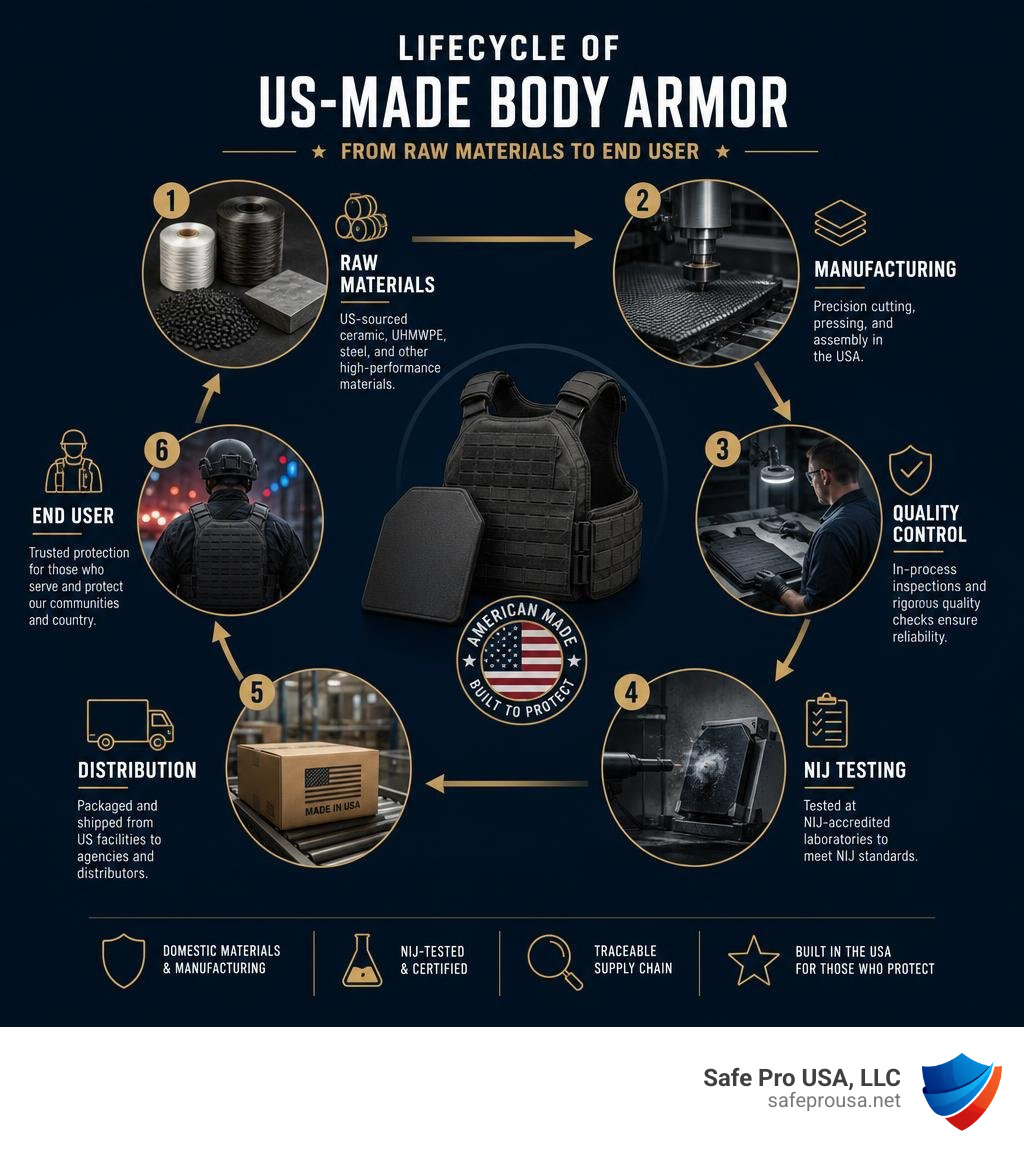
American made body armor is ballistic protection — plates, vests, and shields — manufactured in the United States using domestically sourced materials, tested to NIJ standards at accredited laboratories.
Here's a quick breakdown of what sets it apart:
-
Materials: Ceramic, UHMWPE (ultra-high-molecular-weight polyethylene), and steel sourced from US mills
-
Testing: Tested at NIJ-accredited labs to standards like NIJ 0101.06 and NIJ 0101.07
-
Compliance: Subject to Berry Amendment requirements for military procurement and FTC "Made in USA" guidelines
-
Traceability: Supply chain tracked from raw material to finished product
-
Protection levels: Ranges from Level IIIA (handgun threats) up to Level IV (armor-piercing rifle rounds)
When lives are on the line, the question isn't just does this armor work — it's where was it made, how was it tested, and can you trust the supply chain behind it?
Not all armor marketed as "American" meets the same bar. Some products use foreign-sourced materials assembled domestically. Others skip rigorous third-party ballistic testing entirely. For tactical professionals operating in high-risk environments, that gap in quality control isn't a footnote — it's a threat.
Understanding what "American made" actually means, and how to verify it, is the first step toward choosing gear you can genuinely rely on.
I'm Michael Wratten, Vice President of Marketing & Sales at Safe Pro USA, and with over 20 years in the defense and protective equipment industry, I've spent my career evaluating what makes american made body armor trustworthy from the factory floor to the field. In the sections below, we'll break down exactly how to verify domestic manufacturing, which materials perform best, and how to match your setup to your threat profile.
Defining True American Made Body Armor: Standards and Compliance

When shopping for protective gear, you will see a lot of flags, bald eagles, and bold claims. But in the defense industry, "American-made" is not a marketing slogan; it is a legally defined standard of compliance. To ensure that your life-saving equipment is genuinely produced in domestic facilities under strict quality controls, you must understand the regulatory frameworks that govern these claims.
The Berry Amendment and Military Procurement
For the Department of Defense (DoD), buying American is not optional—it is a statutory requirement. The Berry Amendment is a federal regulation that restricts the DoD from using funds for food, clothing, fabrics, fibers, and other made-up textile products that are not grown, reprocessed, reused, or produced in the United States.
When it comes to american made body armor, Berry Amendment compliance ensures that every single component of a plate carrier, tactical vest, or soft armor panel—from the advanced synthetic fibers down to the thread, hook-and-loop fasteners, and plastic buckles—originates in the United States. For military personnel and federal agencies, sourcing Berry-compliant gear is a matter of national security and legal compliance. It ensures that our armed forces do not rely on foreign adversaries for critical life-saving technology.
FTC Guidelines for Made in USA Claims
For civilian and law enforcement markets, the Federal Trade Commission (FTC) regulates "Made in USA" claims. According to the FTC, for a product to be labeled as "Made in USA" without qualification, it must be "all or virtually all" made in the United States.
This means:
- The final assembly or processing of the product must take place in the United States.
- All significant parts, processing, and labor that go into the product must be of US origin.
- The product should contain no—or only negligible—foreign content.
Some manufacturers attempt to bypass these strict guidelines by using clever wording. You might see phrases like "Designed in the USA," "Assembled in the USA," or "Packaged in the USA." These are qualified claims indicating that while some assembly or design work occurred domestically, the raw materials—such as the ballistic ceramic or the polyethylene backing—were imported from overseas. True domestic manufacturers maintain complete supply chain traceability, allowing them to verify the origin of their raw materials from the initial chemical synthesis or ceramic pressing to the final stitch.
NIJ Certification and Material Science: Ceramic and UHMWPE
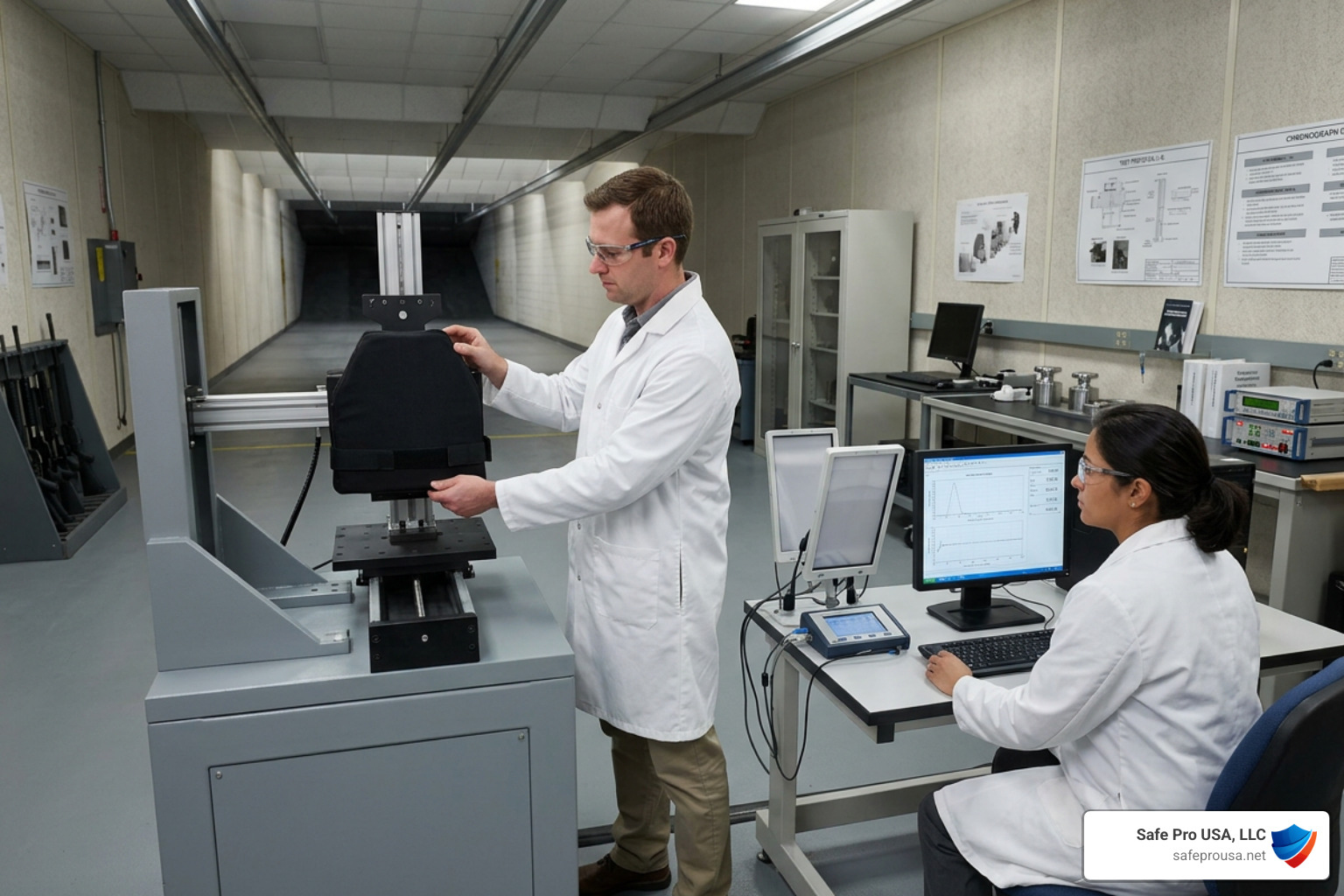
Ballistic standards are the benchmark of safety. In the United States, the National Institute of Justice (NIJ) sets the physical performance and testing standards for body armor. Buying domestic armor is closely tied to these standards, as reputable American manufacturers subject their designs to rigorous, independent testing in NIJ-accredited laboratories.
To understand how to protect yourself against modern threats, it helps to read our comprehensive ballistic armor plates guide which outlines how different ratings match up against real-world threats.
The Importance of Lab Testing for American Made Body Armor
An NIJ certification is not a one-time stamp of approval. It is a continuous quality assurance process. To achieve and maintain certification, manufacturers must submit their armor to independent, third-party laboratories. These labs test the plates under extreme conditions, measuring:
-
V50 Ballistic Limit: The velocity at which a specific projectile has a 50% chance of penetrating the armor.
-
Back-Face Signature (BFS): The depth of the indentation made by the armor into a clay backing material during a non-penetrating impact. This measures the blunt force trauma transferred to the wearer's body. To pass, the BFS must not exceed 44mm.
-
Environmental Conditioning: Armor is subjected to extreme temperatures, moisture, and mechanical wear before testing to ensure it will perform in harsh field conditions.
By choosing certified hard armor rifle plates, you ensure that your gear has been proven to stop the exact ballistic threats it claims to defeat.
Ceramic and UHMWPE: Lightweight Innovation in American Made Body Armor
For decades, heavy steel plates were the standard for rifle protection. However, modern material science has ushered in a new era of lightweight, high-performance materials. Today, the gold standard for tactical operators consists of Ceramic and Ultra-High-Molecular-Weight Polyethylene (UHMWPE).
-
Ceramic Strike Faces: Advanced ceramic materials like Alumina Oxide, Silicon Carbide, and Boron Carbide are incredibly hard. When a high-velocity rifle round strikes a ceramic rifle plates setup, the ceramic shatters the bullet, stripping away its kinetic energy and destroying its shape.
-
UHMWPE Backers: Polyethylene is an ultra-strong plastic fiber that is spun into a dense, multi-layered matrix. When the shattered fragments of the bullet pass through the ceramic strike face, the UHMWPE backing catches them like a catcher's mitt. It absorbs and disperses the remaining energy, preventing penetration and minimizing back-face deformation.
These materials are bonded together to create state-of-the-art armor plates. This combination provides superior protection against high-velocity, armor-piercing rounds while keeping the weight minimal. To see how these materials are shaping the next generation of defense technology, explore our insights on futuristic military body armor.
Advanced Composite Armor: The Modern Standard for Tactical Operators
Traditional steel plates are incredibly heavy, prone to dangerous spalling (where bullet fragments shear off the face of the plate and strike the wearer's chin, arms, or throat), and offer poor multi-hit capabilities against modern high-velocity rounds like the M193 or M855.
Advanced composite armor—combining ceramics and UHMWPE—has become the modern standard for tactical operators because it solves these issues:
-
Weight Savings: Composite plates can weigh up to 50% less than equivalent steel plates, drastically reducing fatigue over long shifts.
-
Fragment Mitigation: The composite structure encapsulates the projectile, eliminating the hazard of ricocheting fragments.
-
Multi-Hit Durability: High-quality American composite manufacturing ensures that the bond between the ceramic and polyethylene remains intact even after taking multiple hits, providing edge-to-edge protection when you need it most.
Choosing the Right Setup: Plate Carriers, Hard Plates, and Ballistic Shields
Selecting the right armor system requires balancing your specific operational environment, mobility needs, and threat profile. A SWAT officer serving high-risk warrants needs a different setup than a patrol officer responding to an active shooter or a civilian preparing for emergency scenarios.
To help you decide, here is a direct comparison of the two primary lightweight ballistic materials used in modern American armor:
| Feature |
Ceramic Composite Plates |
Pure UHMWPE Plates |
| Primary Threat Focus |
Armor-piercing rifle rounds (e.g., .30-06 AP, M855A1) |
Standard rifle rounds (e.g., M80 Ball, mild steel core) |
| Weight Profile |
Moderate (typically 5.5 to 7.5 lbs per plate) |
Extremely Light (typically 2.5 to 4.5 lbs per plate) |
| Thickness |
Average 0.8" to 1.0" |
Average 0.9" to 1.2" |
| Multi-Hit Performance |
Excellent (shatters bullet on impact) |
Outstanding against non-armor-piercing rounds |
| Durability |
Requires careful handling (can crack if dropped heavily) |
Highly durable, resistant to moisture and drops |
Ballistic Shields for Tactical Patrol and Entry Operations
For law enforcement officers and tactical teams, personal body armor is only part of the equation. Ballistic shields provide critical mobile cover during high-risk entries, active shooter responses, and corridor clearing.
Modern American-made ballistic shields utilize advanced UHMWPE construction to deliver Level III or Level IIIA protection at a fraction of the weight of legacy designs. This allows a single officer to deploy the shield dynamically, maintaining maneuverability and speed while providing a rolling wall of protection for the entire stack.
Plate Carriers and Hard Armor for High-Threat Scenarios
For maximum rifle protection, tactical professionals rely on a high-quality plate carrier paired with standalone hard armor plates. When configuring this setup, look for a mil-spec armor plate carrier that offers robust load distribution, heavy-duty stitching, and modular attachment options (MOLLE/PALS).
Your carrier should fit snugly against your torso, positioning the front plate to cover your vital organs from the collarbone to about two inches above your navel. A properly fitted carrier ensures that your armor stays in place during dynamic movement, providing consistent coverage without restricting your range of motion.
Frequently Asked Questions about US Armor Manufacturing
How can I verify if body armor is actually made in the USA?
To verify if armor is genuinely made in the USA, look for a clear statement of FTC compliance or Berry Amendment compliance from the manufacturer. Legitimate domestic manufacturers are transparent about their supply chain and will gladly provide documentation regarding where their materials are sourced and where their products are assembled. Additionally, you can check the NIJ Active Compliant Product List to ensure the specific model is registered and certified under an American manufacturing facility.
Why are ceramic and UHMWPE the preferred materials for modern armor?
Ceramic and UHMWPE are preferred because they offer the highest level of ballistic protection with the lowest possible weight. Unlike steel, which is heavy and creates dangerous bullet splatter (spall), ceramic shatters the bullet, and UHMWPE safely catches the fragments. This combination keeps tactical operators fast, agile, and protected against modern high-velocity rifle threats.
What is the typical shelf life of American-made ballistic plates?
Most high-quality American-made ceramic and UHMWPE ballistic plates carry a manufacturer’s warranty of 5 to 10 years. Because composite materials are highly resistant to environmental factors, they maintain their ballistic integrity for a long time if stored properly—at room temperature, away from direct sunlight, and dry. Regular visual inspections are recommended to ensure the outer cover is intact and the plates have not suffered structural damage from being dropped.
Conclusion
In the defense and tactical industry, there is no room for compromise. When you choose american made body armor, you are investing in rigorous quality control, proven material science, and a transparent supply chain that puts your safety first.
At Safe Pro USA, LLC (a proud subsidiary of Safe Pro Group, Nasdaq-Listed: SPAI), we are dedicated to manufacturing high-performance, American-made ballistic protection gear for military, law enforcement, and tactical professionals. Our products are engineered with mil-spec quality, clean design, and honest, high-performance materials like advanced ceramics and UHMWPE. We control our manufacturing processes right here in the United States to ensure that every plate, carrier, and shield we produce is ready to perform when it matters most.
Protect your team with gear built to the highest standards of American craftsmanship.
Explore Safe Pro USA Armor Plates


