When Seconds Count: What You Need to Know About Military Portable Ballistic Shields
A military portable ballistic shield is a handheld, bullet-resistant barrier that gives operators mobile cover in high-threat environments — something body armor alone cannot provide.
Quick answer for tactical professionals:
| Feature |
Details |
| What it is |
A carried (not worn) ballistic barrier for mobile protection |
| Who uses it |
Military, SWAT, law enforcement, special operations |
| Protection levels |
NIJ Level IIIA (handgun) up to Level IV (armor-piercing rifle) |
| Key materials |
UHMWPE, ceramic composites |
| Common sizes |
Mini (12"x18") to full-body (24"x51") |
| Primary advantage |
Mobile cover that stops projectiles without transferring blunt trauma to the user |
Unlike body armor, a ballistic shield doesn't wrap around you — it moves with you, creating a protective barrier between you and incoming fire. That distinction matters enormously in dynamic situations like structure clearing, active shooter response, and forced entry operations.
When threats escalate and lives are on the line, having the right shield — matched to the right threat level — can be the difference between mission success and tragedy.
I'm Michael Wratten, VP of Marketing & Sales at Safe Pro USA and a 20-year law enforcement veteran with experience spanning the full spectrum of military portable ballistic shield products — from product development to hands-on field use with the Los Angeles and West Covina police departments. In this guide, I'll break down the top options available today so you can make an informed decision for your mission profile.
Understanding the Military Portable Ballistic Shield and Its Tactical Role
A Ballistic shield - Wikipedia is more than just a piece of safety equipment; it is a deployable, mobile barrier designed to alter the geometry of a gunfight. In both defensive operations and offensive advancement, tactical teams rely on these systems to establish instantaneous cover where none naturally exists.
When a team transitions from a secure staging area into an uncleared space, the lead operator—the "shield bearer"—uses the shield to absorb initial contact. This allows the cover team to identify, target, and neutralize threats. Defensively, shields serve as mobile defensive fighting positions, protecting downed officers during rescue operations or holding critical thresholds during high-risk standoffs.
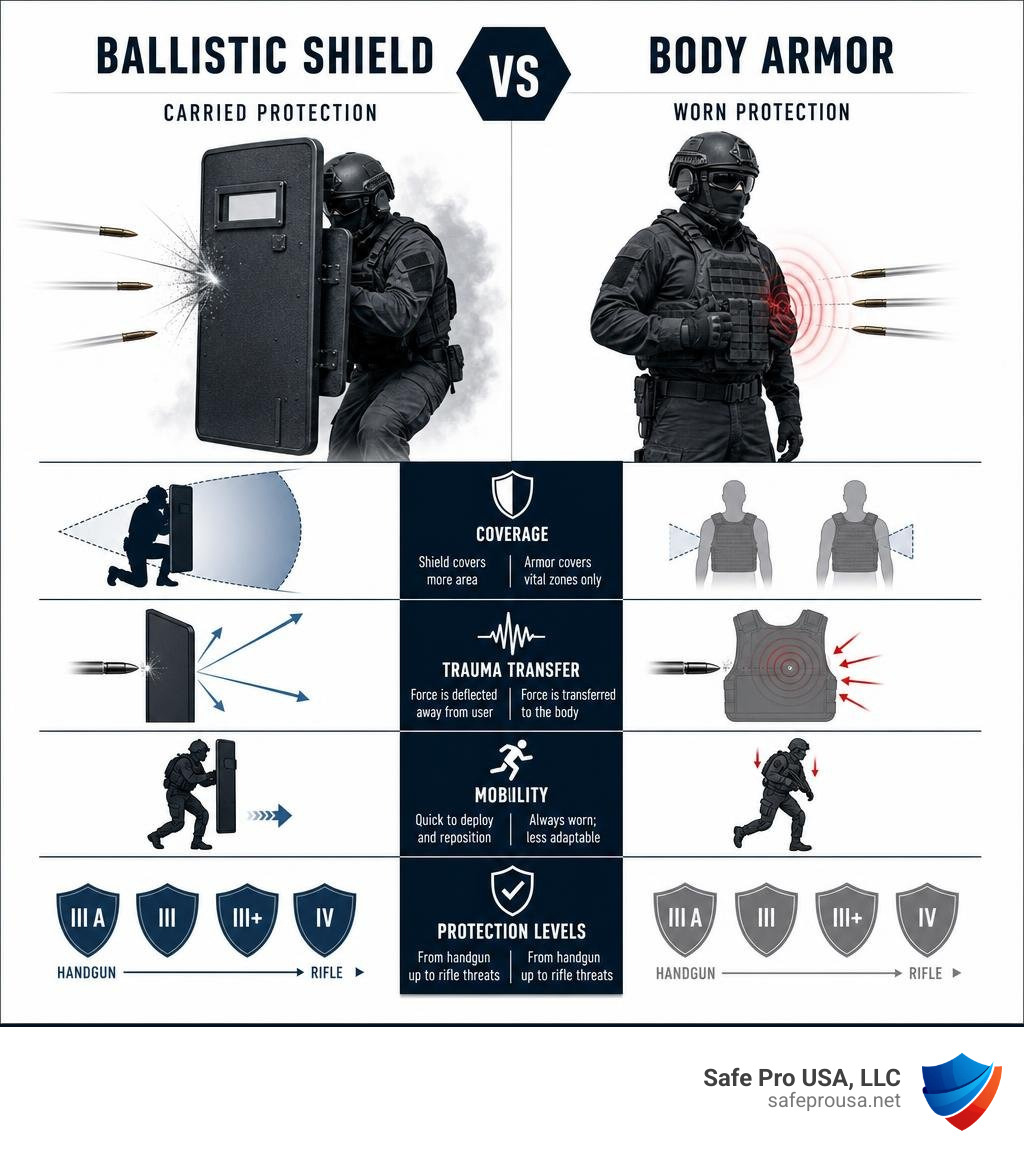
One of the most significant mechanical advantages of a military portable ballistic shield is blunt force trauma mitigation. When a round strikes standard wearable Armor Plates, the kinetic energy is absorbed and dispersed across the operator's torso. This can result in severe bruising, broken ribs, or internal organ damage (known as backface deformation). Because a handheld shield is physically separated from the operator's body, the energy of the impact is absorbed by the shield's internal matrix and the supporting handle system, preventing dangerous trauma transfer to the operator.
Key Differences Between Ballistic Shields and Body Armor
While both systems are engineered to stop ballistic threats, their operational parameters are entirely different:
-
Load Carriage: Wearable body armor is supported by the operator's shoulders and torso, distributing weight across the skeletal frame via a Mil-Spec Armor Plate Carrier. A ballistic shield must be supported by the arms and shoulders, requiring specialized handle geometry and ergonomic straps to prevent rapid physical fatigue.
-
Trauma Transfer: As noted, body armor transfers kinetic energy directly to the wearer. A portable shield completely isolates the operator from this blunt force impact, keeping the operator conscious and capable of returning fire.
-
Coverage Area: Body armor protects vital organs within the thoracic cavity. A portable ballistic shield offers a significantly larger coverage area, shielding the head, neck, torso, and often the lower extremities of both the bearer and the operators stacked directly behind them.
Ballistic Shields vs. Riot Shields
It is common to see riot shields and ballistic shields confused in popular media, but in tactical operations, mistaking one for the other is a fatal error:
-
Riot Shields: Constructed primarily from lightweight, transparent polycarbonate or acrylic, these shields are designed strictly for impact resistance. They protect operators against thrown objects, blunt weapons, chemical splashes, and non-lethal projectiles during crowd control operations. They offer zero protection against ballistic penetration.
-
Ballistic Shields: Constructed from advanced ballistic composites, these systems are specifically rated to stop high-velocity handgun and rifle rounds. They are heavier, thicker, and engineered for high-threat tactical deployment where active shooters are present.
Ballistic Protection Levels and Advanced Materials
Selecting the right level of protection requires a thorough understanding of the National Institute of Justice (NIJ) standards and the materials used to defeat specific threats. In our design and manufacturing processes, we focus heavily on balancing weight and protection to ensure operators remain agile. For a comprehensive breakdown of ballistic testing, refer to our guide on Ballistic Armor Plates: The Essential Guide to Choosing the Right Protection.
Handgun Protection: NIJ Level IIIA
For patrol deployment and rapid active shooter response, Level IIIA shields are the standard. These shields are designed to defeat common handgun threats, including 9mm Full Metal Jacket (FMJ) and .44 Magnum rounds.
Because they do not require heavy rifle-rated materials, Level IIIA shields offer lightweight mobility. This makes them ideal for first responders who must navigate tight residential hallways or school corridors immediately upon arrival, without waiting for heavy tactical units to deploy.
Rifle-Rated Protection: NIJ Level III and Level IV
When facing high-velocity rifle threats, tactical entry teams require heavier protection.
-
NIJ Level III / RF1: Rated to stop standard centerfire rifle rounds, such as 7.62x51mm NATO (M80) and 5.56x45mm (M193) rounds. These shields are essential when executing high-risk warrants where suspects are likely to possess rifles. For more on these threat levels, see our resource on Hard Armor Rifle Plates.
-
NIJ Level IV / RF3: The highest level of portable protection, engineered to stop armor-piercing rifle rounds, including .30-06 Springfield M2 Armor Piercing (AP) threats. These shields are typically deployed by SWAT entry teams during high-risk breaches.
To demonstrate the capability of modern designs, extreme testing protocols (such as CAST tests) have shown advanced mobile shields capable of stopping over 30 rounds of 5.56mm and 7.62mm NATO ammunition without a single penetration.
Ultra-High-Molecular-Weight Polyethylene (UHMWPE)
The shift away from traditional steel armor has been driven by the development of Ultra-High-Molecular-Weight Polyethylene (UHMWPE). This advanced polymer features an incredibly high strength-to-weight ratio.
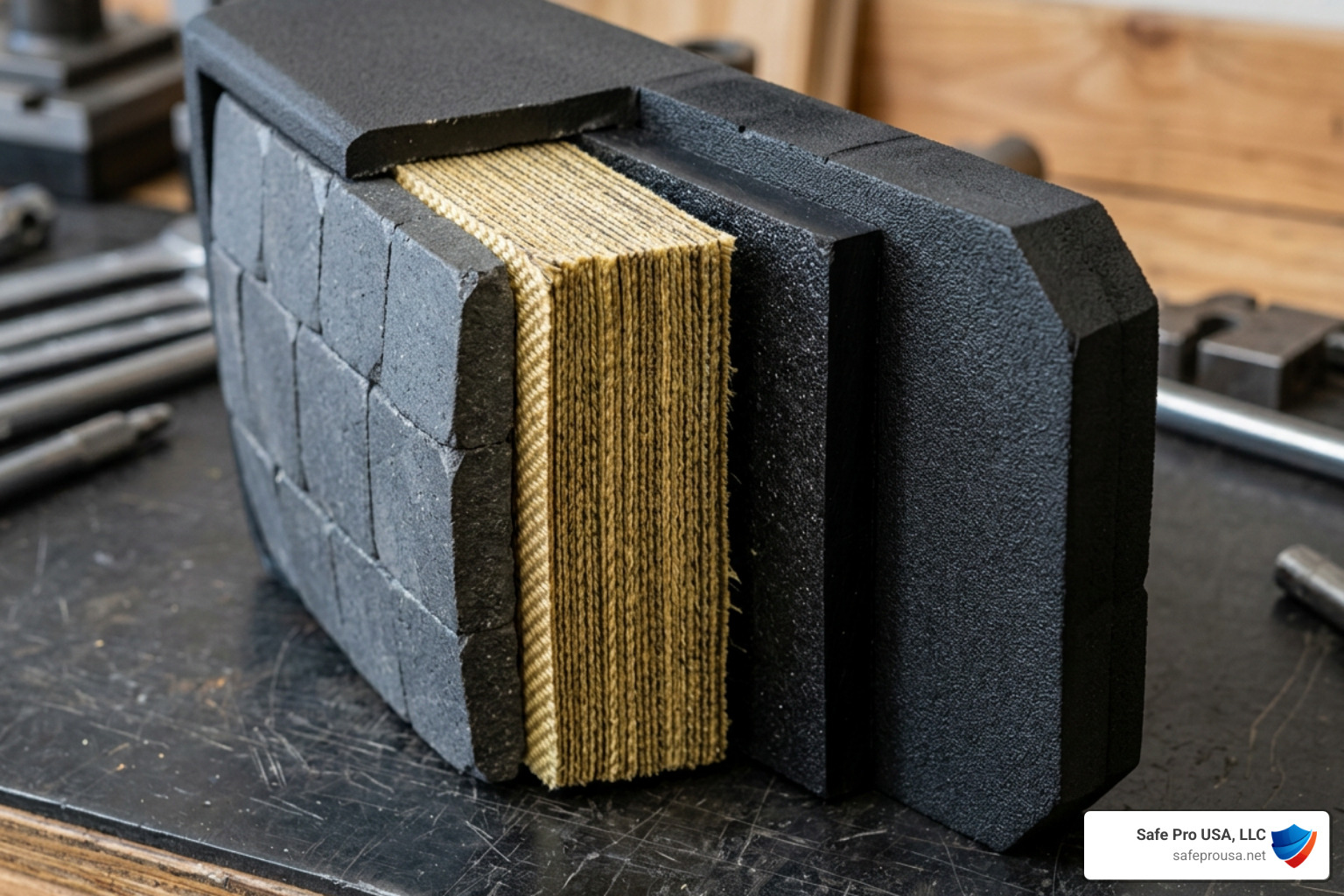
When a bullet strikes a UHMWPE shield, the friction of the spinning projectile melts the plastic fibers, which then wrap around the bullet and stop its rotation, dispersing its energy across the molecular web. UHMWPE provides exceptional multi-hit performance and outstanding moisture resistance, ensuring the shield does not degrade in humid or wet environments. To understand why modern composites have surpassed traditional metals, read our analysis of Body Armor Steel Plates.
Ceramic and Hybrid Composite Systems
While UHMWPE is excellent for stopping standard lead-core rounds, it can struggle against hardened steel-core ammunition, such as the 5.56mm M855 "Green Tip" or armor-piercing rifle rounds. To defeat these threats, we utilize ceramic and hybrid composite systems.
These shields feature a hard ceramic face bonded to a high-performance UHMWPE backing. The ceramic layer shatters the hardened penetrator of the bullet on impact, reducing its kinetic energy and turning it into fragment debris. The underlying composite backing then catches the remaining fragments. For detailed insights into how this material works, see our guide on Ceramic Rifle Plates.
Key Design Features and Mobility Comparisons
An effective military portable ballistic shield must balance raw protective power with ergonomic usability. If a shield is too heavy or poorly balanced, an operator will tire quickly, compromising their safety and the integrity of the tactical stack.
| Shield Classification |
Typical Dimensions |
Average Weight Range |
Primary Protection Rating |
Best Use Case |
| Mini / Patrol Shield |
12" x 18" to 14" x 24" |
8 to 12 lbs |
Level IIIA to III+ |
Rapid vehicle deployment, active shooter response |
| Standard Tactical |
20" x 30" to 20" x 36" |
15 to 25 lbs |
Level III / RF1 |
SWAT entry, building clearing, hostage rescue |
| Heavy Entry / Full-Body |
24" x 48" to 24" x 51" |
30 to 55+ lbs |
Level III+ to IV |
Hostile door breeches, barricaded suspect operations |
Ballistic Viewports and Visibility
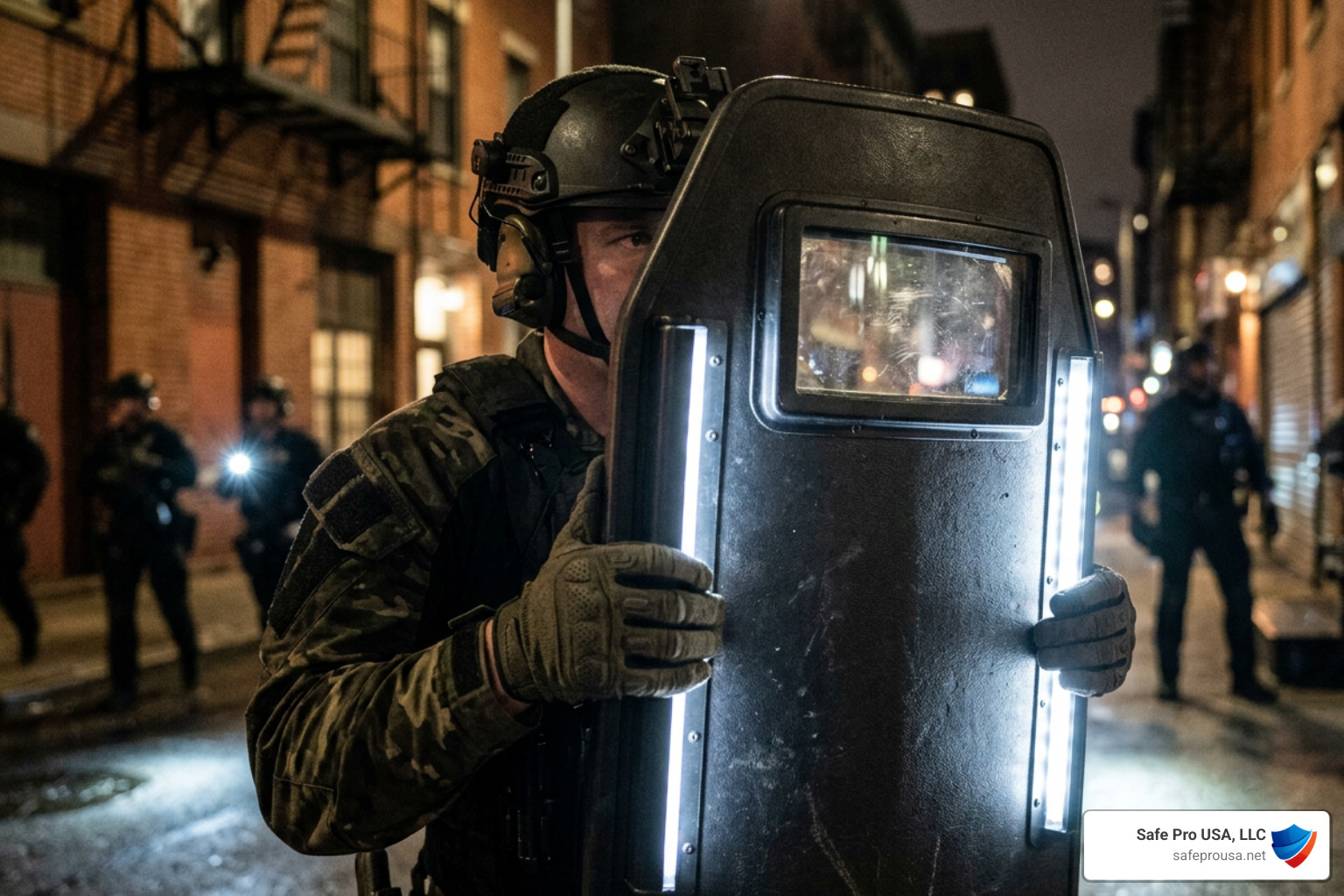
A shield is useless if the operator cannot see the threat. Ballistic viewports are made from multi-layered bulletproof glass or heavy polycarbonate composites designed to match the rating of the surrounding shield.
Modern viewports utilize advanced boltless designs. Traditional viewports require drilling holes through the ballistic material to mount the window, which creates potential weak points where stress fractures or ballistic penetration can occur. Boltless mounting systems eliminate these weak points, ensuring consistent protection across the entire face of the shield.
Ergonomic Handles and Support Systems
The handle is the primary interface between the operator and the shield. Ambidextrous grips allow the shield to be held comfortably with either the left or right arm, enabling dual-side firearm deployment.
High-quality support systems feature heavily padded handles to absorb vibration and shock, alongside adjustable shoulder straps that distribute the weight across the operator's upper body. This load distribution is critical for reducing fatigue during extended standoffs. Additionally, integrated weapon support ledges or cutouts allow the operator to rest their handgun or long gun directly against the shield, stabilizing their aim while maintaining full coverage.
Compact vs. Full-Body Tactical Shields
Choosing the right size is a trade-off between coverage and maneuverability:
-
Compact Mini Shields: These are optimized for rapid deployment and tight spaces. They fit easily in the trunk of a patrol car, can be held effortlessly with one hand, and allow operators to move quickly through narrow school buses, trains, or residential hallways.
-
Full-Body Tactical Shields: These are designed for slow, methodical clearing and entry teams. They provide maximum physical coverage, allowing multiple operators to stack behind the shield bearer during a dynamic entry. However, their size and weight make rapid movement and cornering much more difficult.
Tactical Deployment and Field Applications
Deploying a military portable ballistic shield requires specialized training and a deep understanding of tactical movement. It is not simply a matter of holding the barrier up; it must be integrated into the team's movement and weapon systems.
Operational Use Cases for a Military Portable Ballistic Shield
During high-risk operations, the shield bearer is responsible for leading the stack through "fatal funnels"—such as doorways, narrow hallways, and stairwells—where defenders have a clear tactical advantage.
-
Immediate Entry: The shield provides a moving wall of cover, allowing the team to breach a door and establish a foothold inside a room.
-
Threshold Evaluation: Before entering an uncleared space, the bearer can use the shield to "pie the corner," gathering visual intelligence while remaining protected.
-
Stack Protection: In a linear stack, the shield protects the entire team from head-on fire, allowing them to move down long hallways with reduced risk.
-
Defensive Positioning: During high-stress negotiations or downed-officer rescues, the shield provides a stationary barrier to protect medical personnel and negotiators.
Integration with Tactical Gear and Weapon Systems
A portable shield must work seamlessly with the rest of the operator's gear. Many modern shields feature integrated weapon cutouts on the upper corners, allowing operators to present their firearms without exposing their heads or shoulders.
One-handed weapon manipulation is a critical skill for shield bearers. Operators must be trained to reload, clear malfunctions, and fire their secondary weapons accurately using only one hand while maintaining control of the shield. To assist with this, sling systems can be used to transfer the weight of the shield to the operator's torso when transitioning to secondary tasks, and modular pouches—such as utility pouches or rapid-deploy IFAKs—can be mounted directly to the back of the shield for quick access.
Frequently Asked Questions about Ballistic Shields
What is the life expectancy of a military portable ballistic shield?
Most high-quality ballistic shields carry a 5-year shelf life and warranty on their ballistic materials. Over time, exposure to extreme heat, moisture, and ultraviolet (UV) radiation can degrade the synthetic fibers and resins within UHMWPE or ceramic composites.
To maximize the lifespan of your shield, store it in a cool, dry environment away from direct sunlight. We recommend performing regular physical inspections to check for signs of delamination, cracks, or loose hardware.
Can a portable ballistic shield stop armor-piercing rifle rounds?
Yes, but only if it is specifically rated as NIJ Level IV (or the equivalent RF3 standard under the newer NIJ 0101.07 guidelines). To defeat armor-piercing ammunition, the shield must utilize a ceramic composite face.
Standard UHMWPE-only shields will not stop armor-piercing rounds, as the hardened steel or tungsten penetrators can slice through polymer fibers. Additionally, even Level IV shields have multi-hit limits against armor-piercing rounds, as the ceramic face is designed to break apart to dissipate the projectile's energy.
How do operators shoot accurately while holding a ballistic shield?
Shooting while holding a shield requires specialized training and modified shooting techniques. Operators typically utilize weapon cutouts or side silhouettes to present their firearms while keeping their head behind the protective viewport.
Because traditional iron sights can be difficult to align through thick ballistic glass, operators often rely on weapon-mounted laser sights or red dot optics to quickly acquire targets. Regular dry-fire and live-fire training is essential to master one-handed weapon manipulation and recoil control.
Conclusion
In modern tactical operations, a military portable ballistic shield is an indispensable tool that bridges the gap between personal body armor and stationary cover. By choosing high-performance materials like UHMWPE and advanced ceramic composites, tactical teams can maintain the speed and agility required for dynamic entry while ensuring complete protection against handgun and rifle threats.
At Safe Pro USA, LLC, we are committed to manufacturing mil-spec, American-made ballistic gear designed to help operators move fast and stay safe. To learn more about selecting the right armor systems for your team's mission profile, explore our comprehensive guide on Ballistic Armor Plates: The Essential Guide to Choosing the Right Protection.


