When Lives Are on the Line: What You Need to Know About Riot Shield Ballistic Protection
Understanding the difference between riot shields and ballistic shields is critical for law enforcement and tactical teams.
Quick Answer: Riot Shield vs. Ballistic Shield Protection
| Feature |
Standard Riot Shield |
Ballistic Shield |
| Primary purpose |
Crowd control, blunt impact |
Protection against specified ballistic threats |
| Material |
Polycarbonate or similar impact-resistant transparent materials |
UHMWPE, aramid composites, steel, ceramic/composite systems, or transparent armor systems |
| Stops handgun rounds? |
No |
Yes, when tested for specified handgun threats |
| Stops rifle rounds? |
No |
Yes, if rifle-rated for specified threats |
| NIJ ballistic rating |
None |
Commonly tested to NIJ 0108.01 and/or manufacturer-specified threats |
| Typical weight |
5–10 lbs |
Varies by rating, size, viewport, materials, and accessories |
Standard polycarbonate riot shields are built for impact protection, not bullets. When threats escalate beyond thrown objects and batons, teams need shields tested and rated for ballistic protection.
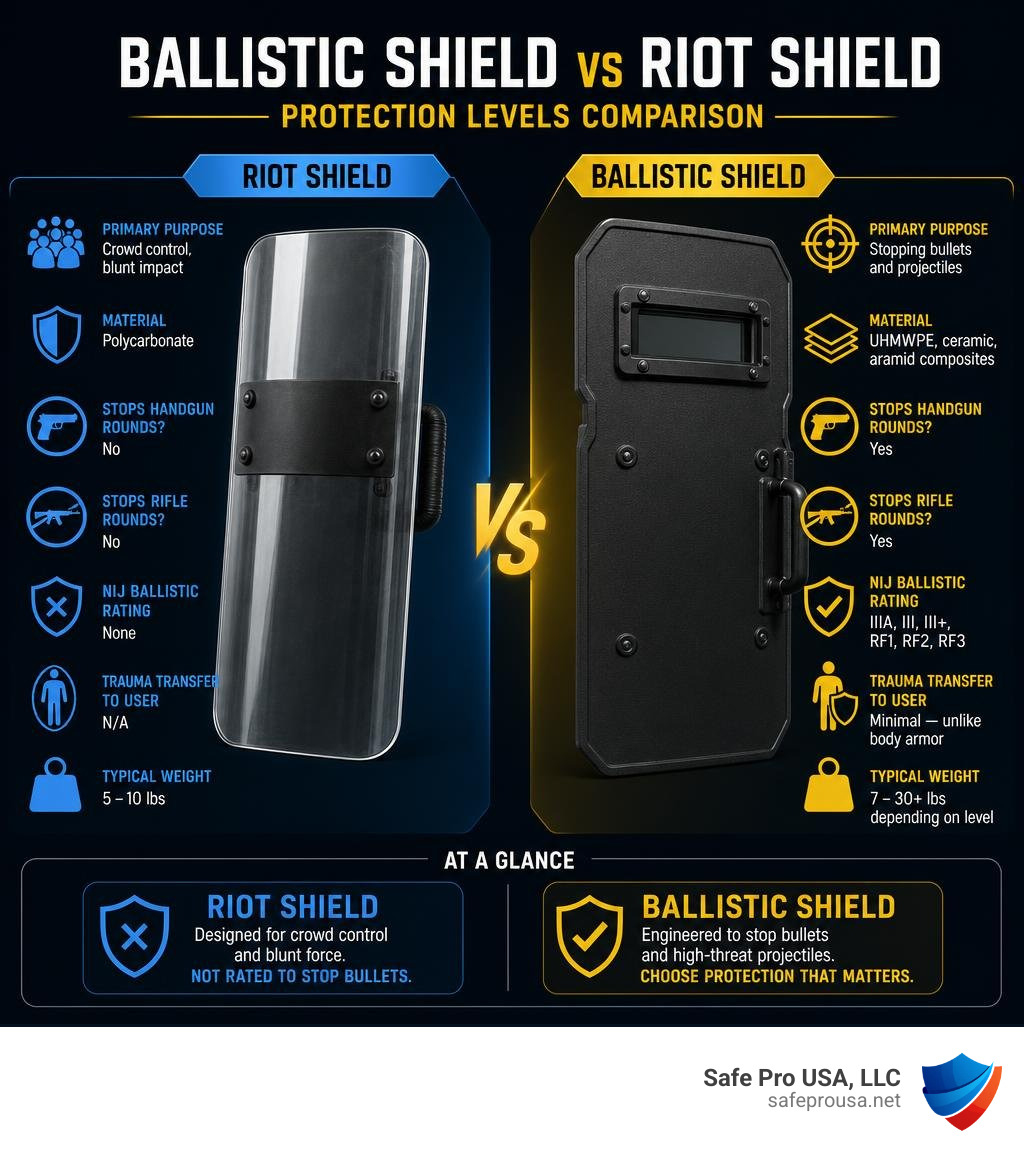
Riot Shield Ballistic Protection: Standard Riot Gear vs. Ballistic Shields
A standard riot shield is designed for crowd control, civil unrest, and defensive policing. Typically made from transparent polycarbonate, it helps protect officers from rocks, bottles, bats, corrosive liquids, and close-quarters assaults. It is not designed to stop bullets. A handgun round can penetrate a standard polycarbonate riot shield, creating serious injury risk.
A ballistic shield is purpose-built to stop specified projectile threats. Instead of simple impact-resistant plastics, it uses layered armor materials that capture, deform, and dissipate the energy of incoming rounds.
Riot shields manage physical altercations in crowds. Ballistic shields are deployed for active shooter response, high-risk warrants, barricaded suspects, and tactical entry work. True riot shield ballistic protection requires ballistic-rated materials and verified threat testing.
NIJ Protection Levels and Ballistic Standards for Tactical Shields
Ballistic protection is commonly evaluated using National Institute of Justice (NIJ) standards. Ballistic shields have historically been tested under NIJ Standard 0108.01, while newer armor classifications under NIJ 0101.07 use updated HG (handgun) and RF (rifle) threat classes.
| NIJ Protection Level (0108.01 / 0101.07) |
Threat Category |
Common Calibers Stopped |
Typical Weight Profile |
| Level IIIA (HG2) |
Handgun & shotgun |
9mm FMJ, .44 Magnum, 12-gauge slugs |
Approx. 7–15 lbs |
| Level III (RF1) |
Standard rifle |
7.62x51mm M80, 7.62x39mm MSC, 5.56mm M193 |
Approx. 15–25 lbs |
| Level III+ (Special Threat) |
Enhanced rifle |
5.56x45mm M855, 7.62x39mm mild steel core |
Approx. 18–28 lbs |
| Level IV (RF3) |
Armor-piercing rifle |
.30-06 M2 AP, 7.62x54R LPS |
Approx. 25–35+ lbs |
Handgun Threats and Level IIIA Riot Shield Ballistic Protection
Level IIIA, or HG2 under newer NIJ terminology, is a common baseline for patrol officers, school resource officers, and municipal law enforcement. These shields are designed for common handgun threats such as 9mm, .357 SIG, and .44 Magnum, plus close-range shotgun threats like slugs and buckshot.
Because Level IIIA shields do not need heavy ceramic strike faces, they can be compact and lightweight. Some weigh around 7 pounds, making them easier to deploy quickly from a patrol vehicle and carry for longer periods.
Rifle Threats and High-Velocity Riot Shield Ballistic Protection
For SWAT teams, active shooter response, and barricaded suspect incidents, rifle protection is often the priority. Level IIIA shields will not stop high-velocity rifle rounds, so teams need Level III (RF1), Level III+ special threat, or Level IV (RF3) protection.
RF1 shields are tested for threats such as 7.62x51mm M80 Ball, 7.62x39mm MSC, and 5.56mm M193. However, 5.56mm M855 “Green Tip” can challenge standard polyethylene rifle shields because of its steel penetrator. Level III+ special threat and Level IV shields address this with composite strike faces that help break up steel-core projectiles before the backing material captures fragments.
Advanced Materials: UHMWPE and Ceramic Composite Engineering
Modern ballistic shields depend on advanced materials. Traditional steel shields are heavy and can create spalling risks, while modern composites offer stronger protection-to-weight performance.
Ultra-High-Molecular-Weight Polyethylene (UHMWPE)
UHMWPE is a lightweight thermoplastic used widely in modern armor. When a bullet strikes, the material helps capture the projectile and spread energy across the shield surface.
UHMWPE is light, waterproof, and durable, making it a common structural and ballistic material for modern lightweight shields.
Alumina and Silicon Carbide Ceramics
UHMWPE performs well against many handgun and lead-core rifle threats, but steel-core and armor-piercing rounds often require ceramic strike faces. Alumina or silicon carbide ceramic tiles over UHMWPE create a two-stage system: the ceramic breaks the projectile, and the backing catches fragments and absorbs remaining energy.
This hybrid design supports higher rifle-rated protection while keeping shields mobile enough for tactical movement. For related armor material guidance, see our guides on Ceramic Rifle Plates and Hard Armor Rifle Plates.
Key Design Features for Operational Deployment
The shield’s physical design matters as much as its ballistic rating. Key features include:
-
Boltless viewport systems: Reducing or eliminating drilled weak points can improve structural integrity around the transparent ballistic viewport.
-
Ergonomic handle systems: Multi-grip handles help operators manage weight, switch angles, and transition between left- and right-handed positions.
-
Integrated LED lighting: Built-in tactical lights help operators identify threats and work in low-light environments without a separate handheld light.
-
Size formats and mobility: Small shields support tight spaces and vehicle extractions; medium shields balance coverage and maneuverability; large or tower shields provide greater coverage and may use wheeled support.
Tactical Integration: Shields vs. Body Armor in the Field
Body armor and ballistic shields solve different problems. Body armor protects vital areas on the wearer, but impact energy can still transfer to the body as blunt trauma. A shield is held away from the body, so it can absorb impact energy before it reaches the operator.
Shields also provide a larger protective area than typical vest plates. A medium-format ballistic shield can cover the head, torso, and pelvic region, while a plate carrier mainly protects the vital organ zone. In a tactical entry stack, the lead operator uses the shield as mobile cover for the team through doorways, hallways, and other high-risk areas.
Pairing American Made Body Armor with a dedicated tactical shield creates layered protection. For more selection guidance, read Ballistic Armor Plates: The Essential Guide to Choosing the Right Protection.
Maintenance, Storage, and Lifespan of Ballistic Shields
To keep riot shield ballistic protection reliable, agencies should follow consistent inspection and storage practices.
-
Shelf life and warranty: Many composite shields carry a 5-year manufacturer’s warranty. Environmental exposure can affect materials over time.
-
Protective coatings: Polyurea coatings help protect the ballistic core from moisture, chemicals, oil, and abrasion. Cracks or gouges should be inspected promptly.
-
Delamination checks: Soft spots, swelling, or a spongy feel may indicate layer separation and compromised ballistic integrity.
-
Storage: Store shields flat or in dedicated racks in a cool, dry, climate-controlled space. Avoid long-term direct UV exposure and extreme heat, such as prolonged storage in hot patrol vehicle trunks.
Frequently Asked Questions about Tactical Shields
Can a standard polycarbonate riot shield stop bullets?
No. Standard polycarbonate riot shields are designed for crowd control and blunt impact protection, not ballistic threats. Even low-caliber rounds can penetrate them.
What is the difference between NIJ 0108.01 and NIJ 0101.07 standards?
NIJ 0108.01 is the legacy standard commonly associated with ballistic shield testing. NIJ 0101.07 updates armor threat terminology with HG handgun and RF rifle classifications that better reflect current ammunition threats.
How do UHMWPE and ceramic shields handle multi-hit threats?
UHMWPE absorbs energy through high-tensile polymer layers. In rifle-rated composite shields, ceramic tiles help break incoming rounds while the backing material catches fragments. Tiled designs can help preserve protection around nearby impact areas.
Conclusion
Standard riot shields are useful for crowd control, but firearm threats require dedicated ballistic shields tested for the expected threat level. By combining UHMWPE, ceramic composites, ergonomic handles, viewports, and lighting systems, modern tactical shields provide mobile protection for law enforcement and tactical teams.
Safe Pro USA manufactures American-made protective gear for military, law enforcement, and tactical professionals. Explore our armor solutions and read Ballistic Armor Plates: The Essential Guide to Choosing the Right Protection to match your shield and body armor to the mission.


