Is Level 4 Body Armor Right for You?
Level 4 body armor is the highest NIJ-rated ballistic protection available — designed to stop armor-piercing rifle rounds that would defeat every lower protection level.
Quick answer for tactical professionals comparing options:
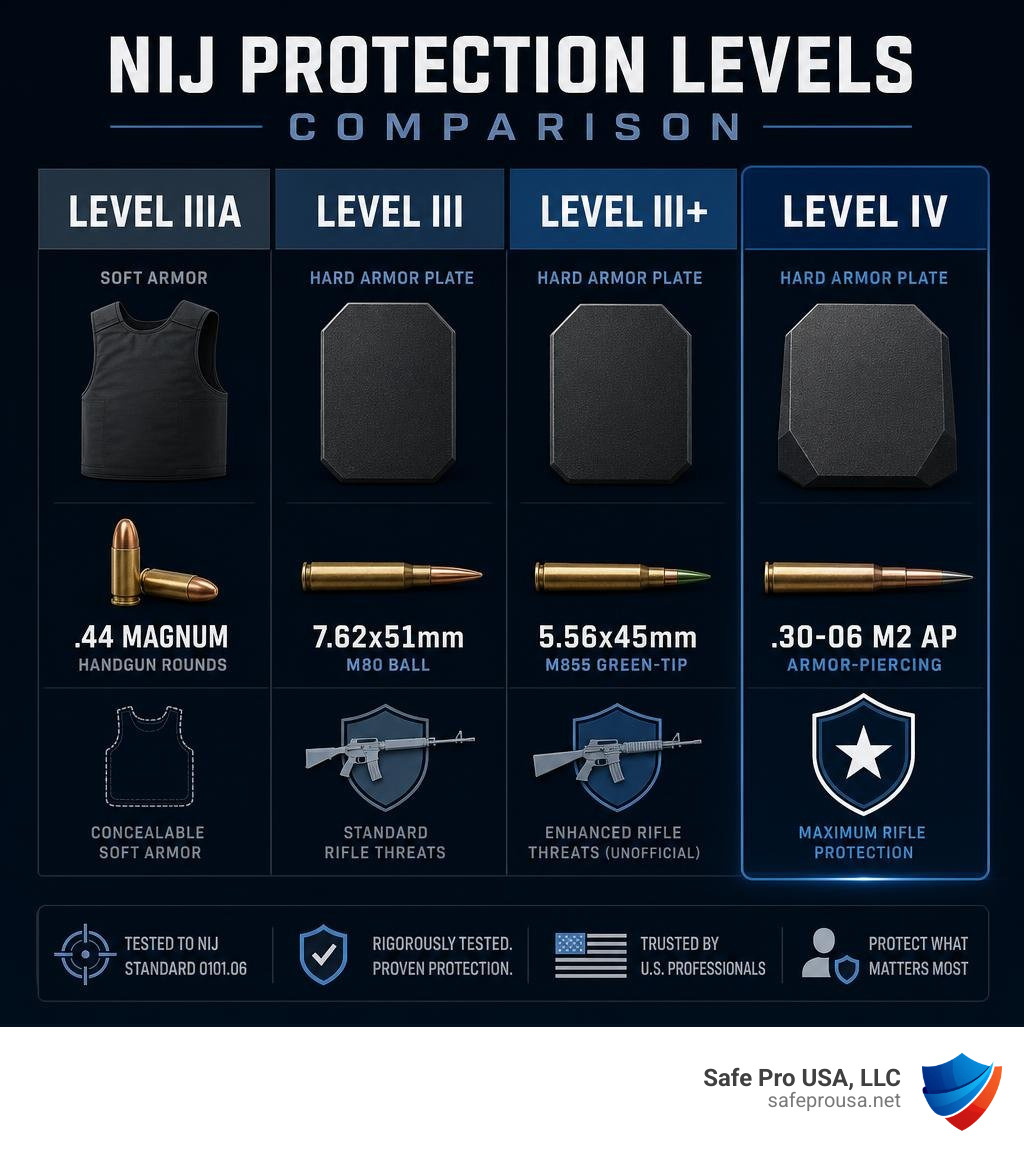
| Protection Level |
Highest Threat Stopped |
Best For |
| Level IIIA |
.44 Magnum handgun rounds |
Concealable soft armor |
| Level III |
7.62x51mm M80 ball rifle |
Standard rifle threats |
| Level III+ |
5.56 M855 green-tip |
Enhanced rifle threats (unofficial) |
| Level IV |
.30-06 M2AP armor-piercing |
Maximum rifle protection |
Level IV plates are tested to NIJ standard 0101.06 and must defeat a .30-06 M2 AP round traveling at 2,880 ft/s. They are the same plates used by U.S. military forces, and civilians can legally own them in most states.
But maximum protection comes with real trade-offs. Ceramic and UHMWPE Level IV plates typically weigh 5-8 lbs each. That weight adds up fast on long shifts or extended operations. Whether Level IV is the right call depends entirely on your threat environment, and that's exactly what this guide breaks down.
I'm Michael Wratten, VP of Marketing & Sales at Safe Pro USA with over 20 years in the defense and protective equipment industry, including over two decades of law enforcement experience, giving me direct field perspective on what level 4 body armor demands in real-world use. Let's walk through everything you need to make the right call.
What is level 4 body armor and What Threats Does It Stop?
To understand level 4 body armor, we have to look at the extreme threats it is engineered to defeat. Under the National Institute of Justice (NIJ) standards, Level IV (often written as Level 4) represents the absolute peak of personal ballistic protection. It is specifically designed to stop high-velocity, armor-piercing rifle ammunition that easily zips through soft armor and lower-rated hard plates. For official background on body armor performance standards and compliance, see the National Institute of Justice body armor standards.
The definitive benchmark threat for Level 4 armor is the .30-06 Springfield M2 Armor Piercing (AP) round. This formidable projectile features a hardened steel or tungsten penetrator core designed to punch through hardened steel plates. During standardized testing, a Level 4 plate must successfully stop at least one of these 166-grain black-tip rounds traveling at a velocity of 2,880 feet per second (ft/s).
For context, if a plate can stop a .30-06 M2AP round, it will also defeat common intermediate and full-power rifle threats, including:
- 5.56x45mm NATO (M193, M855 green-tip, and the advanced M855A1)
- 7.62x39mm (mild steel core and armor-piercing variants)
- 7.62x51mm NATO (M80 ball and M61 AP)
- 7.62x54R (LPS and B-32 API)
As of July 2026, the industry is transitioning between testing standards. While the older NIJ 0101.06 standard remains the benchmark for many plates currently in service, the newer NIJ 0101.07 standard introduces updated nomenclature. Under the 0101.07 standard, the equivalent of Level IV is designated as RF3. Both standards require the armor to defeat the same .30-06 M2AP threat, ensuring that your protection level remains uncompromised regardless of which standard is printed on the label.
To explore how these heavy-duty plates differ from other rifle-rated options, check out our guide on hard armor rifle plates.
Stopping a bullet is only half the battle; the armor must also protect your internal organs from the crushing kinetic energy of the impact. When a high-velocity round strikes an armor plate, the energy is transferred instantly. The backside of the plate flexes inward toward the wearer's body. This inward movement is known as back face deformation (BFD).
The NIJ sets a strict maximum allowable limit of 44 mm (approximately 1.7 inches) of back face deformation during testing. If a plate stops the bullet but deforms deeper than 44 mm into the backing clay, it fails certification. This limit is crucial because excessive BFD can cause severe blunt force trauma, including fractured ribs, collapsed lungs, and internal bleeding, even if the projectile never punctures the plate.
To mitigate this kinetic energy transfer and reduce the risk of blunt-force injury, we highly recommend pairing Level 4 plates with non-ballistic trauma pads. These slim, padded inserts sit behind your hard plates inside the carrier, absorbing and dispersing the blunt impact force across a wider surface area.
Multi-Hit Capabilities of Level 4 Body Armor
While the official NIJ standard only requires a Level 4 plate to stop a single .30-06 M2AP round, real-world gunfights rarely involve only one shot. Modern tactical professionals demand armor that can withstand multiple impacts.
To achieve true multi-hit capability, high-end Level 4 plates utilize a tile array construction. Instead of using a single monolithic sheet of ceramic, the strike face is composed of smaller, individually bonded ceramic tiles. When a bullet strikes one tile, the damage is localized. The surrounding tiles remain completely intact and ready to defeat subsequent rounds.
This ceramic strike face is backed by a highly resilient composite layer, typically made of Ultra-High-Molecular-Weight Polyethylene (UHMWPE) or advanced aramid fibers. This composite backing catches the shattered fragments of both the bullet and the ceramic tile, delivering reliable threat defeat across multiple closely spaced impacts.
Comparing Level 4 to Other NIJ Protection Levels
Choosing the right armor requires a clear understanding of how Level 4 compares to lower protection levels. While Level 4 offers maximum security, lower levels are optimized for different threat profiles and operational roles.
-
Level IIIA: This is soft body armor. It is highly flexible and lightweight, designed to stop common handgun rounds up to .44 Magnum. It offers zero protection against rifle rounds.
-
Level III: Hard armor plates designed to stop standard rifle threats, specifically 7.62x51mm M80 ball ammunition. It does not protect against armor-piercing rounds.
-
Level III+ (Unofficial): A manufacturer-created designation designed to bridge the gap between Level III and Level IV. These plates are specifically tested to defeat high-velocity intermediate rounds like the 5.56mm M855 "green-tip" but lack the construction required to stop full-power .30-06 M2AP rounds.
-
RF1 and RF2: Under the newer NIJ 0101.07 standard, RF1 replaces Level III, while RF2 introduces a formal intermediate category specifically rated to handle mild steel core rifle threats like the 7.62x39mm and 5.56mm M855.
For a comprehensive breakdown of how to match your gear to your operational environment, see our ballistic armor plates selection guide.
| NIJ Protection Level |
Plate Type |
Standard Test Round |
Velocity |
Best Threat Environment |
| Level IIIA |
Soft Armor |
.44 Magnum & 9mm Submachine Gun |
~1,430 ft/s |
Handgun threats, concealable patrol wear |
| Level III / RF1 |
Hard Plate |
7.62x51mm M80 Ball |
2,780 ft/s |
Standard military/LE rifle threats |
| Level III+ |
Hard Plate |
5.56x45mm M855 Green-Tip |
~3,110 ft/s |
High-velocity intermediate carbine threats |
| Level IV / RF3 |
Hard Plate |
.30-06 M2 Armor Piercing |
2,880 ft/s |
Advanced armor-piercing and sniper threats |
When to Choose Level 3 vs. Level 4 Body Armor
The choice between Level 3 and Level 4 armor is a classic balancing act between maximum protection and physical endurance.
Level 3 plates, especially those made of pure UHMWPE, are incredibly light, often weighing between 3 and 5 lbs per plate. This lightweight profile maximizes mobility and minimizes fatigue, making them ideal for patrol officers, search-and-rescue teams, or anyone wearing armor for consecutive 12-hour shifts where standard rifle threats are the primary concern.
Conversely, Level 4 plates should be selected when operating in high-threat environments where armor-piercing rifles, sniper platforms, or unknown rifle calibers are a realistic threat. If you are a tactical team member executing high-risk warrants, a security contractor in a hostile region, or preparing for severe emergency scenarios, the added protection of Level 4 is indispensable.
Material Science: Ceramic and Polyethylene Plates
The incredible stopping power of modern level 4 body armor is a triumph of material science. Gone are the days of relying solely on heavy steel plates. Today's armor utilizes advanced ceramics and ultra-lightweight polymers to achieve unprecedented protection.
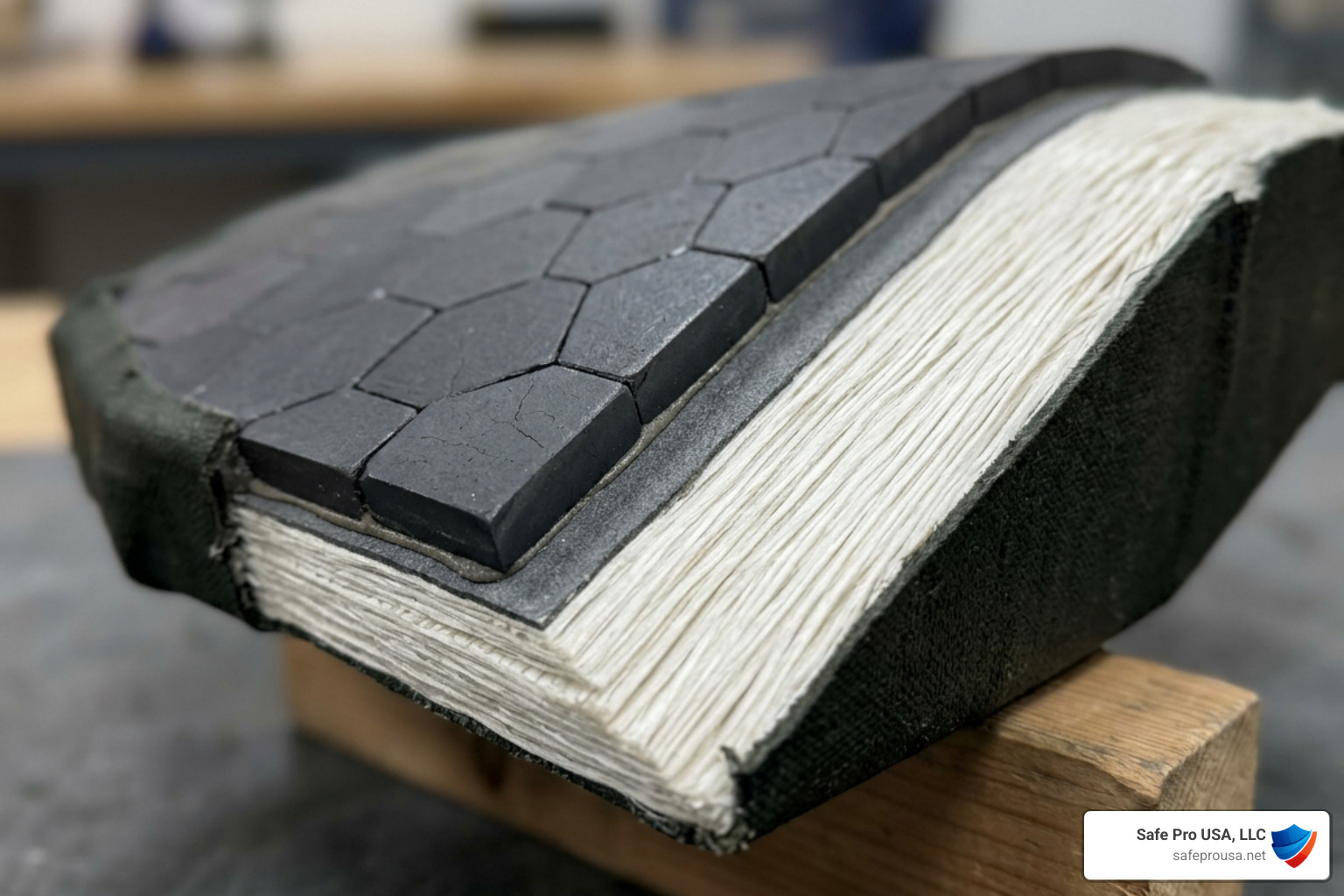
A modern Level 4 plate is almost always a composite design, featuring a hard ceramic strike face bonded to a high-strength polymer backing. The three primary ceramic materials used in these plates are:
-
Alumina (Aluminum Oxide): The most common ceramic material. It is highly reliable and structurally stable, though it is slightly heavier than more exotic ceramics.
-
Silicon Carbide: A lighter, harder ceramic material that offers excellent multi-hit performance. It provides a significant weight reduction compared to Alumina.
-
Boron Carbide: The gold standard of ceramic armor. It is incredibly hard and exceptionally lightweight, making it the preferred choice for elite military units and specialized tactical teams.
Behind this ceramic strike face sits a backing layer made of Ultra-High-Molecular-Weight Polyethylene (UHMWPE). UHMWPE is an advanced polymer with an incredibly high strength-to-weight ratio, containing long, continuous molecular chains that disperse kinetic energy with extreme efficiency. To learn more about how these ceramics are engineered, explore our deep dive into ceramic rifle plates.
Why Ceramic and UHMWPE are the Preferred Materials
When a high-velocity, armor-piercing round strikes a ceramic/UHMWPE composite plate, a highly coordinated two-stage defeat mechanism occurs:
-
Stage 1 (The Ceramic Strike Face): The extreme hardness of the ceramic material shatters the hardened steel penetrator of the armor-piercing round, stripping away its aerodynamic shape and reducing its velocity instantly.
-
Stage 2 (The UHMWPE Backing): The high-tensile polymer backing catches the shattered fragments of both the bullet and the ceramic tile, stretching and absorbing the remaining kinetic energy like a high-tech catcher's mitt.
This composite matrix provides immense weight savings compared to heavy, outdated steel alternatives. Steel plates are exceptionally heavy and pose a severe hazard known as spalling, where a bullet splashes upon impact, sending sharp metal fragments into the wearer's neck, chin, and arms. Even with protective coatings, steel cannot safely match the ballistic efficiency of ceramic and UHMWPE.
For a closer look at why steel has fallen out of favor for high-threat scenarios, read our articles on body armor steel plates and level 3 steel plates.
Practical Considerations: Weight, Lifespan, and Carrier Compatibility
Before adding Level 4 armor to your kit, you must account for the practical realities of wearing and maintaining hard plates.

A standard 10" x 12" ceramic Level 4 plate typically weighs between 5 and 8 lbs. A full setup of two plates adds 10 to 16 lbs to your torso, not including your plate carrier, loaded magazines, radio, and medical gear.
To ensure your plates perform flawlessly when called upon, follow these strict storage and maintenance guidelines:
-
Avoid Extreme Heat: UHMWPE can begin to degrade at temperatures exceeding 150°F. Never store your plates in a hot vehicle trunk during the peak of summer.
-
Store Flat or Vertical: Store your plates flat or upright in a cool, dry, dark closet. Avoid stacking heavy equipment on top of your plates.
-
Inspect Regularly: Inspect your plates for visible cracks, chips, or soft spots in the backing material. If a ceramic plate is dropped onto a hard surface, it should be x-rayed or replaced, as internal fractures can occur without showing external damage.
Selecting the Right Plate Carrier for Heavy Plates
Carrying Level 4 plates requires a high-quality plate carrier designed to distribute heavy loads evenly across your upper body. When selecting a carrier, look for the following features:
-
Proper Plate Cuts: Ensure your carrier matches the cut of your plates. SAPI (Small Arms Protective Insert) cut plates feature triple-curved, multi-angled corners for a highly ergonomic fit, while shooter's cut and swimmer's cut plates feature more aggressive shoulder cutouts to maximize your range of motion when shouldering a rifle.
-
Padded Shoulder Straps: Broad, padded shoulder straps prevent the carrier from digging into your collarbones during extended operations.
-
Robust Cummerbund: A structural cummerbund transfers a portion of the plate weight from your shoulders to your hips, dramatically reducing fatigue.
-
MOLLE Webbing: Heavy-duty laser-cut or traditional MOLLE webbing allows you to mount essential gear securely without shifting the load.
Frequently Asked Questions About Level 4 Armor
Is Level 4 armor legal for civilians to own?
Yes. In the vast majority of the United States, it is 100% legal for law-abiding civilians to purchase and wear Level 4 body armor. However, there are a few important legal restrictions to keep in mind:
-
Federal Law: Under federal law, it is illegal for anyone convicted of a violent felony to purchase, own, or possess body armor.
-
State-Specific Laws: Connecticut and New York have implemented strict regulations. In these states, body armor transactions generally must be conducted in person, and sales to non-law enforcement civilians are heavily restricted. Always check your local and state regulations before purchasing.
What is the difference between NIJ-certified and NIJ-tested plates?
This is one of the most critical distinctions in the body armor industry:
-
NIJ-Certified: These plates have been submitted to the National Institute of Justice's Compliance Testing Program. They undergo rigorous testing at independent, NVLAP-accredited laboratories and are officially listed on the NIJ Compliant Products List (CPL). Certified plates are subject to ongoing quality assurance audits.
-
NIJ-Tested: This term means a manufacturer sent their plates to a lab to be shot according to NIJ protocols, but the plate was never officially certified or listed on the CPL. While some tested plates are high quality, others lack the independent oversight and quality control guarantees of certified armor. Always look for official certification when your life is on the line.
Does Level 4 armor expire?
Yes, body armor has a defined service life, typically ranging from 5 to 10 years depending on the manufacturer and the materials used.
While ceramic materials are exceptionally stable and do not degrade on their own, the composite backing materials (like UHMWPE or aramid fibers) and the bonding adhesives can slowly lose their structural integrity over time due to body heat, sweat, moisture, and physical wear. Regularly inspect your plates and replace them once they surpass their manufacturer-specified warranty period.
Conclusion
Level 4 body armor represents the ultimate shield against high-powered, armor-piercing rifle threats. By combining the extreme hardness of ceramic strike faces with the energy-dispersing power of UHMWPE backing, modern Level 4 plates deliver military-grade protection to defense and tactical professionals.
At Safe Pro USA, LLC, we are dedicated to manufacturing high-performance, American-made ballistic protection gear. Our mission is to provide military personnel, law enforcement officers, and prepared citizens with elite protective equipment that never compromises on quality or comfort.
To learn more about our manufacturing standards and the future of protective gear, read our articles on American made body armor and futuristic military body armor.
Ready to upgrade your protective kit? Explore Safe Pro USA Ballistic Armor Plates and equip yourself with the ultimate in ballistic defense.


